🚨UPDATE: INTERNET COMPUTER'S CAFFEINE V3 REDEFINES ON-CHAIN DEVELOPMENT
@Dfinity has rolled out its most significant update yet to the Internet Computer’s self-writing cloud, redefining on-chain development.
The @caffeineai V3 protocol now features a dedicated team of specialist AI agents and a new "Context as RAM" architecture to power autonomous software builds.
This overhaul includes a redesigned UI and integrated version history to streamline the transition from initial discovery to live deployment.
Proposal 141306 just hit the NNS to create the very first $ICP test cloud engine.
This first test engine deploys across AWS, GCP, and Azure specifically to stress-test critical protocol upgrades like xnet shielding, firewall isolation, registry replication, and delegation fetching.
https://t.co/YkA28FeeZn
🚨JUST IN: CAFFEINE V3.0 OPENS A NEW ERA ON ICP IN A FEW DAYS
@Dfinity's Internet Computer (ICP) is scheduled to launch the Caffeine v3.0 upgrade on April 7th, enabling natural language-based application development.
According to Dominic Williams (@dominic_w), the update introduces "Cloud Engines," enabling enterprises to deploy private subnets using a mix of sovereign nodes and traditional AWS instances to achieve specialized throughput.
A new "Internet Intelligence Network" (IIN) is being proposed to provide verifiable AI inference at lower costs than centralized GPU clouds.
Caffeine v3.0 ☕️, Tuesday, April 7th
https://t.co/IfQrVovF3L
A new era begins on ICP in a few days. A huge Caffeine upgrade will take place. This is about more than the new features it packs: what can be built on the Internet Computer through chat alone shall advance by a quantum leap.
It will blow your mind, because you can go so much further: those wanting to build apps and services on self-writing cloud, where every technical task is automated and directed by natural language interaction, may rationally decide that the Internet Computer is the place to be thanks to the work of Caffeine Labs.
But, stunning as the v3.0 advance is, this only marks the beginning of a new beginning for ICP. Caffeine is just getting started, and will be joined by other major advances unfolding in the ICP ecosystem. Several things are coming together:
1) The architecture that powers Caffeine v3.0 will ensure it continues to grow more powerful as time goes on. We expect that it will be possible for non-technical people to build almost anything on the Internet Computer in the future. Eventually special features like "Caffeine Snorkel" will also make it possible to auto-migrate legacy apps and services to the Internet Computer.
2) For the first time, Caffeine will allow all users to publish the App Market, so that other users can install copies of their apps, and if they want, remix them, since apps from the market are mutable and can be changed as needed. This is important change will be followed by the activation of monetization features, which will kickstart a new open source onchain economy based around the AI-driven development of re-usable apps and services.
3) Caffeine apps use ICP Blob Storage (which is currently exclusively available to Caffeine owing to its ongoing development) to maintain copies of files and binary large objects. Coming advances will enable Caffeine apps to store data at the world's best $/GB — making the Caffeine the perfect plartform to use to build apps that must store and share large amounts of data (for example, for a photo sharing app, or a team communications platform where video meetings are routinely recorded and archived).
4) Caffeine will soon be joined by new ICP "cloud engine" functionality, and then, the Internet Intelligence Network (IIN) — two new parts of the Internet Computer. Cloud engines will provide enterprise users with much more control over how the Internet Computer hosts their apps and services. IIN will provide everyone with access to inference on open weights models at lower cost than is possible today (for example allowing a business to create an e-commerce website on the Internet Computer where every customer can be helped through product exploration by AI, without worrying about the cost).
5) Cloud engines, which are essentially private subnets that can be controlled via a control panel, enable the Internet Computer to provide a cloud experience that feels more familiar to prosumers and enterprises used to centralized clouds. Users will be able to select the nodes combined to power their cloud engines, and nodes can include cloud-on-cloud nodes, such as AWS instances, as well as traditional sovereign node hardware. These nodes can be chosen to match precise throughput needs, or regulatory requirements (e.g. GDPR). The Internet Computer is thus transforming into a mass market cloud solution.
6) Powerful additional advantages of cloud engines include a) since they are essentally Internet Computer subnets, as usual hosted apps and services are tamperproof and unstoppable, and don't require support by security and systems administration personnel, b) hosted apps can have their query throughput auto-scaled horizontally by adding nodes, which can be located in proximity to demand, and can have ther update throughput auto-scaled by splitting the engines — enabling auto-scaling where software does not have to be updated — and c) owners can traverse underlying compute vendors and geographies and jurisdictions, simply by adding and deleting nodes, which can be done without interrupting hosted apps.
7) The Internet Intelligence Network is an extension to the Internet Computer that we plan to propose to the NNS soon (which I have mentioned before). This will be powered by community-operated hardware devices, which crucially, in combination with new technology we are developing, shall shall facilitate provision of lower per-token inference costs than AI clouds can currently achieve within targeted market segments (low costs that are derived from the technology involved, in contrast to certain contemporary decentralized GPU networks that use token appreciation to drive unsustainable subsidization flywheels).
8) A key unique additional aspect of IIN is that inference is verifiable, just like onchain compute — that is, those supplying prompts and context will know that their results are correct, and shall not have to trust that the IIN nodes powering inference haven't changed their results (for example, by inserting advertising, or malicious content). The strength of the verification is configurable. In the default mode, there will be no discernible difference in cost or performance/time thanks to the techniques developed. In higher security modes, useful for special high-security purposes, verification cost will scale linearly with every node checking the inference, while the hit to performance/time remains very small. (Note that because inference is non-deterministic, inference verification is technically challenging and novel, and will advance the state-of-the-art).
In all, v3.0 is part of the Internet Computer's march towards the mainstream cloud market, which is predicted to generate $1 trillion in revenue in 2026, and $2 trillion in 2030.
While we see the Internet Computer as a revolutionary decentralized cloud platform, rather than a network beloning to the web3 industry per se, we note that after tokens (Bitcoin), and DeFi (Ethereum), onchain cloud is the first new decentralized network functionality to unlock mass market potential — and it's happeing exclusively on the Internet Computer, which is by far the most technologically advanced network the world has ever seen.
ICP is advancing to define an important new cloud sector, where the network is the cloud, and the cloud is self-writing.
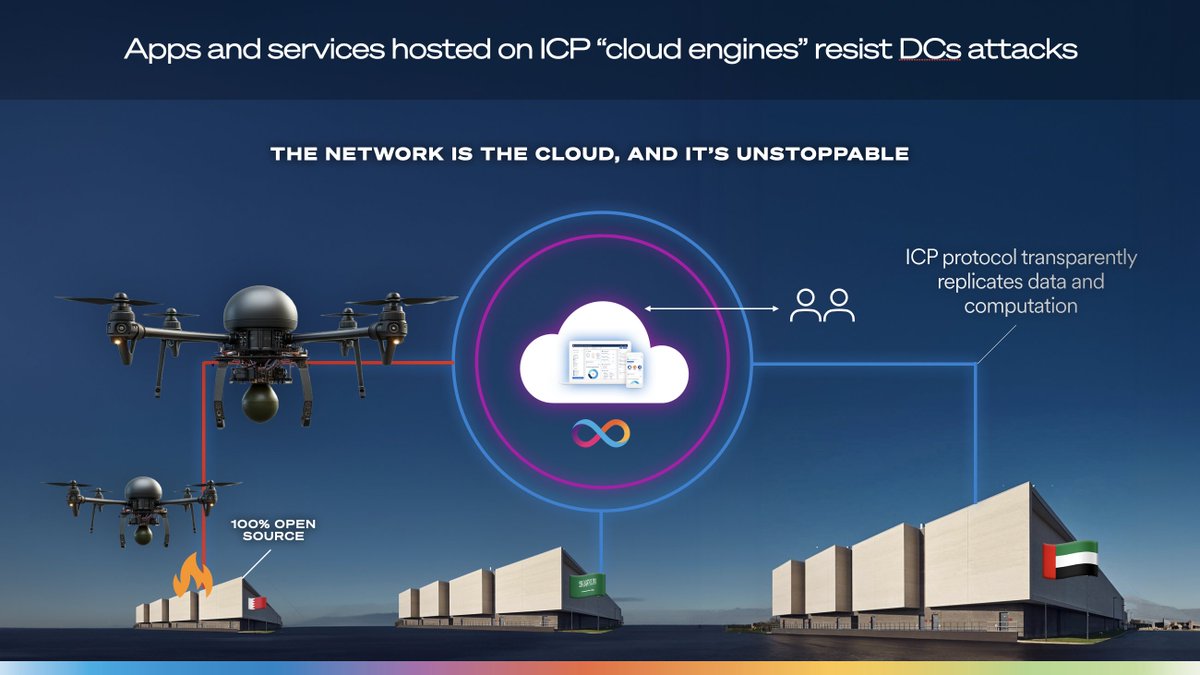
AWS in Bahrain went down after drone hit.
The ICP solution coming – apps and services hosted on ICP "cloud engines" running over multiple AWS data centers will be immune.
https://t.co/Vm3D3yZ9Zd
This is exactly why Nation-States need Sovereign Cloud. $ICP
✅Strong data protection
✅Decentralized
✅Tamperproof
The Sovereign Cloud is no longer a buzzword. It’s a matter of National Security.
Multiple independent research desks are circling the same conclusion about #InternetComputer $ICP — and it’s not price speculation.
Bitget Research, TradersUnion, MEXC, Binance Square and others are all framing ICP as a sovereign on-chain cloud that plugs into existing enterprise stacks.
What’s actually emerging:
• Azure & Google Cloud
Not “partnership hype,” but architectural compatibility.
Web2 clouds handle heavy GPU inference.
ICP handles state, identity, governance & fully on-chain execution.
That’s how enterprises actually adopt new infrastructure.
• SWIFT / ISO 20022
No official integration announced.
But ICP’s alignment with ISO 20022 puts it directly in the tokenized payments conversation.
That’s narrative-level signal — not execution (yet).
The pattern matters more than any headline:
Multiple analysts, different regions, same conclusion.
ICP isn’t being positioned as a hype L1 or an “X-killer.”
It’s being cited as the missing neutral layer where AI, cloud and Web3 can converge without trust collapse.
I’ll wait for official confirmations.
But the signal is already clear:
Infrastructure gets noticed after it becomes necessary.
And the world is starting to notice what a sovereign on-chain cloud enables.
$ICP #Web3 #AI #CaffeineAI #Cloud #Tokenization #DePIN $BTC
Bitcoin is digital gold, created by burning energy, but...
There's a strong argument that blockchain is otherwise a new kind of cloud: where code is tamperproof and unstoppable, which happens to enable tokenization, and now helps AI build apps.
ICP leads this race by a mile.
AWS outage. No problem.
Cloudflare outage. No problem.
All apps, websites, DeFi, enterprise services, AI models, etc, built/running on the Internet Computer — the only blockchain that hosts real apps fully onchain — continued running flawlessly
You guys know this, rigghtt ;) ?