Four days ago, #Russia attacked #Ukraine. More than 600,000 people are now asking #NATO countries to close Ukraine's airspace to prevent Russia from attacking from the air. What's your opinion? ✍️https://t.co/32IfFXF8yR
Deciphering the capacitance frequency technique for performance-limiting defect-state parameters in energy-harvesting perovskites by Vikas Nandal https://t.co/nXuSyhfza4
Deciphering capacitance frequency technique for performance limiting defect state parameters in energy harvesting perovskites. (arXiv:2106.06930v2 [https://t.co/5TYjzlDa1e] UPDATED) https://t.co/ovizqWY3XK
[2106.06930] Vikas Nandal, Sumanshu Agarwal, Pradeep R. Nair: Deciphering capacitance frequency technique for performance limiting defect state parameters in energy harvesting perovskites https://t.co/J5BfArqXLn https://t.co/ttyL2yWCgE #cond_mat_mtrl_sci
Researchers in AIST developed a process for producing high-concentration methane from low-concentration CO₂ in collaboration with TU Delft. This process does not require a CO₂ capture and separation process prior to the conversion process.
https://t.co/kigEPUSHkc
Design Predictions of n-n Heterojunction Based Photoanode for Efficient Unbiased Overall Solar #WaterSplitting (aۻKazuhiro Takanabe) @UTokyo_News_en @KCCkaust https://t.co/e8CVTgRPok
Results of our collaboration with Prof. A.G. Nasibulin were published in @ACS_AEM. Check out: "Surface Passivation for Efficient Bifacial HTL-free Perovskite Solar Cells with SWCNT Top Electrodes". https://t.co/4BOM4MDMuX
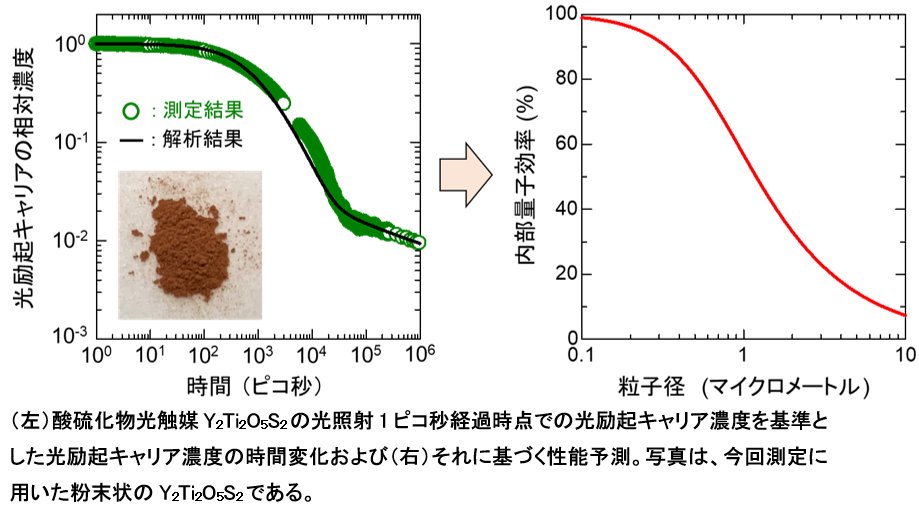
Prof. Domen group unveils charge carrier dynamics, long carrier lifetime (6ns), and design strategies for emerging Y2Ti2O5S2 photocatalyst. Congratulation to my friend Vikas Nandal and his colleagues on such excellent work:
https://t.co/pf4XOJlfHx
It is my pleasure to share our recently published research work titled “Probing fundamental losses in nanostructured Ta3N5 photoanodes: design principles for efficient water oxidation” in Energy & Environmental Science (impact factor 30) journal.
https://t.co/zYuQT082gr
Ta3N5-Nanorods enabling highly efficient water oxidation via advantageous light harvesting and charge collection - now published in Energy & Environmental Science https://t.co/UEUZX7rbTa
Nanochannels and ferroelectric LiNbO3 are used to create a high‐performance room‐temperature proton conductor. A µFC with LiNbO3 NCs achieves a remarkable power output of up to ≈54 mW cm−2, which is 1.4 times higher than bare glass NCs.











![pollinus66's tweet photo. [ASAP] Anomalous Scaling Exponents in the Capacitance–Voltage Characteristics of Perovskite Thin Film Devices https://t.co/LioWc9eCgf https://t.co/srKxFMuCQ5](https://pbs.twimg.com/media/DtMNRv1WsAMw3zr.jpg)