CRISPR deleted the extra chromosome behind Down syndrome.
In a groundbreaking world-first, researchers have successfully used CRISPR gene-editing technology to remove the extra chromosome responsible for Down syndrome, opening a potential path toward treating genetic disorders previously considered incurable.
Down syndrome, or trisomy 21, occurs when a person has three copies of chromosome 21 instead of the usual two. It is one of the most common genetic conditions, affecting about 1 in 700 babies worldwide, and leads to intellectual disability, developmental delays, and various health issues. Until now, no treatment has been able to correct the underlying cause.
That may soon change.
In a new proof-of-concept study, scientists applied CRISPR-Cas9 to cells taken from people with Down syndrome—including skin cells and pluripotent stem cells—and successfully eliminated the extra chromosome 21. The edited cells showed a striking return to normal gene expression patterns and cellular function. To improve precision, the team briefly disabled certain DNA-repair pathways during the process, making the chromosome removal cleaner and more effective.
At this stage, the technique has only been demonstrated in laboratory cell cultures and is far from ready for human use. Removing an entire chromosome carries significant risks, including possible off-target effects, so extensive safety work lies ahead. If those challenges can be overcome, however, the approach could one day be applied to brain cells or even used during early fetal development.
The implications extend beyond Down syndrome. The same strategy might eventually treat other life-limiting trisomies, such as trisomy 13 and trisomy 18, which are often fatal in infancy or cause severe disability. For the first time, a tool exists that could, in principle, correct the root chromosomal abnormality rather than merely managing symptoms.
["Trisomic rescue via allele-specific multiple chromosome cleavage using CRISPR-Cas9 in trisomy 21 cells." PNAS Nexus, 2025]
Scientists have discovered that the fungus Aspergillus tubingensis, isolated from a landfill in Islamabad, Pakistan, can rapidly break down polyurethane, one of the world’s most durable plastics. This material is widely used in insulation, furniture, footwear, coatings, and synthetic leather, and it typically persists in the environment for hundreds of years.
In laboratory tests, the fungus colonizes the surface of polyurethane films, secreting enzymes that disrupt its chemical bonds. Scanning electron microscopy revealed clear signs of degradation, including cracks, pits, and surface erosion. Within just two months in liquid culture, the plastic films were broken down into smaller fragments, with near-complete degradation observed.
This represents the first reported case of A. tubingensis degrading polyurethane. The process is an example of mycoremediation, the use of fungi to clean up environmental pollutants. Other fungi have also shown the ability to use plastics as a primary food source, even in low-oxygen landfill conditions.
Researchers are now exploring the potential of fungal enzymes for large-scale applications, such as bioreactors, to help address the global plastic waste crisis. If scaled effectively, these biological approaches could offer a practical, low-cost method to reduce the billions of tons of persistent plastic accumulating worldwide.
[Khan, S., et al. (2017). Biodegradation of polyester polyurethane by Aspergillus tubingensis. Environmental Pollution, 225, 469–480. DOI: 10.1016/j.envpol.2017.03.012]
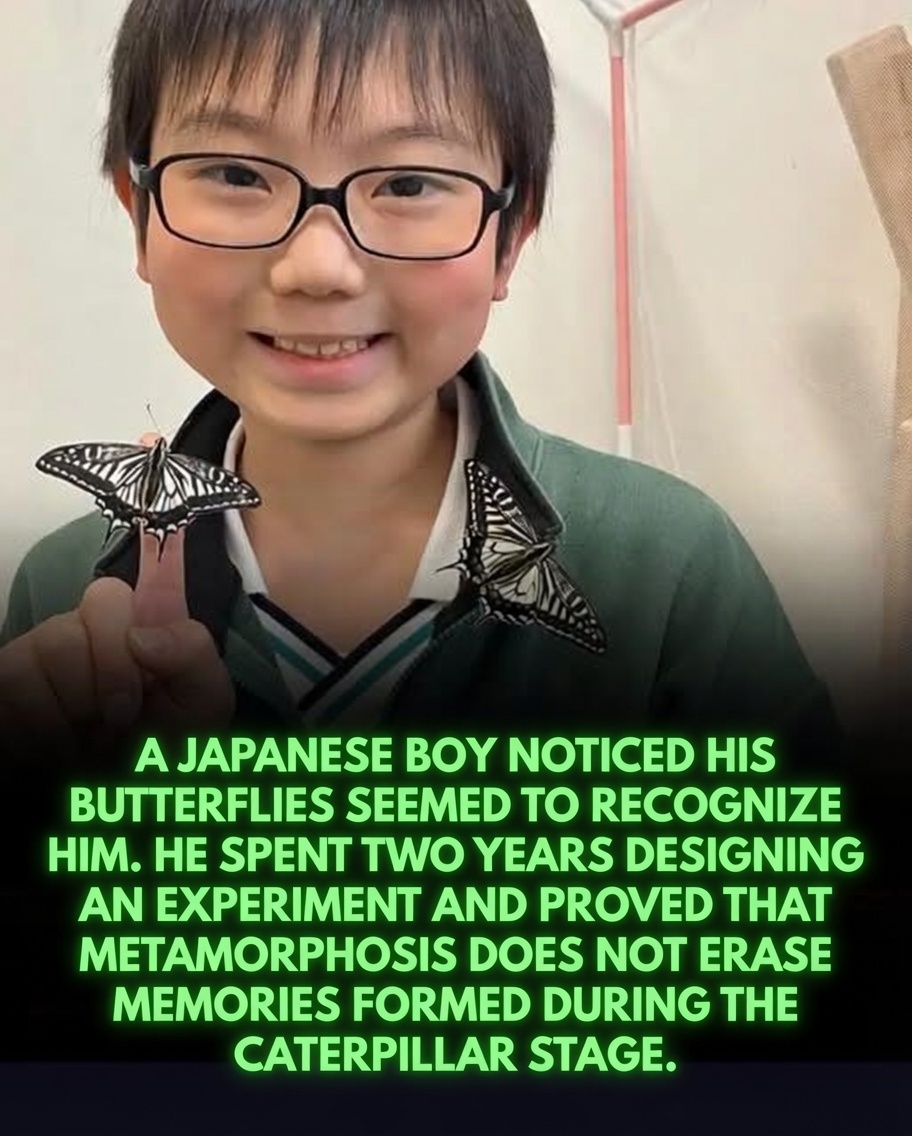
A 10 year old child’s experiment demonstrated that memories can be inherited across generations.
The story started when Jo Nagai, a second grader from Kobe, Japan, observed that swallowtail butterflies he had raised by hand appeared to recognize him, whereas wild butterflies would flee.
Motivated to uncover a scientific explanation, he contacted Georgetown University entomologist Dr. Martha Weiss, who had previously shown that moths retain memories despite the extensive cellular reorganization during metamorphosis.
Encouraged by her research, Jo suggested conducting a similar study with butterflies. This led to a remarkable international collaboration. Using a simple setup created at home, Jo conditioned caterpillars to link a gentle vibration with the smell of lavender.
Remarkably, after their brains were entirely reconstructed inside the chrysalis, 70 percent of the adult butterflies still avoided the lavender scent, demonstrating that their memories had endured the transformation.
The most surprising result emerged when Jo bred these conditioned insects. Neither the offspring nor the grandchildren had ever encountered the vibration, yet both generations displayed an instinctive aversion to the lavender scent.
At the age of ten, Jo compiled his groundbreaking observations into a 33 page paper and presented them alongside Dr. Weiss at the International Congress of Entomology in Kobe. This discovery of transgenerational memory challenges conventional views of genetics and inheritance while illustrating how a child’s curiosity can push the frontiers of scientific understanding.
BREAKING: Watch the moment England's team plane lands in Birmingham
Live updates: https://t.co/3FWsPZhBxN
📺 Sky 501, Virgin 602, Freeview 233 and YouTube


![Rainmaker1973's tweet photo. CRISPR deleted the extra chromosome behind Down syndrome.
In a groundbreaking world-first, researchers have successfully used CRISPR gene-editing technology to remove the extra chromosome responsible for Down syndrome, opening a potential path toward treating genetic disorders previously considered incurable.
Down syndrome, or trisomy 21, occurs when a person has three copies of chromosome 21 instead of the usual two. It is one of the most common genetic conditions, affecting about 1 in 700 babies worldwide, and leads to intellectual disability, developmental delays, and various health issues. Until now, no treatment has been able to correct the underlying cause.
That may soon change.
In a new proof-of-concept study, scientists applied CRISPR-Cas9 to cells taken from people with Down syndrome—including skin cells and pluripotent stem cells—and successfully eliminated the extra chromosome 21. The edited cells showed a striking return to normal gene expression patterns and cellular function. To improve precision, the team briefly disabled certain DNA-repair pathways during the process, making the chromosome removal cleaner and more effective.
At this stage, the technique has only been demonstrated in laboratory cell cultures and is far from ready for human use. Removing an entire chromosome carries significant risks, including possible off-target effects, so extensive safety work lies ahead. If those challenges can be overcome, however, the approach could one day be applied to brain cells or even used during early fetal development.
The implications extend beyond Down syndrome. The same strategy might eventually treat other life-limiting trisomies, such as trisomy 13 and trisomy 18, which are often fatal in infancy or cause severe disability. For the first time, a tool exists that could, in principle, correct the root chromosomal abnormality rather than merely managing symptoms.
["Trisomic rescue via allele-specific multiple chromosome cleavage using CRISPR-Cas9 in trisomy 21 cells." PNAS Nexus, 2025]](https://pbs.twimg.com/media/HPXq5aiX0AAPYzX.jpg)
![Rainmaker1973's tweet photo. Scientists have discovered that the fungus Aspergillus tubingensis, isolated from a landfill in Islamabad, Pakistan, can rapidly break down polyurethane, one of the world’s most durable plastics. This material is widely used in insulation, furniture, footwear, coatings, and synthetic leather, and it typically persists in the environment for hundreds of years.
In laboratory tests, the fungus colonizes the surface of polyurethane films, secreting enzymes that disrupt its chemical bonds. Scanning electron microscopy revealed clear signs of degradation, including cracks, pits, and surface erosion. Within just two months in liquid culture, the plastic films were broken down into smaller fragments, with near-complete degradation observed.
This represents the first reported case of A. tubingensis degrading polyurethane. The process is an example of mycoremediation, the use of fungi to clean up environmental pollutants. Other fungi have also shown the ability to use plastics as a primary food source, even in low-oxygen landfill conditions.
Researchers are now exploring the potential of fungal enzymes for large-scale applications, such as bioreactors, to help address the global plastic waste crisis. If scaled effectively, these biological approaches could offer a practical, low-cost method to reduce the billions of tons of persistent plastic accumulating worldwide.
[Khan, S., et al. (2017). Biodegradation of polyester polyurethane by Aspergillus tubingensis. Environmental Pollution, 225, 469–480. DOI: 10.1016/j.envpol.2017.03.012]](https://pbs.twimg.com/media/HOzSWdjXMAAI7Dw.png)