Post-Doctoral Researcher, Philosophy @UniSalzburg
Epistemology - esp. Value Theory
Philosophy of Science - esp. Realism Debate and Science Communication
Did you ever wonder what scientists and science communicators in physics, chemistry and biology think about scientific realism? And are experimentalists more likely realists than theorists?
@SchoeneggerPhil and I jointly conducted a study to answer these and related questions:
Did you ever wonder what scientists and science communicators in physics, chemistry and biology think about scientific realism? And are experimentalists more likely realists than theorists?
@SchoeneggerPhil and I jointly conducted a study to answer these and related questions:
Also, I am sorry to say that the paper is actually technical philosophy and does not say anything about detectives :p but it says something about the mystery of scientific knowledge.
New Paper out in Journal for General Philosophy of Science. (open access)
Imagine you're trying to solve a mystery and you've got two detectives on the case... (1/4) https://t.co/bMzECmrFlE
We follow the best explanations of the clues, but that is actually not a secure inference pattern.
Is it possible to solve the mystery? For that, you need to read the paper. (4/4)
@ron2718@SchoeneggerPhil@drseanmullen This is an exciting idea. It would be worth exploring the implications of writing discussion sections in a more stripped-down manner and putting it into pre-registration.
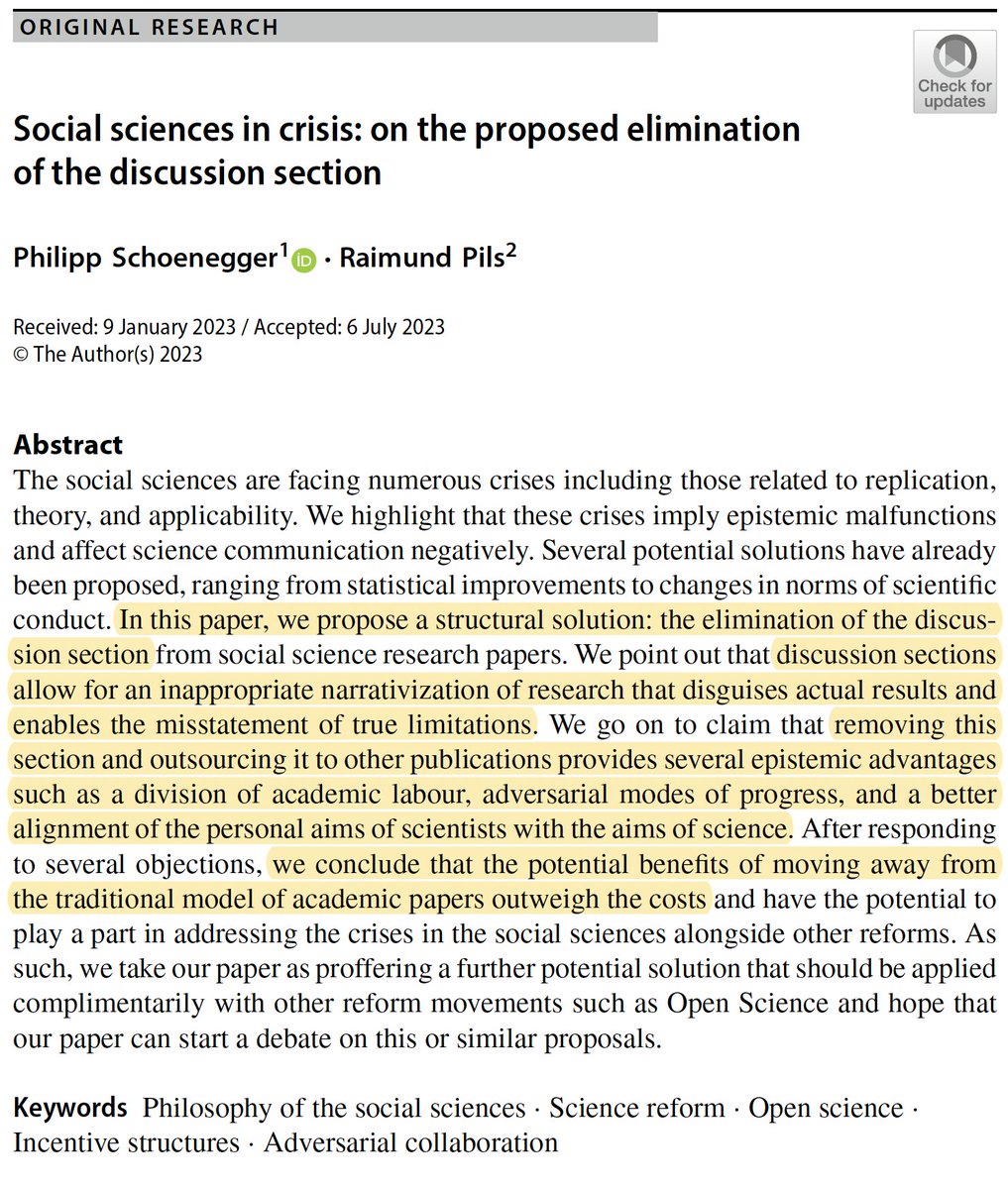
New paper out in Synthese with @SchoeneggerPhil , where we propose a structural solution to the crises facing the social sciences. For more details see the tweet below and the full article here: https://t.co/jDFZWM1iVP
New paper out with @PilsRaimund!
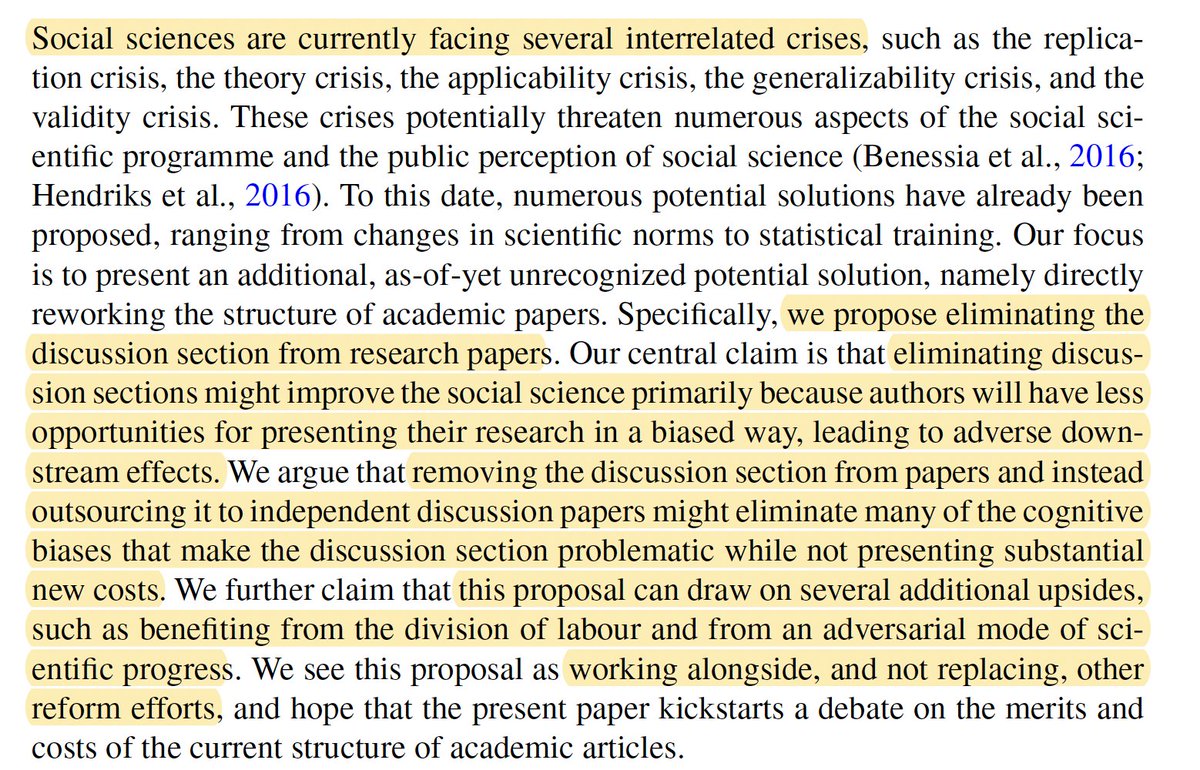
We propose a new solution to the crises facing the social sciences: removing the discussion sections.
We argue that they harm honest scientific reporting and would provide epistemic benefits if outsourced from the standard article.
More below!
New paper out with @PilsRaimund!
We propose a new solution to the crises facing the social sciences: removing the discussion sections.
We argue that they harm honest scientific reporting and would provide epistemic benefits if outsourced from the standard article.
More below!
@danwilliamsphil (i) slowly introduces many main concepts of quantitative methodology, (ii) is accessible and not technical, (iii) is very recent, and (iv) is quite opinionated, so gives students in class discussion material.
@danwilliamsphil I used Fletcher's "How (not) to Measure Replication" just a few weeks ago in an undergrad seminar on scientific methodology. I think it's a good text for that purpose as it (i)
For all the epistemologists out there, my paper on "A Satisficing Theory of Epistemic Justification" just got published in The Canadian Journal of Philosophy. Open access, here: https://t.co/YLkgBs3mvZ
Are you interested in the scientific realism debate, stance voluntarism, and the proper integration of evidence from the history of science? My article “Scientific Realism and Blocking Strategies” just got published, here: https://t.co/7Af0RcUq21
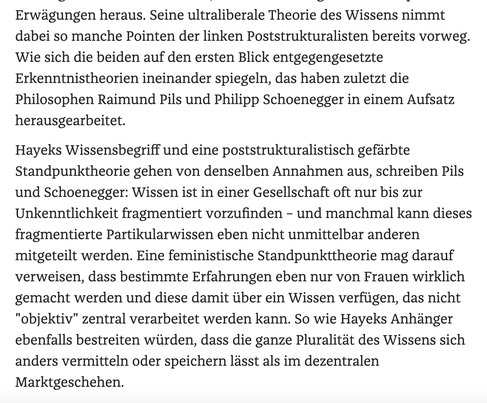
Happy to have our work (jointly with @PilsRaimund) on Hayek and standpoint theory cited in this ZEIT article by @Maja_Larissa - irrespective of the main claim made in the article!
https://t.co/zYa9MkYj1f