📢 PinGo Official Profitability Update
We are pleased to share an important milestone with our community and partners:
PinGo’s CDN business and emerging AI Token infrastructure segment have collectively achieved approximately $30,000 in monthly net profit.
Based on current growth trajectory and ecosystem expansion, we project monthly net profit to reach $100,000 by Q3.
This milestone reflects not only the strong product-market fit of PinGo’s infrastructure services, but also the accelerating demand for decentralized AI and compute-driven solutions.
As we continue to evolve, we remain committed to innovation, execution, and long-term ecosystem building — growing together with our community on the right path forward.
Unpopular opinion:
The GPU shortage is the best thing that's happened to crypto.
It forced the world to look for alternatives.
And the alternative was sitting idle in everyone's homes the whole time 🐰
NEW SPACE: Proof of Reserve 🎙️
FTX made everyone realize that "trust us" isn't a risk management strategy.
How should reserves be verified? What should users actually be able to check? And where does onchain data fit into all of it?
@ShiftRWA@PinGoAI@cellframenet + more
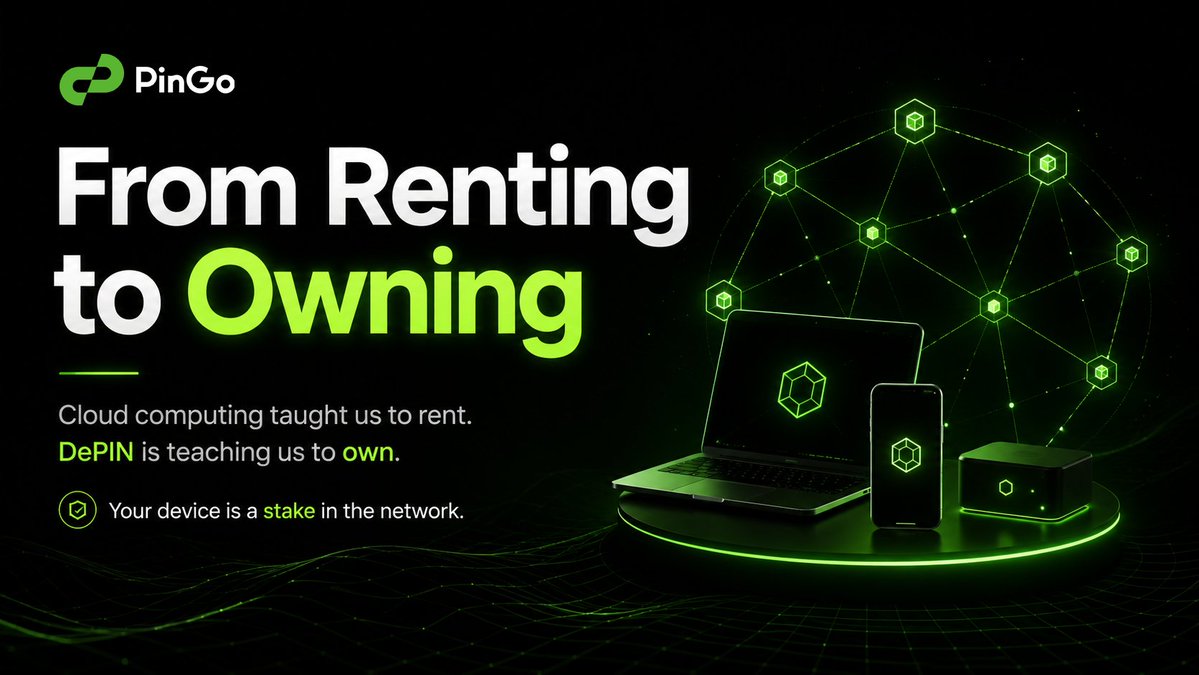
In 2006, nobody owned "the cloud."
One company built it. Now everyone rents from them.
In 2026, the same mistake is happening with AI compute.
A few companies hoarding GPUs. Everyone else waiting in line.
Except this time, there's an alternative.
Billions of devices. One network. No landlord.
History doesn't repeat.
But it rhymes.
Don't rent the future. Own a piece of it 🐰
The Data Layer 🎙️ Friday | 2 PM UTC
We don't talk about the enough:
Blockchain doesn't know the price of ETH.
It doesn't know whether it rained.
It doesn't know if a company really holds the assets it claims.
Who is distributing that information?
@PinGoAI@joinFIO@OpenverseGlobal + more!
Let's talk about who does that, why it matters, and what the future of Web3's data layer looks like!
Things that age badly:
→ "Nobody needs more than 640KB of memory"
→ "The internet is a fad"
→ "Decentralized compute will never work"
Two of these already aged badly.
Guess which one's next 🐰
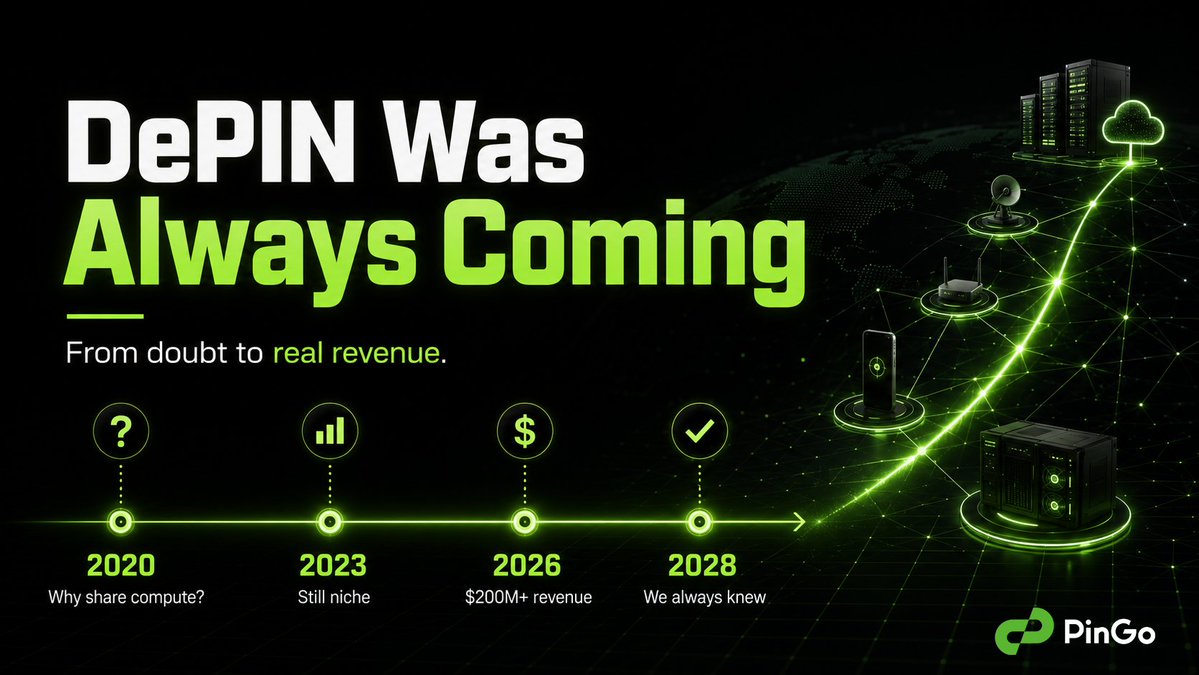
2020: "Why would anyone share their computing power?"
2023: "Okay but it's just a niche thing"
2026: DePIN generating $200M + in real revenue
2028: "We always knew it would work" 🐰
Your future will run on compute.
The question is: who controls it?
Option A: A handful of corporations
Option B: Networks owned by millions of contributors
We know which side we're building for 🐰
Decentralized compute isn't a crypto narrative anymore.
It's a $9B sector generating $200M in real annual revenue.
Here's why it matters for your future 🧵
The DePIN sector grew 270% in one year.
Projections put it at $3.5 trillion by 2028.
Early participants in infrastructure shifts always benefit most.
The people who set up nodes early. The ones who contributed first.
History rewards early infrastructure builders.
Old infrastructure: You're a consumer. You pay. You depend.
DePIN: You're an infrastructure owner. You contribute. You benefit.
That's not just different technology.
That's a different relationship to the systems you use 🐰
DePIN creates:
✓ No single point of failure (thousands of nodes)
✓ No corporate control (rules in code, not boardrooms)
✓ No gatekeeping (open to anyone)
✓ Alignment (you benefit when network grows)
That's resilience. That's decentralization.