Mining was the first stage.
Energy was the second.
Compute is the next.
Over time, PinLink is evolving toward a broader infrastructure marketplace where productive machines, whether miners, GPU clusters, or AI inference systems, become accessible through programmable ownership.
Infrastructure is becoming liquid.
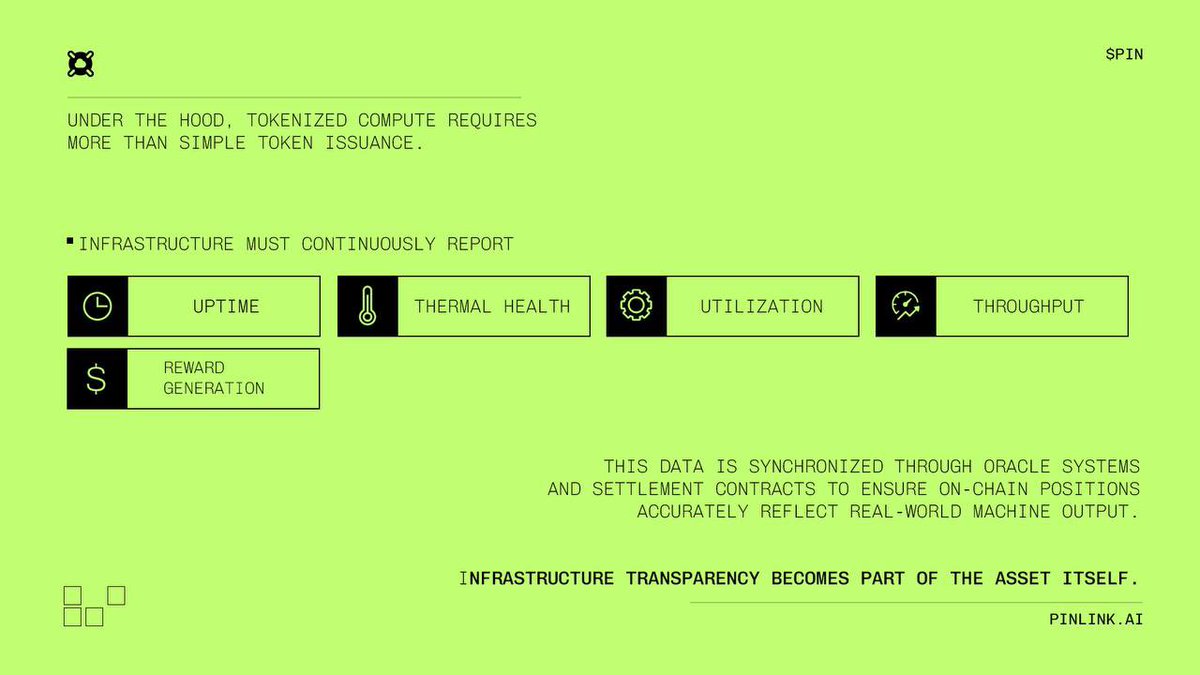
Under the hood tokenized compute requires more than simple token issuance.
Infrastructure must continuously report:
• uptime
• thermal health
• utilization
• throughput
• reward generation
This data is synchronized through oracle systems and settlement contracts to ensure onchain positions accurately reflect real world machine output.
Infrastructure transparency becomes part of the asset itself.
Tokenized compute allows physical processing infrastructure to be represented digitally onchain.
A GPU node or inference server can be onboarded into the protocol, benchmarked for output capacity, and divided into fractional ownership units.
Rewards are then tied directly to real compute utilization and infrastructure performance.
The result is programmable ownership of productive AI infrastructure.
Compute is no longer just a backend resource.
It is becoming a financial primitive.
GPU clusters, inference servers, AI processing capacity, these systems generate measurable economic value every second they operate.
As demand for AI scales globally, ownership of compute infrastructure becomes increasingly important.
PinLink intends to bring that ownership on-chain.
Frontend Latency Improvements Shipped
A new frontend performance pass has been deployed, reducing dashboard load times and improving wallet-state rendering during peak usage periods.
Caching layers, request batching, and lighter state hydration were introduced to make navigation faster across staking, listings, and rewards pages.
User experience is infrastructure too.
Contract Efficiency Pass Underway
Core settlement contracts are undergoing optimization review focused on reward distribution logic.
Open the protocol up to more tokenized asset payout models.
Efficient contracts create better economics for everyone using the system.
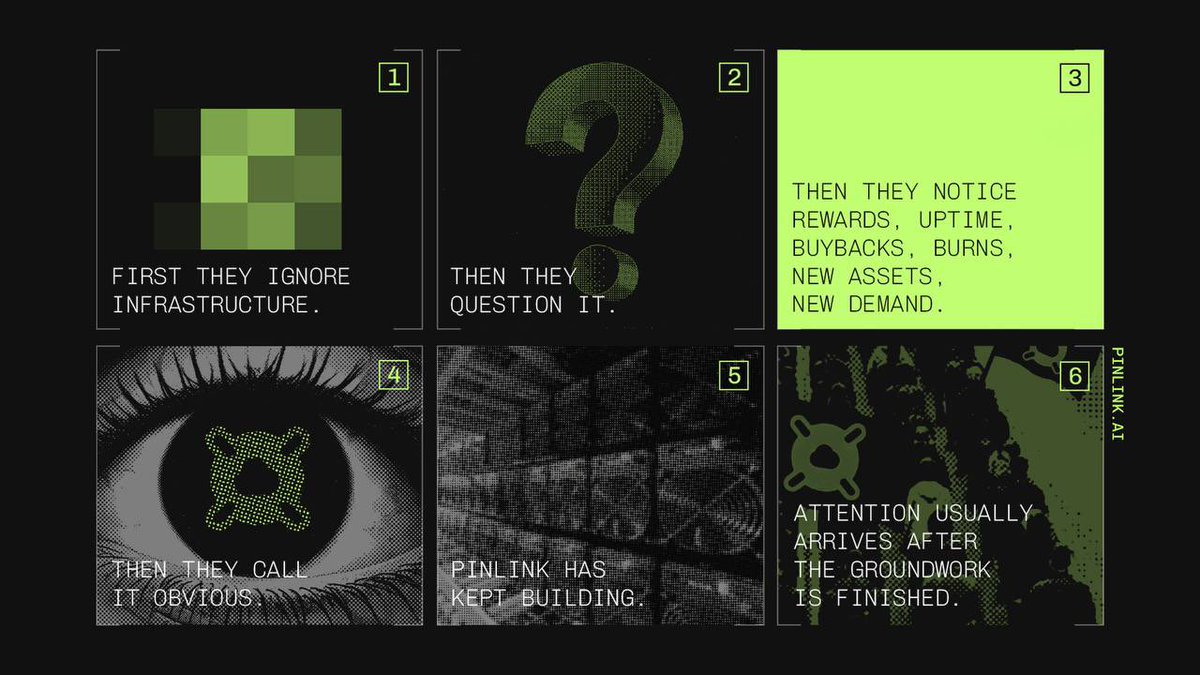
First they ignore infrastructure.
Then they question it.
Then they notice rewards, uptime, buybacks, burns, new assets, new demand.
Then they call it obvious.
PinLink has kept building.
Attention usually arrives after the groundwork is finished.
Execution Layer Upgrade Completed
PinLink has completed an internal upgrade to the marketplace matching engine, improving how listings, fills, and reward states are synchronized across frontend and smart contract layers.
This reduces stale state events, improves order responsiveness, and creates a smoother path for scaling higher transaction throughput as new assets are onboarded.
Small backend changes often create the biggest performance gains. Allowing PinLinks infrastructure to handle more assets and be ready for the shift towards the tokenized economy.
Across infrastructure, tokenization, and autonomous systems, development has been progressing in parallel.
Each layer physical assets, on-chain execution, and agent coordination has been designed to integrate into a unified system rather than standalone products.
When these components begin operating together, the shift becomes visible very quickly.
Energy Infrastructure Is Coming Online
PinLink’s energy operation in the UAE is approaching energification in the coming months, bringing new megawatts of production capacity into the ecosystem.
This energy directly underpins mining and compute infrastructure, forming the base layer of yield generation. By integrating energy at the protocol level, PinLink strengthens control over cost, uptime, and output.
Real-world production is becoming directly connected to on-chain value.
Supply Is Becoming Structurally Scarce
1% of total $PIN supply has been burnt today making it permanently removed from circulation. Token burns ensure that supply reduction is transparent, irreversible, and aligned with long-term ecosystem growth.
With a total of 3% burnt and over 20% staked, $Pin tokens continue to become more scarce. As usage increases across tokenization, infrastructure, and the introduction of agent execution, these mechanisms will compound.
There’s never been a better time for tokenization on ethereum.
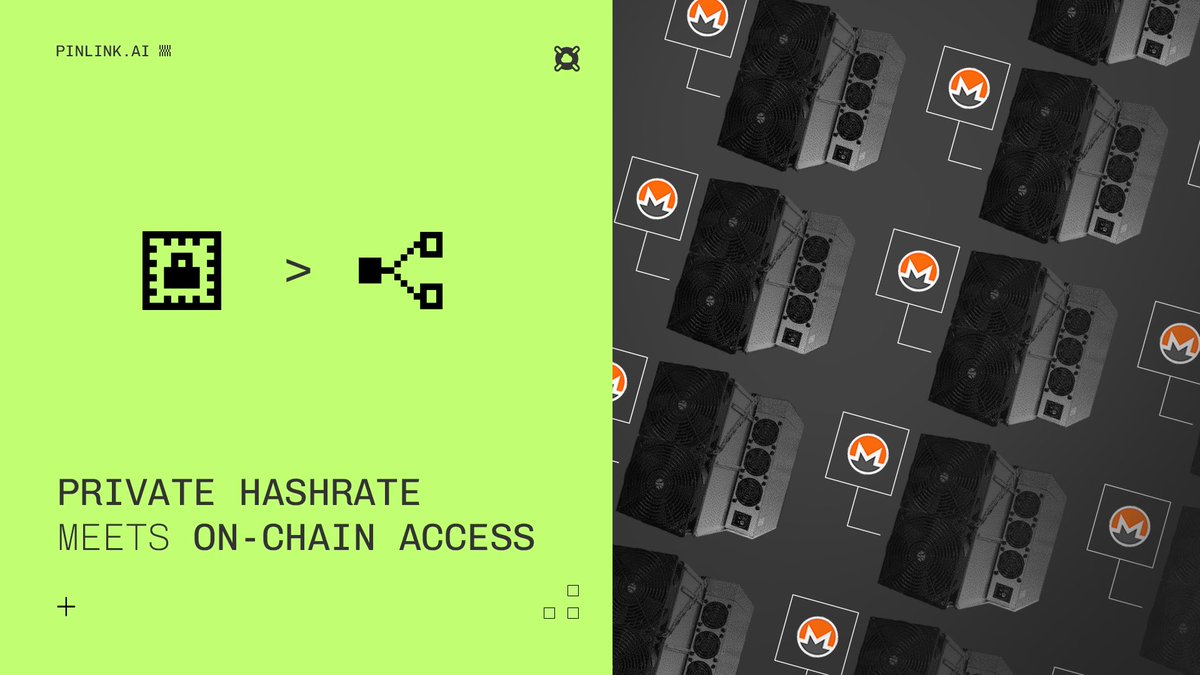
Private Hashrate Meets On-Chain Access
A new fleet of XMR miners is arriving next month, enabling the onboarding of privacy-focused Proof-of-Work infrastructure. These machines will be integrated into PinLink’s tokenization layer, converting physical hashrate into on-chain, yield-generating positions.
This introduces a new primitive: hardware-backed privacy yield that can be accessed digitally without operating the machines directly.
Physical infrastructure is no longer isolated, it becomes programmable.
What is an RWA in 2026?
RWAs in 2023 meant tokenizing static assets. Real estate, gold, art - representations of things that don't compose with on-chain infrastructure.
RWAs in 2026 mean tokenizing productive systems. The infrastructure itself, not just ownership certificates.
Bitcoin mining operations operating continuously. AI coordination systems executing across DeFi protocols. Energy infrastructure integrated on-chain.
Not static representations.
Active infrastructure that operates, executes, and interacts with blockchain protocols directly.
HashLink tokenizes mining infrastructure where hashrate becomes verifiable on-chain.
Agent Pin ran autonomously for 60 days coordinating across Pendle strategies.
Over $5M in infrastructure brought on-chain through PinLinks tokenization engine.
The category evolved from representing assets to operating infrastructure. We've been building that layer for over a year.
We were early
We built PinLink for DePIN before the market was ready.
2025 was proving concepts worked. 2026 is proving they can operate reliably at scale.
The numbers are showing it. Multiple DePIN projects now generating $10M+ in annual revenue. Aethir hit $166M ARR. Grass monetizing 8.5M users at $33M annually. The DePIN market reached $11.1B, with institutional capital starting to flow toward proven operations.
The shift is real. Institutions want operational track records, not experimental pilots. Verified uptime over token metrics. Infrastructure that's survived real conditions.
PinLink has been operational for over a year through this transition. Maintaining uptime. Processing payouts. Demonstrating that productive infrastructure actually works when markets are difficult.
Our thesis was always that DePIN and RWA would converge at productive infrastructure. Not static tokenization. Operational systems that generate verifiable output. The PinLink marketplace becomes the focal point for that convergence.
That vision is mapping to reality.
Being early meant building when nobody cared about operational metrics. The payoff is being operational when the market finally does.
Here's what we've proven over the last year:
If something generates verifiable output autonomously it can be tokenized and traded.
Mining rigs run 24/7 producing hashrate. Energy infrastructure delivers megawatts on schedule.
People buy and sell these on PinLink right now because the production is real and the metrics don't lie.
That's the framework. Physical infrastructure taught us how this works.
Now here's where it gets interesting.
An AI agent runs for months without intervention. It generates returns you can verify onchain. The performance history is immutable.
Why wouldn't you value that the same way?
Mining rigs are predictable, you know what you're getting. AI agents are adaptive, they improve as they run.
Different characteristics. Same category: autonomous systems producing measurable value.
We're not pivoting from physical to digital infrastructure. We're building a marketplace for anything that operates and generates revenue autonomously.
Hashrate from mining operations.
Megawatts from energy assets.
Yield strategies from AI agents.
If it produces if it's verifiable, if it runs without you, it belongs on PinLink.
The infrastructure economy isn't just physical anymore.
The Fragmentation Problem
The RWA infrastructure market is fragmenting before it's even built.
Different blockchains hosting different asset types. Different custody solutions that don't talk to each other. Different compliance frameworks per jurisdiction. Different token standards with incompatible assumptions.
Everyone's building their own walled garden.
But productive infrastructure doesn't work in isolation. Mining operations need DeFi liquidity. AI systems need to coordinate across protocols. Energy infrastructure needs cross-network settlement. Tokenized production has to compose with everything else or it's useless.
The PinLink marketplace was built as the convergence point.
One platform. Multiple asset types. Unified standards. Built on Ethereum with ERC-1155 specifically so everything integrates with existing DeFi infrastructure instead of requiring custom bridges and proprietary solutions.
Mining infrastructure, AI coordination systems, energy assets, compute capacity - all accessible through one marketplace with consistent integration points.
While the market fragments into incompatible pieces, we're building the hub where productive infrastructure actually connects and composes.
The fragmentation happening now means capital and infrastructure will eventually consolidate where interoperability actually works.
We didn't build another isolated protocol. We built the layer where fragmented RWA infrastructure comes together.
That's the advantage.