BREAKING: On the same day, on two continents, two central-bank ecosystems used the same word.
Schnabel (ECB, Seoul): a digital euro is "essential to counter" dollar stablecoins.
Japan's LDP (Tokyo): build yen stablecoins as a "counterweight."
You don't build a counterweight to something theoretical.
Round one is already over.
The wealthiest families of the last century didn't become rich because they consumed oil.
They became rich because they owned the asset and infrastructure the world depended on.
John D. Rockefeller didn't get wealthy by driving more carriages or burning more kerosene than everyone else. He built an empire around the asset that powered the industrial age.
As oil became the lifeblood of the global economy, the value of owning oil fields, pipelines, refineries, and energy companies compounded for generations.
Today, we are watching the digitization of value itself.
If oil was the asset that moved the world in the 20th century, what becomes the asset that moves money in the 21st?
The biggest fortunes are often built by owning the infrastructure behind a global trend long before the rest of the world recognizes its importance.
The Rockefellers understood oil.
The next generation of wealth may be built around understanding the movement of value.
I really like this quote
"For many it is little, and for few it is much"
I’m not here to give financial advice or anything, but I want to address the grievance that some people feel.
If you can afford it, buy just 1 or maybe 10, but never envy the person who buys 100. And if you buy 100, don't sigh with regret looking at the person who buys 1000.
Because at the end of the day, everyone’s journey and capacity are different, what matters is being in the game with what you can afford.
In life, while someone's gain of 1000 brings them no blessing, your gain of 100 might turn out to be far more blessed for you than their 1000.
14 years ago, we got together with an idea to build a better way to move value. What happened next was something none of us could have built alone.
And by "us," I don't just mean the three of us.
I mean the developers, validators, businesses, community members, and everyone who helped shape XRP into what it is today.
Happy Birthday, XRP!
XLM: It positions itself more around bringing banking to the unbanked and asset tokenization, such as minting bonds or stocks as seen in the DTCC example.
XRP: It aims directly at the heart of the global financial system, meaning Tier-1 banks and the core settlement layer that will replace SWIFT. This is why XRP's need for regulatory clarity in the US, like the Clarity Act, and institutional compliance is far more critical compared to XLM. Tier-1 banks will only perform cross-border gross settlement with a network that provides a solid legal foundation and commands a price level high enough to effortlessly absorb billion-dollar orders in a matter of seconds. XRP is the only bridge asset capable of getting this job done.
In summary: Yes, XLM can also execute cross border transfers, but its lane is focused on retail remittances, micro payments, and the movement of tokenized assets. XRP, on the other hand, is a heavy industry play engineered to carry trillion dollar cross border liquidity transfers at the institutional and central bank levels
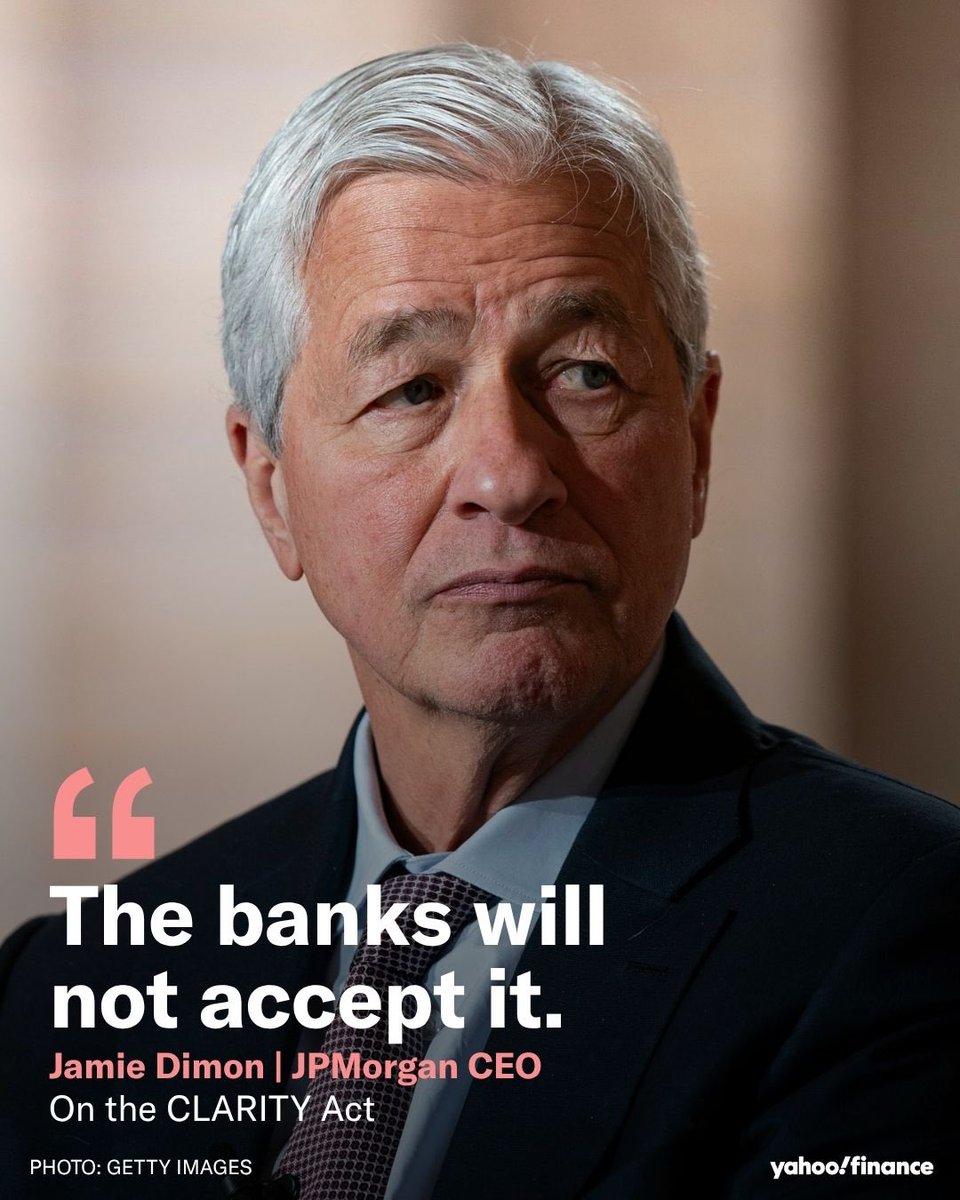
this interview is crazy.
big bank ceo of jp morgan.
says he’s not worried about stablecoins or crypto.
but will fight tooth and nail against the clarity act.
NOTHING IS THE SAME AFTER THIS
Two days ago the company that clears every single stock trade in America did something almost nobody noticed.
The DTCC — the clearinghouse that settles 4.7 quadrillion dollars in trades every year — announced its putting real stocks, real ETFs, and real US Treasuries onto a crypto blockchain called Stellar.
And this is the second time in two weeks.
Two weeks ago it was Chainlink running their collateral system. Now its Stellar settling actual securities. Same playbook, second coin.
Stop and think about what that actually means.
The most regulated piece of plumbing in all of Wall Street is not building its own government coin. Theyre not inventing some new blockchain from scratch. Theyre taking the altcoins that regular people already own and quietly rebuilding the entire financial system on top of them.
And this isnt a someday maybe. The SEC already cleared it back in December with a no-action letter covering the Russell 1000, the major ETFs, and Treasuries. Limited live trades start this July. Full launch in October. 50+ firms already lined up.
We are not talking 5 years out. We are talking 5 months.
Heres the part that gets me. 234 years ago, 24 stockbrokers stood under a buttonwood tree on Wall Street and signed a 2 sentence agreement that became the New York Stock Exchange. That machine ran the worlds money for over two centuries.
Now that same machine is quietly tearing it down and moving onto crypto rails. The same coins you can buy today.
The pattern is already in motion. Most people just havent connected it yet.
Going live at 4PM EST to break down every piece of it.
Here’s the link:
https://t.co/gJS5fwD724
To get access to the live Q&A, you must choose the $49 price level.
🔥 BREAKING: CME Group launches 24/7 crypto trading today.
Starting May 29 at 4:00 p.m. CT, institutions can trade BTC, ETH, SOL, XRP, ADA, LINK, XLM, AVAX, and SUI futures around the clock.
$XRP and $XLM aren't competing. They're completing each other.
Together, they create the perfect flywheel for the internet of value, as trillions in real-world assets go digital.
https://t.co/Q98XWoIvGK