My thinking on BIP-110 has shifted quite a bit in the last weeks and months. Where I currently stand is complicated. Honestly, I'm a bit tired of the whole thing.
I stand with BIP-110 in principle, in that I disagree strongly with the proliferation of arbitrary data on Bitcoin.
At the same time, my reasoning has always been a little different from the motivations cited in the BIP itself.
I view arbitrary data as an attack on Bitcoin's availability as a monetary network. I mean that in a technical sense, from the cybersecurity world, where availability refers to one of 3 primary ways that cyber attacks target systems and information, the others being data confidentiality and information integrity.
Arbitrary data isn't the same thing as gold jewelry, which only takes a portion of the stock off the open market and distorts the price a little. Arbitrary data also competes for the throughput of scarce block space.
It's shortsighted to think that fees generated by arbitrary data are a good thing. The situation might be somewhat positive for the miners, but again, only in the short term. The real effect on users, making it more expensive to transact and potentially pushing activities off the main chain, is only net negative in my view. Growing real adoption will solve the fee issues in the long run. We don't need arbitrary data protocols for that.
This is all to say that my concern over spam isn't quite the same as cited in the BIP. I'm not as worried about contiguous data as the strongest proponents are. I'm more frustrated by the size and volume generally.
It has also been truly concerning to me the way that Bitcoin Core tacitly allowed the propagation of arbitrary data even before the OP_RETURN change. Taproot shipping without covering Tapscript with datacarriersize and adhering to previously established limits made it much easier for inscriptions to get a foothold in the market when it did. Refusing to fix those bugs in Core feels strongly disingenuous to me.
On a technical level, I believe the BIP has some flaws. I wouldn't have set the OP_RETURN limit at 83 bytes by consensus. If the goal of the BIP was to limit data vectors to 256 bytes, set that to 256 bytes also. I've been consistent on this point. I would also have preferred to see a method of closing the "OP_FALSE OP_IF" envelope without totally disabling OP_IF in Tapscript. Breaking Miniscript isn't a good thing.
At the same time, I also assert that it must be possible to walk back certain parts of upgrades, at least temporarily. Otherwise, there's nothing we can do in the case of unforeseen consequences in future upgrades. Breaking user space isn't a good excuse here. Bitcoin is a distributed system, not individual computers. It's not a valid security model to say that no individual can ever be impacted by network-level changes.
Therefore, I assert that the tradeoffs of BIP-110 are technically acceptable to me. Having a little bit less development freedom (again, temporarily) is perfectly fine if it serves greater network goals.
As to whether BIP-110 will actually reduce spam, honestly I'm not convinced about that anymore. I see the willingness for arbitary data enthusiasts to move to other methods. Perhaps the cost can be increased for them, somewhat, but the claim at least is that the cost increase is negligible.
Still, I come back to another cybersecurity principle, where actively exploited bugs are prioritized and fixed first. Closing off the vectors that are being actively used at least forces the spammers to do something in order to salvage their precious JPEGs and tokens.
Then again, is any of this worth a potential chain split? I don't think so.
There are 3 logical scenarios here:
One is that BIP-110 fails entirely, and the status quo is maintained. At this point, I find that scenario acceptable. Move on, continue the fight another day.
The other is that BIP-110 succeeds, activates, and becomes the rules of Bitcoin. I believe this is a good outcome, and will be good for the network in the long run. Others disagree, and say that Bitcoin's reputation will be permanently damaged by a change being forced through without consensus.
The final scenario is a protracted chain split. I'm told that this is unlikely by BIP-110 proponents, and that it's extremely likely by opponents. I at least acknowledge that it's a possibility. And I unequivocally believe that this outcome would be bad for Bitcoin.
All scenarios probably result in some individuals leaving the space, for better or worse. It would be a shame for monetary maximalists to give up on Bitcoin. I don't want that, considering I consider myself one. It would also be negative if a lot of dedicated developers left the space if 110 activates. And a split is a split. Not good either.
This whole post is mostly all to say that I'm tired of fighting for the merits of this BIP when I don't really believe in it entirely. I like the idea of the BIP, and the idea of taking action against arbitrary data. But if the BIP isn't going to be truly effective, and all it's going to do is cause community controversy, then I don't think it's a net positive.
I still support the idea of taking action against arbitrary data in the future. I also support increasing the share of node implementations other than Core. In my ideal scenario, no one implementation has the majority of the market share. Perhaps it's optimal to have only one primary implementation, but in the case where multiple implementations exist, not having any one be dominant is preferable to me.
So, I'm withdrawing from the fight, for now at least. I'm continuing to work on Bitcoin education and adoption efforts. Whatever happens, all I care about is Bitcoin fixing the money and fixing the world. I hope that's still possible.
What is the easiest way to ferret out libertarians among our ranks, i.e. those who defend the tenets of economic liberalism?
See if they refuse to uphold these two principles of Catholic economics:
1. The State and subordinate public-authorities are the “true and effective directing principle” of economic affairs, not free competition of corporations and individuals
2. The State has the right (and often duty) to positively intervene in the economy to remedy various evils
We are Bitcoiners who still believe Bitcoin is money.
Not a JPEG gallery.
Not cheap cloud storage.
Not a data layer for arbitrary spam.
For too long, non-monetary data has bloated the UTXO set, raised verification costs, and threatened the decentralization that keeps Bitcoin sovereign.
BIP-110 is our temporary, pragmatic line in the sand — a soft fork that limits abuse of blockspace and refocuses the chain on its original purpose: peer-to-peer electronic cash.
We run Knots.
We signal BIP-110.
We filter what doesn’t belong.
This is not about control.
It’s about preserving a sound monetary network that anyone can run and verify — without permission, and without carrying everyone else’s junk.
The network is waking up. More sovereign nodes choose this path every week.
Filters up. 🛡️
#BIP110 #RunKnots #Bitcoin
«Nadie puede salvarse fuera de la Iglesia Católica, Apostólica y Romana, como tampoco nadie pudo salvarse del diluvio fuera del Arca de Noé, que era una figura de la Iglesia».
Papa San Pío X
>Modern Hollywood has completely failed at making historical epics, choosing to rewrite history with modern agendas instead
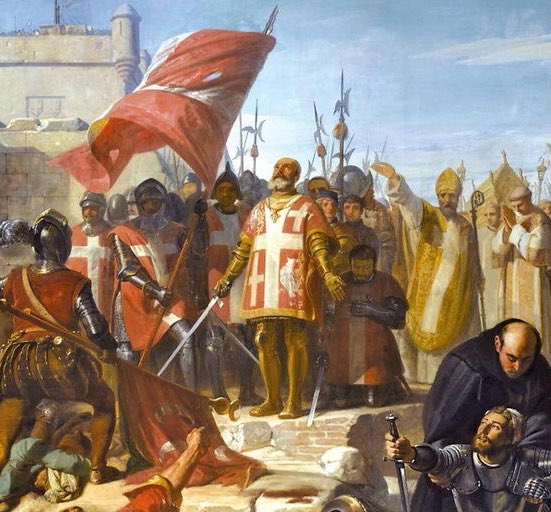
>Mel Gibson decides to do it himself, announcing a limited TV series about the Great Siege of Malta
>The true story of roughly 700 Catholic Knights of St. John and local Maltese citizens facing down an Ottoman invasion force of 40,000 men
>The Knights believed they were fighting for the absolute survival of Christianity itself
>After four months of brutal, non-stop bombardment, the massively outnumbered defenders miraculously broke the siege and won
>Gibson is to film on location in the exact ancient Maltese fortresses where the battle actually happened
>Just pure, unapologetic European excellence and Catholic heroism
We need this.
CAPTURE
An investigation across four articles into how informal power over Bitcoin Core was assembled, exercised, and defended.
Article Two: The Lever
https://t.co/72sC4969Tm
I renounce the devil and all his works.
I reject Vatican II, the Novus Ordo, its spirit and all its modernist pomps.
I despise heresy.
I hold fast to the Holy and eternal Catholic Faith, once delivered to the Saints.
So help me God!
Run knots.
I've never said Core V30 would destroy Bitcoin.
But it DOES increase the attack surface and threat vectors to node runners and thus the network.
Core is compromised. They are incompetent and their fucking around with Bitcoin is why we are where we are today.
@jacksonhinkle It is not communism, it is not capitalism. These are two sides of the same coin and having the same origin: theft. Communism originates in capitalism and capitalism is nothing more than state enforced usury. The west was conditioned for centuries to only see these two options.
@zamir591582@adam3us@satflation@jabulanijakes@BitMEXResearch@giacomozucco Yes we should be working towards this kind of soft fork. But given core's current priorities, this may be a very long term indeed, possibly forever. So meanwhile Knots is the best protection noderunners have available.