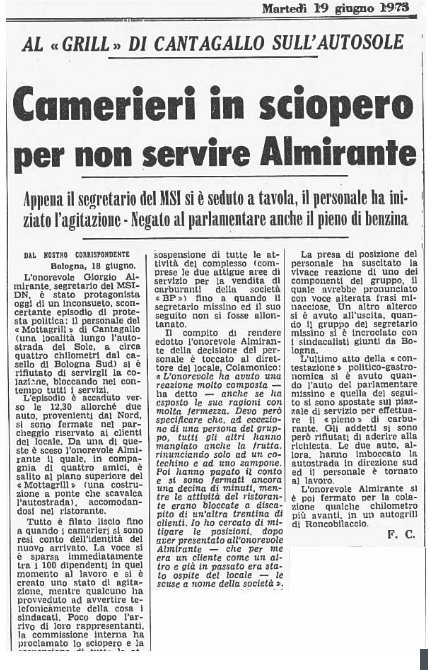
18 giugno 1973, un lunedì rosso. Il giorno in cui i camerieri del Cantagallo si rifiutarono di servire Almirante e la sua scorta.
Né cibo né carburante per i #fascisti in sosta al Mottagrill, cacciati via ignominiosamente dai lavoratori in #sciopero.
Ma non ci sono già 4997372747031 forze riformiste?
Quante ne servono?
L’unica cosa che vi serve sono i voti
Che non avete
Perché avete ‘ste facce qui: come il curriculum 🤡
Per la propria credibilità il Quirinale avrebbe enormemente fatto meglio a dire: "Ogni anno estraiamo a sorte (bimbo bendato) un graziato a caso fra tutti i condannati, meritevoli o meno che siano. Nicole Minetti è semplicemente una donna fortunata"
“Per la cena andiamo volentieri, facciamo passare questa settimana. Tra il caos del lavoro e l’incidente di giovedì che ho distrutto la Gt3 nuova sono un po’ off”
Questo mentre la ragazza investita a 200 km/h dalla sua Porsche stava morendo in ospedale
https://t.co/RwxdU6EEaP
@CCKKI@PMO_W@Quirinale@FranceskAlbs È evidente che l'interesse alla tutela dei rapporti politico-economici in essere metta in secondo piano il ruolo di garante. Sono scelte.
Ma non lo percepisci tutto l’impegno politico der momento? L’arti valori morali? Er senso delle istituzioni? Le sfide che pone la modernità? La schiena dritta la testa alta l’alluce valgo e le chiappe prensili sulla poltrona?
🔚
Di quale classe media parla?
Quella italiana ha un patrimonio che non arriva a 500 Mila euro 1ª casa compresa,fate allarmismo come fecero all'epoca per la riforma Sullo.
https://t.co/XsJqgarXMs
@Foggiagrad@GeekTheVivian@maicolciotti Sono già all'opera per accertare gli abusi. "Sanzioni che vanno dalla censura all’interdizione dalla partecipazione ai lavori del Senato per un periodo non superiore a dieci giorni di seduta."
Sanzioni pesantissime.
https://t.co/Kg8dmJMe49
On 7 June 1952, Orhan Pamuk was born, a man who has spent much of his life walking through Istanbul and asking one deceptively simple question: what happens to a civilization when it can no longer decide whether it is looking toward the East or toward the West?
Pamuk was born into a wealthy, secular, Western-oriented family in Istanbul, one of those great Turkish families that once believed the future would arrive neatly packaged in engineering, progress, Europeanization, and rational planning. His father was an engineer, his grandfather had accumulated considerable wealth, and the household itself represented a miniature version of modern Turkey: prosperous, educated, ambitious, and quietly uncertain about its own identity.
Perhaps that is why family occupies such a central place in Pamuk's imagination.
Not because families are harmonious.
Quite the opposite.
Because families are where history stops being abstract and becomes personal.
In Pamuk's world, grandparents, fathers, mothers, uncles, cousins, inheritances, secrets, silences, disappointments, and unspoken longings are never merely domestic matters. They are history wearing a human face.
"One day I read a book and my whole life was changed."
Few sentences describe a writer more accurately.
Pamuk originally wanted to become a painter. Then books intervened, as books so often do, and the future painter became a novelist. Literature gained what painting lost.
His novels are not merely stories.
They are philosophical laboratories.
"My Name Is Red" transforms a murder mystery into a meditation on art, beauty, individuality, faith, and the clash between civilizations.
"Snow" examines politics, religion, modernity, loneliness, and the dangerous temptation of certainty.
Pamuk's philosophy is built upon uncertainty.
He distrusts slogans.
He distrusts ideological certainty.
He distrusts people who believe they possess final answers.
Because many writers secretly understand that solitude is not always the enemy of creativity.
Sometimes it is its source.
And nowhere is this clearer than in Istanbul itself, that magnificent city suspended between continents, religions, empires, memories, and futures.
"Life isn't so bad. No matter what happens, I can always take a walk along the Bosphorus."
Only someone from Istanbul could write such a sentence.
Only someone who understands that cities are not places.
They are emotional states.
Women occupy an important place in Pamuk's life and fiction, though never as simple romantic ornaments. His women are intelligent, mysterious, independent, wounded, resilient, and often possess a deeper understanding of reality than the men around them. Love in Pamuk's novels rarely arrives as happiness. More often it arrives as memory, longing, absence, regret, or obsession.
At this point Bertrand Russell would probably smile.
Because Pamuk seems to understand something fundamental about human beings: most people are not destroyed by what they know.
They are destroyed by what they refuse to question.
"In the end, a woman who doesn't love cats could never make any man happy."
One suspects that even philosophy occasionally benefits from a cat.
The more I read Pamuk, the more it seems to me that he is not writing about Turkey at all.
He is writing about the eternal human condition: the desire to belong, the fear of being divided, the longing to be understood, and the endless search for a home that exists somewhere between memory and imagination.
And perhaps that is why his novels feel so universal.
Because every human being carries within themselves a private Istanbul.
And as Pamuk himself reminds us:
"I believe in a world without heroes. Of course, I admire personal courage, intelligence, and hard work. These are qualities I genuinely value... and qualities possessed by so many 'ordinary' people."