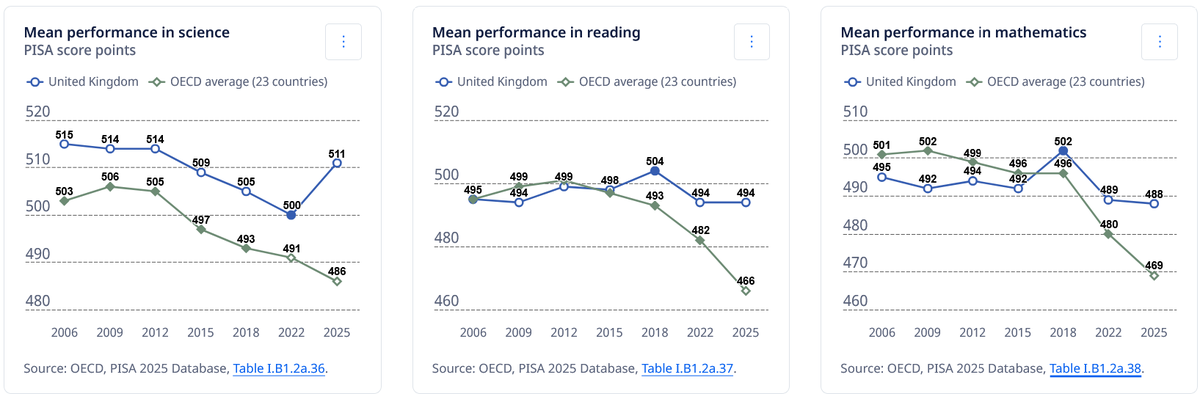
I beg you, United Kingdom of England and Wales, to celebrate properly this amazing achievement, result of bipartisan efforts, and to celebrate the achievements of this incredible young generation, against all odds, against covid, smartphones, and ambient doomerism
#OTD in 1989, #BalticWay 🇱🇹🇱🇻🇪🇪
2 million people, 3 nations, 672 km, one unbreakable chain for #freedom.
No internet. No mobile phones. Just courage, solidarity and an unbreakable belief.
From my personal archive.
Monopoly is usually seen as a company controlling a market.
But property rights also create exclusive control.
@PirateOrg connects this idea to public blockchains, where the line between private property and public good is harder to define.
@MishaTeplitskiy Every quantitative scholar in the social sciences knows and does just that. Few admit it in public, possibly because they mistakenly believe that "abduction" is synonymous with a lack of rigor?
Do you know one marginal change that would probably improve the education of future economists?
Instead of jumping straight into “externalities” in introductory courses, professors should begin by talking about the difficulties of resolving conflicts of interest over scarce resources when transaction costs are high.
(This would require defining transaction costs carefully, and the best article for that purpose might be Douglas W. Allen’s “What Are Transaction Costs?” [1991].)
The professor could then introduce historical cases in which private solutions emerged over time. They could discuss how property rights themselves often develop precisely because they help reduce transaction costs.
Or they could turn to Cheung’s (1973) article on beekeeping, which shows how beekeepers sometimes pay farmers for the right to place hives in their orchards, while in other cases farmers pay beekeepers for pollination services.
The class could also examine cases in which no fully satisfactory private solution has yet emerged, along with the different alternatives that have been proposed and the tradeoffs each entails.
Why is this approach better than immediately framing the issue in terms of externalities?
First, externalities are ultimately conflicts of interest over scarce resources that remain unresolved because the affected parties have not found a workable mechanism for compensation or coordination. Starting from that underlying problem makes the economics much clearer.
Second, beginning immediately with “externalities” makes it too easy to leap from identifying a problem to prescribing government intervention without first thinking carefully about the nature of the problem itself. The analysis quickly turns into a cookbook of taxes and subsidies.
Whenever an economist wants the government to do something, it is tempting to invoke a positive or negative externality and treat that as sufficient justification for almost any public policy proposal. But identifying an externality is only the beginning of the analysis, not the end of it. Treating it otherwise is bad economics, and we should teach future economists to do better.
Astonishing rise in borrowing costs in some of the world's largest, and most fiscally irresponsible, economies. 30Y yields:
US: 5.29% (highest since 2007, with deficit at 6% of GDP in spite of growth)
UK: 5.83% (highest since 1998)
Japan: 4.14% (record high since 30Y was introduced in 1999)
France: 4.90% (highest since 2008, with debt at ~118% of GDP)
No chance any of them voluntarily implements a fiscal adjustment. How long until we start to see serious debt crises?
After 9/11, the Patriot Act massively expanded government surveillance.
From 2000 → 2004, FBI NSL requests rose 6.6x.
Phone / bank records could be demanded in secret, and gag orders kept you from ever knowing.
Enter The Surveillance State Exhibition: https://t.co/m6AlHagjgW
@ProfAliceS@CurtisRMcManus Wait, is it the same P. Berger who authored "The social construction of reality"? That quote is brilliant and timeless (okay, maybe it would be overstating the importance of Air France in the 21st century)