Interview with a $GOOGL employee who thinks we still have at least five more years of strong capital deployment ahead in the AI buildout:
1. The expert sees the AI data center build cycle as roughly at the halfway point, with the buildout expected to continue through 2035 before the next architectural shift. The current phase is transitioning from training-heavy investment to inference, and the expert sees at least five more years of strong capital deployment ahead. On the shape of spending, the expert expects the composition to shift rather than the total to decline, with heavy hardware investment dominating through 2027 and 2028 before giving way to a larger proportion of software and operational spend as AI becomes more of a commodity.
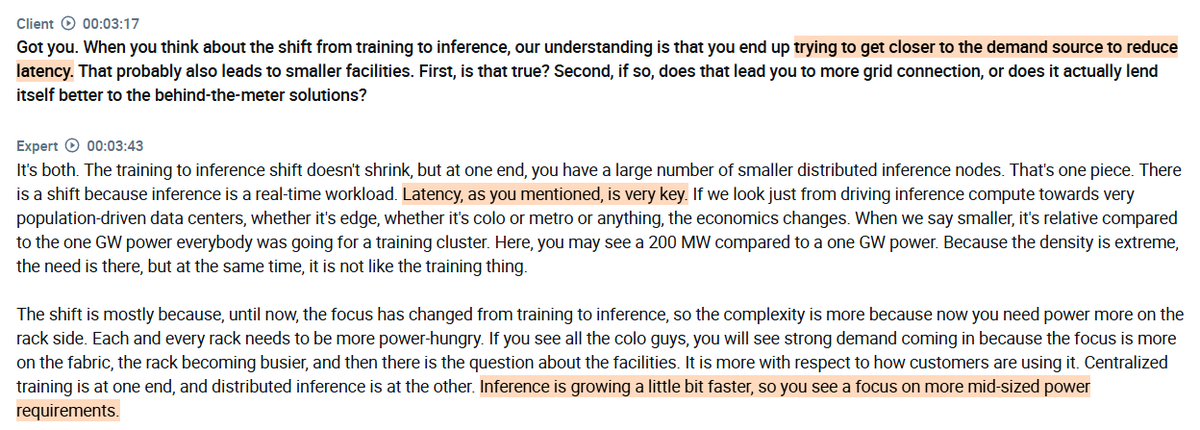
2. He emphasizes that the shift from training to inference pushes compute closer to population centers to reduce latency. Training clusters were chasing 1GW facilities, while inference deployments sit closer to 200MW, spread across colocation and metro sites rather than concentrated in one place.
3. The expert highlights a clear distinction between training and inference from a power design perspective. Training runs at flat, sustained load for weeks, making it predictable but requiring over-provisioned capacity, while inference is spiky and needs capacity available on demand even when mostly idle.
4. According to the expert, hyperscalers would willingly pay a 5-15% premium above the equivalent volume price to secure a shorter-duration PPA, with the logic being that retaining the option to extend, restructure, or walk away after 7 years is worth paying for compared to being locked into a 20-year commitment with no flexibility. The expert sees hyperscalers holding a stronger position in most markets, since power assets without a signed contract generate no revenue, giving hyperscalers leverage in all but the most supply-constrained regions.
5. The expert sees two forces driving the push for on-site power over waiting for grid connections. GPUs are expensive depreciating assets that generate no return when not running, and customer demand cannot wait, with any hyperscaler that fails to deploy quickly risking losing that customer to a faster competitor. In the near term, a small increase in power costs is not a deal breaker, but over a 5 to 10 year operating period that difference compounds, and the expert expects cost efficiency to become a much bigger priority by 2029.
found on @AlphaSenseInc
Citadel Securities just put institutional weight behind what the AI bulls won't say out loud.
In a new macro note titled "Tokenomics," Citadel makes the argument plainly: even the most powerful technology on earth still has to pass through the boring discipline of cost curves, capacity limits, and marginal returns.
The evidence is piling up:
– Amazon removed its token usage leaderboard
– Microsoft cancelled Claude Code subscriptions
– Multiple companies reporting unexpectedly massive token bills
Their conclusion is the part that matters.
Adoption is no longer about what AI can do in principle. It's becoming about the price and scarcity of the inputs needed to run it at scale. Compute. Power. Cooling. Memory bandwidth. Inference budgets. All real, all binding constraints.
And here's the kicker from the chart.
The Silicon Data LLM Token Expenditure Index, a benchmark for how much the market is actually spending on AI tokens, has started rolling over. Citadel reads it as a shift toward cheaper models. Companies substituting away from expensive frontier AI toward "good enough" alternatives.
That's economics 101 doing what it always does. When the price of something rises, people use less of it, or find a cheaper version.
Citadel sees a bifurcation forming. Frontier AI concentrated among a few firms with the balance sheets to absorb the cost. Everyone else quietly downgrading to simpler, cheaper models.
This is the part of every technology revolution the early narrative ignores.
The technology being real was never the question.
The question was always whether the economics could carry the valuations.
When one of the most sophisticated trading firms on earth starts writing about AI in the language of cost curves and rationing instead of limitless demand, the conversation has quietly changed.
The hype was about what AI could do.
The reckoning is about what it costs.
How are buy-side investors actually using AI?
At @TRowePrice, Priyal Maniar, co-PM of $TURF and Global Energy Analyst, uses AI to:
• Analyze 20 yrs of transcripts for CEO tone shifts
• Ring-fence inputs to reduce hallucinations
• Run Excel sensitivities faster
The $1 Trillion hidden value of the X acquisition?
Imagine the advantage of owning X and using that as your company’s PR (propaganda) machine.
X’s revenue is down to $1.8B from $5.1B in 2021, pre-purchase.
MAU’s down 9%.
But, that’s 33 Million potential TSLA or $SPCX buyers who are more likely to “trade the news” then read the 10-k.
You don’t even have to make any content, just tweak the algo to spread the posts from the self dealing bulls and suppress the bears.
And the neutral valuation guru’s at Morningstar - @NicholasOwens have it pegged at $780B vs the $1.75B the 21 bank underwriting syndicate is marketing it at (and for a $500 MM fee, why not?)
The main rationale I can think of is:
1.) “In Musk we Trust” [he’s crushed TSLA so SPCX gets his ora too]. That’s what legendary investor @RonBaronAnalyst touts. That’s a credible person who is adding $1B at the IPO price of $135.
2.) The $1 Trillion hidden value of the X media machine combined with the power of retail traders in this market. It’s real.
3.) And of course the passive funds will have to come in as the next buyer.
Good luck.
Let's ask the TMT axe : @RihardJarc
#SPCX #SpaceX #ElonMusk #GoldmanSachs #MorganStanley
We posted about the risk to the squishy toy wave of popularity in April. We spotted this trend early (it helps to have kids ages 7 and 9) and recommended a long position beginning in q3 of 2025 but we saw risks to a trend reversal earlier this year. We recommended clients short the stock into this print over concerns about the oversized contribution to comps from trendy categories like squishy dumplings. We expected the guide to appropriately reflect caution.
Today we learned of several summer (sleep-away) camps banning the toys for this summer citing, among other reasons, concerns over safety. We believe this will materially and negatively impact demand for the month of June, and we believe there is risk that schools pick up on the move by summer camps and ban the toys for next school year.
$FIVE
Pounding the table on META with Divya Narendra, CEO of SumZero, Inc.
Free access to the webinar compliments of AlphaSense and SumZero, Inc. in the Newsletter below.
We dive into 3 key debates:
1. What is the future FCF profile of the company?
- What Zuck decides to do on capex drives the stock in the near-term. Divya has followed META since his days at Harvard where he founded Harvard Connect, the predecessor to Facebook.
- Avory & Co put out a deep-dive calling for peak hypescaler capex in 2027 from due to a pull forward or retrofit of existing infrastructure. Something we discussed in episode 12 with Aaron Ginn, the CEO of HydraHost
2. Are the AI investments paying off?
- The recent Muse launch puts META on par with leading frontier models per the Alpha Sense expert network checks we did.
- Revenue or productivity per employee has doubled in the last 3 years.
META AI app downloads are taking-off recently
3. What is the market discounting?
- META is valued more like a neocloud than an asset light oligopoly with 3 billion users.
- META is the cheapest since the 2022 Apple IOS tracking change concern
13 Key Charts and Analysis Table of Contents in the Newsletter:
1. META NTM P/E is 90% correlated to ' 2027 FCF revisions.
2. META is valued like an asset heavy neocloud not an asset light oligopoly with billion users.
3. 5 of the top 15 app downloads are META’s
4. Instagram reels are beating YouTube shorts now
5. Core ad business growing at historically strong levels of 33%
6. META has the second best revenue growth + EBIT margin of the Mag 7
7. The concern is capital allocation into AI is capital intensive post the metaverse spree
8. The Muse launch puts META on par with frontier models per AlphaSense’s experts
9. Historical and Relative P/E
10. Variant View: The META AI app will build another top of funnel value enhancer and the AI capex is front end loaded per Sean Emory at Avory & Co.
11. Meta is seeing significant productivity gains. Revenue per employee has doubled since 2023
12. META app downloads are gaining traction
13. Catalysts for the Street to Realize the View?
https://t.co/l0inCOhGwh
Priyal Maniar, Co-PM of $TURF and Global Energy Analyst, dives deep into why T. Rowe - who manages $1.8 Trillion - is structurally bullish the oil cycle. The marginal cost of production is increasing and US shale geology has peaked meaning the next well is more expensive and less productive.
The recent U.S. - Iran war, wipes out the over supply from the start of the year and pulls forward the bullish productivity decline thesis. It also puts energy security in focus and improves demand for energy sources like coal. TURF expresses the bullish oil bet through an overweight position in Oil Sands producers such as Suncor ($SU), Canadian Natural Resources and Cenovus Energy.
Pyrial also highlights her top U.S. oil picks that have idiosyncratic catalysts in their FCF inflections coming up. Her top idea has free cash flow doubling over the next four years at flat prices with a great management team and a great balance sheet and ample low cost inventory. She also highlights three other names with ample inventory and FCF inflections. She notes that these stocks do well when large projects wind down free cash flow inflects.
Timestamps
[00:00] – Intro: U.S. Shale Peak Debate
[01:00] – Why It Doesn't Matter If Shale Peaks: Cost Curve Matters
[02:15] – Long Energy Cycles & S&P Energy vs. S&P 500 [03:30] – The Marginal Barrel Today: Guyana, Brazil, Middle East, Shale
[05:00] – Shale Elasticity & Where Marginal Cost Goes Next
[06:00] – Iran War Impact on the Oil Setup
[07:15] – Energy Security as a Structural Demand Driver [08:30] – How to Express the Thesis in TURF
[09:30] – Low-Cost U.S. E&Ps with Inventory & Balance Sheet
[10:30]– The Canadian Oil Sands Bull Case
[11:45] – Oil Sands Economics: Mining vs. Shale Decline Curves
[13:00] – Why No New Greenfield Mines Get Sanctioned [14:15]– Venezuela: Heavy Oil Revival Math
[15:30] – Chevron's Unique Position & Production Growth [16:45]– Political Risk: Venezuela vs. U.S. Election Cycles [18:00] – Middle East Egress & Pipeline Redundancies [19:15]– Aramco, ADNOC & National Project Dynamics [20:30] – East-West Pipeline Capacity & U.S. Expertise [21:45 ]– Global LNG: Qatar Outages & Project Delays [23:00] – Coal as the New Price-Setting Fuel
[26:45] – Long-Term Bullish on Henry Hub
[27:45] – Offshore Comeback: Conoco Alaska, Clearwater, Namibia, Guyana
[30:30] – AI Power Demand & U.S. Gas Longevity
[31:45] – Utilities, Nuclear & SMRs as Part of the Stack [33:00] – Advice for Aspiring Investors: Dig for the Next Insight
[34:15] – How Priyal Uses AI in Her Research Process 📩
Subscribe to the Pitch the PM newsletter to get the deeper investment framework, key metrics investors should track, and Doug's structured checklist for evaluating the idea. https://t.co/31KnSyCpg1
💡 Presented by AlphaSense
Free trial access: https://t.co/DO1Jxd7lDb 🎧
This episode is for informational purposes only and does not constitute investment advice. See full disclosures at: https://t.co/cfXtjZZO6D
Priyal Maniar, CFA, Co-PM of $TURF and Global Energy Analyst, dives deep into why T. Rowe Price - who manages $1.8 Trillion - is structurally bullish the oil cycle.
The marginal cost of production is increasing and US shale geology has peaked. What does this mean?
The next well is more expensive and less productive.
#financeadvice #investment #TROWE
Priyal Maniar, Co-PM of $TURF and Global Energy Analyst, dives deep into why T. Rowe - who manages $1.8 Trillion - is structurally bullish the oil cycle. The marginal cost of production is increasing and US shale geology has peaked meaning the next well is more expensive and less productive.
The recent U.S. - Iran war, wipes out the over supply from the start of the year and pulls forward the bullish productivity decline thesis. It also puts energy security in focus and improves demand for energy sources like coal. TURF expresses the bullish oil bet through an overweight position in Oil Sands producers such as Suncor ($SU), Canadian Natural Resources and Cenovus Energy.
Pyrial also highlights her top U.S. oil picks that have idiosyncratic catalysts in their FCF inflections coming up. Her top idea has free cash flow doubling over the next four years at flat prices with a great management team and a great balance sheet and ample low cost inventory. She also highlights three other names with ample inventory and FCF inflections. She notes that these stocks do well when large projects wind down free cash flow inflects.
Timestamps
[00:00] – Intro: U.S. Shale Peak Debate
[01:00] – Why It Doesn't Matter If Shale Peaks: Cost Curve Matters
[02:15] – Long Energy Cycles & S&P Energy vs. S&P 500 [03:30] – The Marginal Barrel Today: Guyana, Brazil, Middle East, Shale
[05:00] – Shale Elasticity & Where Marginal Cost Goes Next
[06:00] – Iran War Impact on the Oil Setup
[07:15] – Energy Security as a Structural Demand Driver [08:30] – How to Express the Thesis in TURF
[09:30] – Low-Cost U.S. E&Ps with Inventory & Balance Sheet
[10:30]– The Canadian Oil Sands Bull Case
[11:45] – Oil Sands Economics: Mining vs. Shale Decline Curves
[13:00] – Why No New Greenfield Mines Get Sanctioned [14:15]– Venezuela: Heavy Oil Revival Math
[15:30] – Chevron's Unique Position & Production Growth [16:45]– Political Risk: Venezuela vs. U.S. Election Cycles [18:00] – Middle East Egress & Pipeline Redundancies [19:15]– Aramco, ADNOC & National Project Dynamics [20:30] – East-West Pipeline Capacity & U.S. Expertise [21:45 ]– Global LNG: Qatar Outages & Project Delays [23:00] – Coal as the New Price-Setting Fuel
[26:45] – Long-Term Bullish on Henry Hub
[27:45] – Offshore Comeback: Conoco Alaska, Clearwater, Namibia, Guyana
[30:30] – AI Power Demand & U.S. Gas Longevity
[31:45] – Utilities, Nuclear & SMRs as Part of the Stack [33:00] – Advice for Aspiring Investors: Dig for the Next Insight
[34:15] – How Priyal Uses AI in Her Research Process 📩
Subscribe to the Pitch the PM newsletter to get the deeper investment framework, key metrics investors should track, and Doug's structured checklist for evaluating the idea. https://t.co/31KnSyCpg1
💡 Presented by AlphaSense
Free trial access: https://t.co/DO1Jxd7lDb 🎧
This episode is for informational purposes only and does not constitute investment advice. See full disclosures at: https://t.co/cfXtjZZO6D
T. Rowe’s TURF, is Bullish the Canadian Oil Sands & The Oil Cycle:
Priyal Maniar, CFA Co-PM of TURF 0.00%↑ and Global Energy Analyst, dives deep into why T. Rowe Price. - who manages $1.8 Trillion - is structurally bullish the oil cycle.
The marginal cost of production is increasing and US shale geology has peaked meaning the next well is more expensive and less productive.
The recent U.S. - Iran war, wipes out the over supply from the start of the year and pulls forward the bullish productivity decline thesis. It also puts energy security in focus and improves demand for energy sources like coal. TURF expresses the bullish oil bet through an overweight position in Oil Sands producers such as Suncor (SU), Canadian Natural Resources (CNQ 0.00%↑) and Cenovus Energy (CVE 0.00%↑).
Pyrial also highlights her top U.S. oil picks that have idiosyncratic catalysts in their FCF inflections coming up. Her top idea has free cash flow doubling over the next four years at flat prices with a great management team and a great balance sheet and ample low cost inventory. She also highlights three other names with ample inventory and FCF inflections. She notes that these stocks do well when large projects wind down free cash flow inflects.
Watch the episode now, exclusively on substack: https://t.co/6xtvM1Cckm
Nobody builds anything meaningful without setbacks.
Every great career has moments of rejection, doubt, and failure behind the scenes. The difference is whether you let those moments define you — or develop you.
Keep going.
One of the hardest parts of being an energy analyst?Getting PMs to believe the thesis before the cycle turns. Priyal Maniar explains how he built credibility internally at T. Rowe Price by consistently presenting — and refining — a repeatable investment process backed by data.
Over time, that process created the confidence needed for PMs to lean in before the market fully recognized the opportunity.“
The PMs buy into the process… then they can come along with you on the call.”
The best investors aren’t reacting to headlines.They’re studying long-cycle shifts before they show up in consensus data. Full episode live now: https://t.co/sdWFSSNCdZ
Most Analysts and PMs I talk to are just scratching the surface with AI's capabilities. It's improving fast. Most don't know how to implement AI into their workflows.
I get it, they are very busy tracking down data points and navigating geopolitical volatility and the AI Capex SuperCycle.
We did a webinar with Chris Vitale (The Alloy Network, an OpenAI Partner + Claude partner coming soon) and Ben Collins from @AlphaSense on the real AI use cases.
In it, we discuss how:
1) Top LOs and HFs are deploying AI right now
2) They are creating custom dashboards
3) They are able to be more thorough in their investment research
4) they are using AI to streamline non-investment workflows such as emails and scheduling.
It's a lively debate with hands on keyboards AI for Asset Mangmenet implementers.
Is there a human needed in the loop or not is a key debate we keep coming back to in the webinar.
Make sure to check it out now. Courtesey of our sponsor @AlphaSense
Check out the Substack: https://t.co/yCjaVbSqP1
⬇️FREE Webinar link in the comments⬇️
What does T. Rowe Price actually look for in investment candidates?
According to Priyal Maniar it wasn’t about having the most industry data points or short-term calls.
It was:
• Intellectual curiosity
• Deep research
• Long-cycle thinking
• Strong opinions, loosely held
One of the most interesting parts of this conversation was hearing how T. Rowe differentiated between “barrel counters” and investors capable of generating differentiated insights.
The best buy-side firms aren’t just hiring intelligence.
They’re hiring process, temperament, and the ability to think independently.
Full episode live now: https://t.co/sdWFSSOa3x
Everyone says “faster inference wins.”
But speed alone isn’t enough.
@SemiAnalysis_ Doug O'Laughlin explains why #Cerebras may be the F1 car of AI… while #Nvidia is still the bus moving the entire economy.
The real battle isn’t just speed. It’s throughput, scalability, and who can serve the most demand.
Episode live now! https://t.co/lGvyUO6M5e
Bunch of questions on SPCX.
Is #SPCX a lay-up after the #CBRS IPO?
- Probably, that's why they (bankers/ECM desks) are launching the "moonshot" IPO (pun intended).
- I'm seeing how the book develops. There is the S&D for a company's product and there is the S&D for a company's stock - the two are different and are frequently dislocated.
- For #CBRS, the range was revised higher twice and it was upsized to $5.5B and those who got an allocation still made $3.74 billion (68% on day one). And the bank gets the greenshoe (another 15% they can purchase at the deal price).
- #CBRS was 20-25x over subscribed. That's a hot deal.
- This is actually one of the most important metrics if you are running an ECM book. Then you want to know is it a "quality"book, i.e. are their LO's who only get partially filled and will be adding on day 1-10, is it syndicate books that are cashing in their day 1 alpha (a reward for doing a lot of business with the banks...i.e. pay for research/conferences and prime services (leverage) and get ECM allocations and alpha capture in return.
- If you can get allocations to IPO's it's a nice alpha stream - they are typically "mis-priced"or priced in the whole "a bit" so that the bank can get the shares off their balance sheet and so that they can execute the next deal.
- So #CBRS told us that the demand for the new AI Industry is insatiable. The seller (company) will want a higher price so that day 1 alpha should diminish over time.
And you have to also do the research, the modeling, the variant view to know what it is worth and what its alpha curve should be post print, what are the next fundamental catalysts, contracts? What is the fair value? S&D stock issues to consider like lock-up expirations? index ads?
I'm breaking down the fundamental thesis into a few workflows. Initial thoughts below. Ping me, let's compare notes on what you think each segment is worth as I am ramping on each segment.
1) Connectivity (Starlink) is a solid internet business with a competitive advantage in its launch capability? Revenue growth and margins are healthy.
2) Space (Starship) has crushed NASA, nice...but this seems reliant on government spending...not just a moonshot, but going to Mars.
3) xAI is burning ~$10B/year fighting OpenAI, Anthropic, Google, and Meta. What is the probability and time frame of that turning into FCF? Or is that ego?
4) What is priced-in at $1.75T?
If you want the SPCX model I start my IPO work with, COMMENT SPCX and I'll DM it over!
This will be a fun one to dig into.
Cheers,
-Doug