Optimized Prompt: The Pilgrim at the Cosmic Threshold
[CONCEPT] A solitary observer dwarfed by cosmic and architectural immensity. A sci-fi pilgrimage meditation on scale, awe, and human smallness, set at a sacred outpost on the edge of a frozen, ringed world.
[SUBJECT & MOTIF]
The Architecture: A colossal, vertically tiered red sandstone tower-temple anchors the left side, intricately carved with stacked columns, balconies, and bulbous finials. A smaller echoing domed shrine sits on the distant right cliffs.
The Observer: A lone human figure in a long matte-black coat stands centrally on an eroded snowfield, back to the viewer. Tiny background figures scattered near the temple base provide a staggering sense of scale.
The Sky: A dominating ringed celestial body fills the upper sky, its banded cloud structures pouring down and curling over the horizon.
[COMPOSITION & PERSPECTIVE] Asymmetric three-zone composition. The massive tower dominates the left third (bleeding off the top edge), while the right two-thirds open to a vast landscape. A massive diagonal sweep of cloud bands leads the eye inward. Shot from a ground-level eye-line with a slight low angle to exaggerate the tower's vertical thrust. Deep linear recession across the snowfield meets a curved, almost orbital horizon.
[STYLE & MEDIUM] High-end cinematic 3D render and digital matte painting. Grand sci-fi concept art (evoking Villeneuve's Dune or Foundation) that merges hard sci-fi planetary scale with Mughal/Rajput-inflected sacred architecture.
[COLOR & LIGHT]
Palette: A tightly controlled triad. Deep oxblood/terracotta red heavily dominates the architecture, contrasting sharply with cool, desaturated blue-grays in the snow and sky, and warm bone-white in the clouds.
Lighting: Soft, diffuse, high-key daylight originating from the upper right. Gentle raking light models the vertical stone ribs, while the snowfield receives flat, ambient illumination with minimal cast shadows.
[TEXTURE & FORM LANGUAGE] A distinct dialogue between hard, rigid built forms (chiseled stone, tessellated reliefs, fluted columns) and soft, fluid atmospheric volumes (billowing, cottony cumuliform clouds with striated grooves). The snow is matte and lightly wind-rippled; the cliffs show eroded sedimentary striations. The human silhouette acts as a thin vertical accent echoing the tower.
[MOOD] Hushed, reverent, and awe-struck. A cold, still, and contemplative vastness charged with anticipation rather than threat.
[TECHNICAL] High-resolution, clean digital render in a 1:1 square aspect ratio. Deep-focus with crisp micro-detail legible from front to back. Subtle aerial haze handles atmospheric falloff. Strictly no lens flares, chromatic aberration, vignettes, film grain, or optical bokeh.
[CONCEPT] A visionary exploration of surreal structural failure and impossible geography. An isolated, C-shaped microcosm experiencing a catastrophic, world-folding collapse, merging apocalyptic destruction with the spatial logic of a floating digital diorama.
[SUBJECT & MOTIF]
The Landmass: A floating, C-shaped cross-section of earth. The upper curve cantilevers impossibly over a flat lower plateau, revealing raw rock strata and lush green plains.
The Cityscape: A dense modern city featuring skyscrapers, stadiums, and winding highways is built into the curves.
Dynamic Elements: Plunging waterfalls and falling debris cascade from the upper arch into the central negative space. A distant, mysterious celestial body hangs in the background void.
[COMPOSITION & PERSPECTIVE] Centered framing focused on the singular suspended object against an empty void. The viewpoint is an elevated three-quarter vantage point. The composition emphasizes a strong vertical relationship, with gravity pulling water and fragments downward from the overhanging arch toward the lower platform, guiding the viewer’s eye through the central void.
[STYLE & MEDIUM] AI-generated video and 3D digital animation with volumetric rendering. The style is a "microcosm" sci-fi aesthetic reminiscent of Inception-style folded architecture and surrealist disaster dioramas. The movement is characterized by generative instability where structures don't just break, but melt and morph.
[COLOR & LIGHT]
Palette: High-contrast mix of earthy browns, forest greens, and slate grey concrete. Transitions from stark white water and smoke to sudden, violent flashes of bright coral and pink as explosions occur.
Background: The void shifts from pure black to a deep twilight blue.
Lighting: Initially bright global daylight casting sharp shadows. As the collapse intensifies, fiery internal light sources emerge, casting intense warm glows from within the disintegrating buildings.
[TEXTURE & FORM LANGUAGE] A juxtaposition of photorealistic surface detailing—rough rock, smooth facades, frothy cascading water—and morphing, pixel-shifting plumes of smoke. The form language begins with sharp, hard-edged geometric curves and extrusions, which rapidly dissolve into fragmented chunks, fluid plumes, and dense, dissolving silhouettes.
[MOOD] Initially stark, isolated, and uncanny. The atmosphere quickly shifts into a state of chaotic, dramatic, and violently apocalyptic energy as the structural logic of the world fails.
[TECHNICAL] High perceived detail with intentional generative AI artifacts. The structural physics exhibit temporal instability: rigid skyscrapers melt into smoke and light rather than fracturing realistically. Fluid and particle effects possess a morphing, shimmering quality, creating a unique "AI-disaster" signature.
[CONCEPT] A visionary exploration of infinite complexity and self-similar recursion. The artwork evokes a cosmic organism or a fractal universe where biological and celestial scales merge, suggesting a boundless, interconnected microcosm-macrocosm unity and the intricate machinery of creation.
[SUBJECT & MOTIF]
The Geometry: Geodesic spheres covered in triangulated tessellation, surrounded by radiating sun-like coronas of pointed teeth or petals. Eye-like concentric ring structures appear repeatedly.
The Connective Tissue: Serpentine, ribbed tubular structures resembling segmented worms, spinal columns, or ornate piping weave throughout the composition.
The Voids: Deep, dark cavities punctuate the mass, containing countless nested smaller spheres (glossy, matte, patterned) and miniature scenes of stars and tiny silhouetted trees.
[COMPOSITION & PERSPECTIVE] An all-over, horror vacui arrangement completely devoid of negative space. There is no traditional horizon or vanishing point; instead, tubular paths guide the eye through a shallow, layered relief. Space folds, nests, and recurses topologically, creating a mesmerizing, claustrophobic visual saturation without a single focal anchor.
[STYLE & MEDIUM] High-resolution, algorithmically generated digital art (procedural 3D or AI-assisted). A maximalist blend of psychedelic visionary art (echoing Alex Grey and Android Jones), Ernst Haeckel's biological illustrations, Art Nouveau flowing curves, and Islamic/mandala geometric traditions.
[COLOR & LIGHT]
Palette: Jewel-toned and iridescent with high chroma. Warm golds, ochres, and creams in the tubular structures contrast beautifully with cool blues, teals, and deep purples in the spheres and voids. Accents of coral pink, orange, and magenta.
Lighting: Omnidirectional, diffuse illumination. Localized specular highlights give each orb a convincing 3D roundness, while dark voids absorb light completely. No global cast shadows, enhancing the gravity-free, dreamlike quality.
[TEXTURE & FORM LANGUAGE] Extraordinarily varied, resembling Fabergé craftsmanship scaled to cosmic proportions. Satin-finish ribbed tubes, faceted crystalline geodesic spheres, glassy beads, and fine lace-like filigree. The shape grammar is overwhelmingly organic, curvilinear, and biomorphic, unified by fluid, self-similar topology and smooth, rounded edges.
[MOOD] Overwhelming, hypnotic, and awe-struck. A warm, generative, and celebratory trance-like state that conveys psychedelic transcendence and the dissolving of boundaries between scales of reality.
[CONCEPT] A colossal nuclear detonation witnessed from kilometers away, where the monumental mushroom cloud is constructed entirely from tangled cabling and infrastructure. A terrifying fusion of raw, annihilating energy and infrastructure-horror, capturing the bleak, terminal stillness of historical nuclear test photography.
[SUBJECT & MOTIF]
The Mushroom Cloud: A monumental columnar stem and massive roiling cap dwarfing the distant horizon. From afar, it reads as a solid, luminous, turbulent mass; only faint thread-like filaments and linear striations betray its actual substrate of wire and conduit.
The Shockwave: A visible shockwave ring—rendered as a disc of near-transparent, gossamer wire mesh—races outward, compressing dust and light.
The Environment: A flat, dark, and featureless ground plane stretches endlessly toward the distant fireball, beneath an irradiated sky.
[COMPOSITION & PERSPECTIVE] Centered, vertically dominant composition. Shot from a low, ground-level vantage point several kilometers away. A telephoto lens (200mm+) aggressively compresses the spatial planes, flattening the depth and making the towering mushroom cloud loom impossibly large in the upper two-thirds of the frame. Massive negative space emphasizes monumental isolation.
[STYLE & MEDIUM] High-fidelity digital photograph or meticulous composite mimicking actual nuclear test photography (e.g., Operation Crossroads, Ivy Mike). The aesthetic is the documentary-industrial sublime—William Gibson's maximalism fused with Refik Anadol's data-sculpture, but captured with stark photographic naturalism. Must NOT look like a visible 3D render.
[COLOR & LIGHT]
Palette: Overwhelming nuclear flash dominating the scene. White-hot cores bleeding into pale yellows and searing blue-whites, fading into deep navy at the sky's extreme edges.
Lighting: Extreme high dynamic range. Blinding internal luminescence backlit through the wire mass. The horizon is saturated with sickly pale radiance, while the ground remains near-black. Scattered, dim indicator LEDs (green, amber, red) are barely visible in the dark outer folds, like dying vital signs.
[TEXTURE & FORM LANGUAGE] At macro scale, the form is purely nuclear: a heavy toroidal cap and columnar stem. Individual cables dissolve into voluminous billowing mass, leaving only faint vermicular striations as textural evidence of the wire. Loose strands fray at the edges like ionized debris. The shockwave appears as refractive distortion, and the ground is a smooth, matte plane.
[MOOD] Awe, dread, and monumental vulnerability. The profound, terminal silence of an annihilation event before the shockwave arrives. An uncanny "wrongness" where the viewer slowly realizes the plasma is actually woven infrastructure.
[CONCEPT] A surrealist Schrödinger's-paradox allegory rendered as a 1930s Dada-era political photomontage. A transparent, glass-walled Kaaba acts as a quantum observation chamber, sealing the floating, disembodied head of an Iranian-style cleric in a superimposed state of life and death.
[SUBJECT & MOTIF]
The Vitrine: A centered, translucent glass Kaaba preserving its traditional cubic proportions, complete with a transparent kiswah veil, a closed door, and a halftone gold hizam band. Built from clipped photographic plates with thick refractive panes, dust, and smudges.
The Cleric: Suspended at the geometric center is the severed head of an elderly Shia cleric (gaunt face, wire-frame glasses, snow-white beard, matte-black sayyid turban, charcoal robe, striped scarf).
The Paradox: The head is cut from a press photo and rendered in TWO superimposed states via mechanical silkscreen mis-registration: one alive (eyes open, flushed), one dead (eyes closed, sunken, corpse-grey).
[COMPOSITION & PERSPECTIVE] Centered, symmetrical, and iconographic. Frontal, eye-level viewpoint. The transparent Kaaba serves as the geometric anchor. Concentric rings of torn paper edges, ripped halftone fragments, and mis-registered print bands radiate outward in the tradition of John Heartfield. Shallow staged depth against a backdrop of densely packed cut-outs, printed noise, and faint architectural lattice.
[STYLE & MEDIUM] Strictly analog mid-century Dada/Surrealist political collage. Absolutely NO digital artifacts (no glitch, no RGB shift, no datamoshing, no pixel noise). Hand-assembled aesthetic featuring visible scissor-cut edges, glue shadows, mechanical print offset, smeared printer's ink, and aged newsprint grain. Must read unmistakably as a scanned 1930s anti-fascist protest magazine.
[COLOR & LIGHT] Strictly monochromatic (full grayscale range from deep blacks to near-white highlights, zero color). High tonal contrast between dark fabrics/ink and bright glass highlights. Diffuse, overcast-style illumination mimicking a flat printed page with posterized light falloff.
[TEXTURE & FORM LANGUAGE] Tactile analog print textures: coarse halftone dots, smooth photographic grain turned into posterized bands, soft wool, thick glass, and ripped paper. The strict, unyielding cubic geometry of the glass Kaaba contrasts with the organic, rounded human masses (turban, beard), which are further fractured by shattered rectilinear paper grids.
[MOOD] Ominous, portentous, and darkly theatrical. A monumental editorial warning poster charged with dread. Reverence and decay are held together in a ghostly, unresolved paradox—power suspended in superposition until observed.
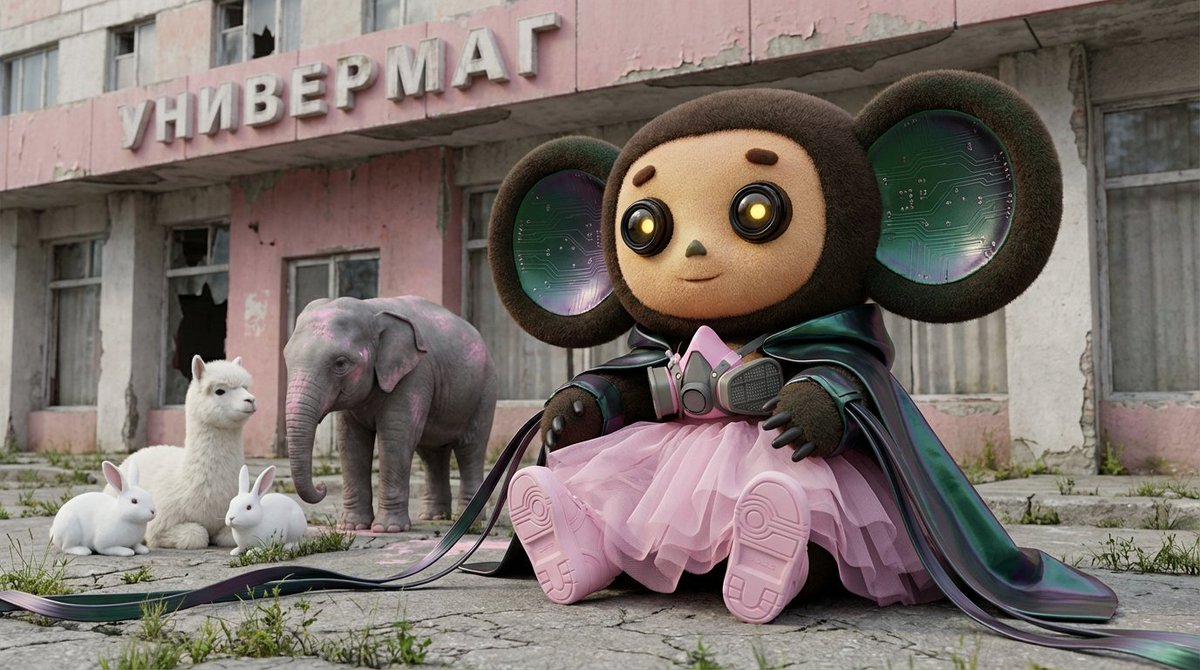
[CONCEPT]A cyberpunk-pastoral hybrid featuring a life-size Cheburashka as a gentle techno-idol. A surreal dreamlike coexistence of post-Soviet nostalgia, kawaii/Harajuku street fashion, and omniscient surveillance infrastructure, set outside an abandoned Khrushchyovka-era retail block.
[SUBJECT & MOTIF]
The Figure: Cheburashka seated casually on cracked concrete. He wears a voluminous layered pink tulle skirt and a dark iridescent teal-green cloak (green-to-purple shifts) draped like ceremonial armor.
Cybernetic Details: Oversized ears wrapped in dark green iridescent panels with fine PCB trace inlays. Eyes replaced by twin glossy black camera lenses. He wears chunky pastel pink sneakers with molded panels and has a pink-crested gas mask hanging loosely around his neck. Heavy ribbon cables trail from his arms across the pavement.
The Menagerie: Resting peacefully on the left are two pristine white rabbits and a white alpaca. Behind them stands a small, calm gray elephant, its deeply wrinkled skin dusted with faint pink chalk.
Background: A faded pink Soviet-era storefront with partially visible Cyrillic "Универмаг" blocky signage, weathered plaster, and a pink awning.
[COMPOSITION & PERSPECTIVE]Low-angle, ground-level shot at pavement height. Naturalistic single-point perspective (~35–50mm focal length, no distortion). Composition reads left-to-right: the elephant adds vertical weight on the left, leading to the clustered animals and Cheburashka on the right. Shallow-to-moderate depth of field keeps the foreground sharp while the storefront softens slightly.
[STYLE & MEDIUM]High-fidelity 3D PBR render (Unreal Engine / Octane-level quality). Photorealistic material simulation. The style merges Japanese street fashion and post-apocalyptic surveillance aesthetics into a highly detailed 3D artwork.
[COLOR & LIGHT]
Palette: High saturation pastel pinks and cool iridescent greens/cyans against a desaturated environment (muted concrete gray).
Lighting: Soft, overcast diffused daylight providing even ambient fill with no harsh shadows. Directional light catches the green-to-purple specular shifts on the cloak. A faint sickly amber glow bleeds from the camera-lens eyes.
[TEXTURE & FORM LANGUAGE]Contrasting tactility: stiff voluminous tulle, soft matte fur, thick crosshatched elephant skin, molded plastic sneakers, and rough gritty concrete with weed cracks. Hard-edged mechanical PCB traces contrast with organic, soft-toy rounded macro-forms.
[MOOD]Quietly surreal, whimsical, and oddly peaceful. A gentle absurdity where the tension between childhood innocence and dark surveillance is muted into a calm, inviting pastoral scene.
[CONCEPT]A theatrically absurd and slightly uncanny allegorical scene of a failed or imaginary negotiation. A grandiose but deflated leader-figure is caught in a moment of dramatic stasis, suspended between power and collapse, reflecting a "doubled" psychological state through a layered, echoing composition.
[SUBJECT & MOTIF]The Figure: An elderly, heavyset man with an orange-tan complexion, voluminous swept-back blonde hair, small squinting eyes, and a prominent double chin. He wears a crumpled black tuxedo with a disproportionately large red silk tie.
The Action: Slumped behind a massive oak table, one hand gripping a golden rotary phone, the other gesturing mid-monologue to an empty chair.
The Environment: A table littered with overturned shot glasses, a half-empty vodka bottle, scattered classified folders, and a wilting bouquet of red roses. A bald eagle perches impassively on a chandelier above.
The Motif: A "doubled" quality to the render, suggesting an inner/outer self or a glitching reality.
[STYLE & MEDIUM]Hyper-realistic 3D render output with tangible physical weight. Subdivision-smooth geometry and pronounced surface fidelity. This is photoreal CGI, not illustration. Think high-end Blender/Cycles or Cinema 4D/Octane presentation. The aesthetic is "fabricated object under studio lights."
[COMPOSITION & PERSPECTIVE]Cinematic wide aspect ratio (~16:9). A centered but cluttered midground focus. Shallow-to-medium depth of field keeps the man and the table sharp, while the ornate background and the eagle on the chandelier soften into a volumetric haze. Ray-traced reflections on the polished oak and glass surfaces create a sense of recursive depth.
[LIGHTING & COLOR]Controlled studio lighting with cinematic color grading. Strong PBR material layering:
Subsurface scattering on the orange-tan skin for a lifelike (yet uncanny) glow.
Ray-traced global illumination capturing the amber glints of vodka and the gold of the phone.
High Contrast: Deep shadows in the tuxedo folds versus bright, specular highlights on the silk tie and polished metal.
Post-processing: Subtle bloom, organic film grain, and rich, weighted shadows.
[TEXTURE & TECHNICAL]Exceptional detail density: fine micro-texture on matte fabrics, wood grain on the massive table, and crisp edges on the paper folders. Smooth anti-aliasing and zero render artifacts. The texture of the "wilting" roses should contrast with the "hard" glossy surfaces of the glasses and phone.
[MOOD]Grandiose yet hollow. The atmosphere is heavy with psychological weight—a performance for an audience that isn't there. A mix of political satire and high-end digital art.
<medium>High-end 3D render / CGI combining photoreal volumetric fluid simulation with translucent surface geometry and emissive line-work elements. Mixed-media sculptural object composited into a clean studio environment. Rendering emphasizes accurate subsurface scattering, volumetric plasma, refractive membranes, and crisp vector-like luminous accents layered over organic flow.</medium>
<style>Contemporary speculative-sculpture aesthetic crossed with editorial tech-brand concept imagery. Echoes of new-media art (teamLab, Refik Anadol) and post-internet luminous sculpture. Clean studio minimalism frames a maximalist luminous core, with shape grammar dialoguing between fluid biomorphism and schematic wireframe precision. Polished, premium, gallery-grade presentation.</style>
<light>Crisp, clean studio lighting — soft key from above-front, gentle fill, and a subtle rim for sculpt — shaping the object without harshness. Primary visual illumination is still self-emissive: the sculpture glows from within, casting soft blue-violet spill onto the nearby studio floor. Balanced exposure with bright localized highlights in the plasma core and controlled falloff around it.</light>
<subject_form_motif>Two figures in an outdoor urban setting: a young woman standing and aiming or inspecting a rifle (appears to be an AK-type weapon) upward, and a man seated on the ground with a white bandage wrapped around his head, dressed in military or combat-style clothing. Shrubs and trees partially frame the background. A third figure may be partially visible at the far left edge.</subject_form_motif>
<composition>Vertical portrait orientation with a slight asymmetry. The standing figure dominates the right-center of the frame while the seated figure occupies the lower left, creating a diagonal tension between the two subjects. Negative space above is occupied by trees and a blurred background structure. The eye moves from the seated man upward to the weapon.</composition>
<form_language>Geometric-organic tension is the core formal principle. Rigid cubic units aggregate into a fluid organic silhouette. The gradient of cube density — tight at center, sparse at edges — creates a visual rhythm from solid to void. The form language borrows from voxel rendering and particle physics simultaneously. Each cube is identical yet the ensemble produces emergent complexity. The walking gesture introduces curvilinear implied lines through an exclusively rectilinear vocabulary. </form_language>
[CONCEPT]A provocative political allegory merging orchestral conducting with high-scale warfare. A maestro stands on a central podium, arms raised, directing a "symphony" of soldiers who launch missiles and rockets instead of playing instruments. War is framed as a choreographed, aestheticized performance staged in a monumental, coliseum-like arena.
[SUBJECT & MOTIF]Central Figure: A conductor in formal attire, silhouetted from behind, baton acting as a command weapon.
Action: Military operatives fanned out in a radial formation, launching projectiles that leave rhythmic diagonal trails.
Sky: Musical staff notation arcs across the upper atmosphere, interweaving with the rocket trajectories.
Background: A singular, monolithic command tower rising like a colossal organ pipe.
[COMPOSITION & PERSPECTIVE]Symmetrical, radial composition with a strong central axis. Low-angle "audience" perspective looking up at the conductor to emphasize authority. The curving tiered seating of the arena creates converging lines that funnel focus to the podium. Layered depth: from the sharp foreground maestro to the hazy, atmospheric distant tower.
[STYLE & MEDIUM]Dystopian cinematic realism meets Soviet Constructivist and Fritz Lang's "Metropolis" aesthetics. Digital matte painting style with a blend of painterly brushwork and photorealistic architectural textures. The musical notation is rendered as clean, vector-like linework overlaid on the expressive, smoky atmosphere.
[COLOR & LIGHT]Strictly monochromatic grayscale (silver gelatin print aesthetic). High contrast: luminous white projectile trails and glowing musical notes against deep black arena shadows. Dramatic backlighting from the sky silhouettes the figures, while volumetric haze and smoke scatter the light, creating a "sublime horror" atmosphere.
[MOOD & TEXTURE]Ominous grandeur and dark irony. The mood is cold, authoritarian, and elegantly terrifying. Textures range from gritty, weathered arena stone to the smooth, blurred motion of ascending missiles. The scene is a "corrupted" documentary of a grand, violent ritual.




![Pixbench's tweet photo. [CONCEPT] A colossal nuclear detonation witnessed from kilometers away, where the monumental mushroom cloud is constructed entirely from tangled cabling and infrastructure. A terrifying fusion of raw, annihilating energy and infrastructure-horror, capturing the bleak, terminal stillness of historical nuclear test photography.
[SUBJECT & MOTIF]
The Mushroom Cloud: A monumental columnar stem and massive roiling cap dwarfing the distant horizon. From afar, it reads as a solid, luminous, turbulent mass; only faint thread-like filaments and linear striations betray its actual substrate of wire and conduit.
The Shockwave: A visible shockwave ring—rendered as a disc of near-transparent, gossamer wire mesh—races outward, compressing dust and light.
The Environment: A flat, dark, and featureless ground plane stretches endlessly toward the distant fireball, beneath an irradiated sky.
[COMPOSITION & PERSPECTIVE] Centered, vertically dominant composition. Shot from a low, ground-level vantage point several kilometers away. A telephoto lens (200mm+) aggressively compresses the spatial planes, flattening the depth and making the towering mushroom cloud loom impossibly large in the upper two-thirds of the frame. Massive negative space emphasizes monumental isolation.
[STYLE & MEDIUM] High-fidelity digital photograph or meticulous composite mimicking actual nuclear test photography (e.g., Operation Crossroads, Ivy Mike). The aesthetic is the documentary-industrial sublime—William Gibson's maximalism fused with Refik Anadol's data-sculpture, but captured with stark photographic naturalism. Must NOT look like a visible 3D render.
[COLOR & LIGHT]
Palette: Overwhelming nuclear flash dominating the scene. White-hot cores bleeding into pale yellows and searing blue-whites, fading into deep navy at the sky's extreme edges.
Lighting: Extreme high dynamic range. Blinding internal luminescence backlit through the wire mass. The horizon is saturated with sickly pale radiance, while the ground remains near-black. Scattered, dim indicator LEDs (green, amber, red) are barely visible in the dark outer folds, like dying vital signs.
[TEXTURE & FORM LANGUAGE] At macro scale, the form is purely nuclear: a heavy toroidal cap and columnar stem. Individual cables dissolve into voluminous billowing mass, leaving only faint vermicular striations as textural evidence of the wire. Loose strands fray at the edges like ionized debris. The shockwave appears as refractive distortion, and the ground is a smooth, matte plane.
[MOOD] Awe, dread, and monumental vulnerability. The profound, terminal silence of an annihilation event before the shockwave arrives. An uncanny "wrongness" where the viewer slowly realizes the plasma is actually woven infrastructure.](https://pbs.twimg.com/media/HII9QhKX0AAxgWu.jpg)
![Pixbench's tweet photo. [CONCEPT] A surrealist Schrödinger's-paradox allegory rendered as a 1930s Dada-era political photomontage. A transparent, glass-walled Kaaba acts as a quantum observation chamber, sealing the floating, disembodied head of an Iranian-style cleric in a superimposed state of life and death.
[SUBJECT & MOTIF]
The Vitrine: A centered, translucent glass Kaaba preserving its traditional cubic proportions, complete with a transparent kiswah veil, a closed door, and a halftone gold hizam band. Built from clipped photographic plates with thick refractive panes, dust, and smudges.
The Cleric: Suspended at the geometric center is the severed head of an elderly Shia cleric (gaunt face, wire-frame glasses, snow-white beard, matte-black sayyid turban, charcoal robe, striped scarf).
The Paradox: The head is cut from a press photo and rendered in TWO superimposed states via mechanical silkscreen mis-registration: one alive (eyes open, flushed), one dead (eyes closed, sunken, corpse-grey).
[COMPOSITION & PERSPECTIVE] Centered, symmetrical, and iconographic. Frontal, eye-level viewpoint. The transparent Kaaba serves as the geometric anchor. Concentric rings of torn paper edges, ripped halftone fragments, and mis-registered print bands radiate outward in the tradition of John Heartfield. Shallow staged depth against a backdrop of densely packed cut-outs, printed noise, and faint architectural lattice.
[STYLE & MEDIUM] Strictly analog mid-century Dada/Surrealist political collage. Absolutely NO digital artifacts (no glitch, no RGB shift, no datamoshing, no pixel noise). Hand-assembled aesthetic featuring visible scissor-cut edges, glue shadows, mechanical print offset, smeared printer's ink, and aged newsprint grain. Must read unmistakably as a scanned 1930s anti-fascist protest magazine.
[COLOR & LIGHT] Strictly monochromatic (full grayscale range from deep blacks to near-white highlights, zero color). High tonal contrast between dark fabrics/ink and bright glass highlights. Diffuse, overcast-style illumination mimicking a flat printed page with posterized light falloff.
[TEXTURE & FORM LANGUAGE] Tactile analog print textures: coarse halftone dots, smooth photographic grain turned into posterized bands, soft wool, thick glass, and ripped paper. The strict, unyielding cubic geometry of the glass Kaaba contrasts with the organic, rounded human masses (turban, beard), which are further fractured by shattered rectilinear paper grids.
[MOOD] Ominous, portentous, and darkly theatrical. A monumental editorial warning poster charged with dread. Reverence and decay are held together in a ghostly, unresolved paradox—power suspended in superposition until observed.](https://pbs.twimg.com/media/HH8tSXNXUAECa0R.jpg)
![Pixbench's tweet photo. [CONCEPT]A cyberpunk-pastoral hybrid featuring a life-size Cheburashka as a gentle techno-idol. A surreal dreamlike coexistence of post-Soviet nostalgia, kawaii/Harajuku street fashion, and omniscient surveillance infrastructure, set outside an abandoned Khrushchyovka-era retail block.
[SUBJECT & MOTIF]
The Figure: Cheburashka seated casually on cracked concrete. He wears a voluminous layered pink tulle skirt and a dark iridescent teal-green cloak (green-to-purple shifts) draped like ceremonial armor.
Cybernetic Details: Oversized ears wrapped in dark green iridescent panels with fine PCB trace inlays. Eyes replaced by twin glossy black camera lenses. He wears chunky pastel pink sneakers with molded panels and has a pink-crested gas mask hanging loosely around his neck. Heavy ribbon cables trail from his arms across the pavement.
The Menagerie: Resting peacefully on the left are two pristine white rabbits and a white alpaca. Behind them stands a small, calm gray elephant, its deeply wrinkled skin dusted with faint pink chalk.
Background: A faded pink Soviet-era storefront with partially visible Cyrillic "Универмаг" blocky signage, weathered plaster, and a pink awning.
[COMPOSITION & PERSPECTIVE]Low-angle, ground-level shot at pavement height. Naturalistic single-point perspective (~35–50mm focal length, no distortion). Composition reads left-to-right: the elephant adds vertical weight on the left, leading to the clustered animals and Cheburashka on the right. Shallow-to-moderate depth of field keeps the foreground sharp while the storefront softens slightly.
[STYLE & MEDIUM]High-fidelity 3D PBR render (Unreal Engine / Octane-level quality). Photorealistic material simulation. The style merges Japanese street fashion and post-apocalyptic surveillance aesthetics into a highly detailed 3D artwork.
[COLOR & LIGHT]
Palette: High saturation pastel pinks and cool iridescent greens/cyans against a desaturated environment (muted concrete gray).
Lighting: Soft, overcast diffused daylight providing even ambient fill with no harsh shadows. Directional light catches the green-to-purple specular shifts on the cloak. A faint sickly amber glow bleeds from the camera-lens eyes.
[TEXTURE & FORM LANGUAGE]Contrasting tactility: stiff voluminous tulle, soft matte fur, thick crosshatched elephant skin, molded plastic sneakers, and rough gritty concrete with weed cracks. Hard-edged mechanical PCB traces contrast with organic, soft-toy rounded macro-forms.
[MOOD]Quietly surreal, whimsical, and oddly peaceful. A gentle absurdity where the tension between childhood innocence and dark surveillance is muted into a calm, inviting pastoral scene.](https://pbs.twimg.com/media/HHohFbfXYAQ2IAZ.jpg)
![Pixbench's tweet photo. [CONCEPT]A theatrically absurd and slightly uncanny allegorical scene of a failed or imaginary negotiation. A grandiose but deflated leader-figure is caught in a moment of dramatic stasis, suspended between power and collapse, reflecting a "doubled" psychological state through a layered, echoing composition.
[SUBJECT & MOTIF]The Figure: An elderly, heavyset man with an orange-tan complexion, voluminous swept-back blonde hair, small squinting eyes, and a prominent double chin. He wears a crumpled black tuxedo with a disproportionately large red silk tie.
The Action: Slumped behind a massive oak table, one hand gripping a golden rotary phone, the other gesturing mid-monologue to an empty chair.
The Environment: A table littered with overturned shot glasses, a half-empty vodka bottle, scattered classified folders, and a wilting bouquet of red roses. A bald eagle perches impassively on a chandelier above.
The Motif: A "doubled" quality to the render, suggesting an inner/outer self or a glitching reality.
[STYLE & MEDIUM]Hyper-realistic 3D render output with tangible physical weight. Subdivision-smooth geometry and pronounced surface fidelity. This is photoreal CGI, not illustration. Think high-end Blender/Cycles or Cinema 4D/Octane presentation. The aesthetic is "fabricated object under studio lights."
[COMPOSITION & PERSPECTIVE]Cinematic wide aspect ratio (~16:9). A centered but cluttered midground focus. Shallow-to-medium depth of field keeps the man and the table sharp, while the ornate background and the eagle on the chandelier soften into a volumetric haze. Ray-traced reflections on the polished oak and glass surfaces create a sense of recursive depth.
[LIGHTING & COLOR]Controlled studio lighting with cinematic color grading. Strong PBR material layering:
Subsurface scattering on the orange-tan skin for a lifelike (yet uncanny) glow.
Ray-traced global illumination capturing the amber glints of vodka and the gold of the phone.
High Contrast: Deep shadows in the tuxedo folds versus bright, specular highlights on the silk tie and polished metal.
Post-processing: Subtle bloom, organic film grain, and rich, weighted shadows.
[TEXTURE & TECHNICAL]Exceptional detail density: fine micro-texture on matte fabrics, wood grain on the massive table, and crisp edges on the paper folders. Smooth anti-aliasing and zero render artifacts. The texture of the "wilting" roses should contrast with the "hard" glossy surfaces of the glasses and phone.
[MOOD]Grandiose yet hollow. The atmosphere is heavy with psychological weight—a performance for an audience that isn't there. A mix of political satire and high-end digital art.](https://pbs.twimg.com/media/HHeQ1HnXoAE1-dV.jpg)


![Pixbench's tweet photo. [CONCEPT]A provocative political allegory merging orchestral conducting with high-scale warfare. A maestro stands on a central podium, arms raised, directing a "symphony" of soldiers who launch missiles and rockets instead of playing instruments. War is framed as a choreographed, aestheticized performance staged in a monumental, coliseum-like arena.
[SUBJECT & MOTIF]Central Figure: A conductor in formal attire, silhouetted from behind, baton acting as a command weapon.
Action: Military operatives fanned out in a radial formation, launching projectiles that leave rhythmic diagonal trails.
Sky: Musical staff notation arcs across the upper atmosphere, interweaving with the rocket trajectories.
Background: A singular, monolithic command tower rising like a colossal organ pipe.
[COMPOSITION & PERSPECTIVE]Symmetrical, radial composition with a strong central axis. Low-angle "audience" perspective looking up at the conductor to emphasize authority. The curving tiered seating of the arena creates converging lines that funnel focus to the podium. Layered depth: from the sharp foreground maestro to the hazy, atmospheric distant tower.
[STYLE & MEDIUM]Dystopian cinematic realism meets Soviet Constructivist and Fritz Lang's "Metropolis" aesthetics. Digital matte painting style with a blend of painterly brushwork and photorealistic architectural textures. The musical notation is rendered as clean, vector-like linework overlaid on the expressive, smoky atmosphere.
[COLOR & LIGHT]Strictly monochromatic grayscale (silver gelatin print aesthetic). High contrast: luminous white projectile trails and glowing musical notes against deep black arena shadows. Dramatic backlighting from the sky silhouettes the figures, while volumetric haze and smoke scatter the light, creating a "sublime horror" atmosphere.
[MOOD & TEXTURE]Ominous grandeur and dark irony. The mood is cold, authoritarian, and elegantly terrifying. Textures range from gritty, weathered arena stone to the smooth, blurred motion of ascending missiles. The scene is a "corrupted" documentary of a grand, violent ritual.](https://pbs.twimg.com/media/HHJJKywW4AAq5aB.jpg)





