https://t.co/iVQ8jKKMQ1 now supports subscriptions, built on Solana's new Subscriptions & Allowances program
Providers can now offer pay-per-call or recurring flat-fee access for https://t.co/iVQ8jKKMQ1 endpoints
More flexibility for agentic commerce on Solana
There's a quiet crisis happening in Solana's validator set. Most people aren't talking about it.
Over a third of active validators on Solana are running at a loss, not just a lil bit, i mean actually losing money, every single epoch, before anyone on the team gets paid.
Let that sit for a second.
Here's how validator economics actually work.
Running a Solana validator is a fixed-cost business with wildly variable revenue.
Every validator on the network pays roughly the same vote costs; around 394 SOL a year, regardless of how much stake they have. Server costs run between $9,600 and $14,400 a year for bare metal. Those numbers don't move much whether you have 10,000 SOL staked or 10 million.
Revenue is a completely different story.
There are three ways a validator makes money: block rewards from inflation, MEV revenue through Jito, and priority fees. The first two scale reasonably with stake. The third one doesn't.
The top 10% of validators capture 69% of all priority fee revenue on the network. The top 1% alone take 25%.
A top-50 validator earns around 7,500 SOL a year just from priority fees. A mid-tier validator earns around 500. A smaller operator at the bottom? Around 80 SOL a year. Same network. Same work. Ninety times less revenue.
Run the numbers and it gets uncomfortable fast.
24% of active validators don't earn enough to cover their vote costs alone, the single unavoidable expense every validator pays just to participate. 35% don't cover vote costs plus server costs combined.
More than one in three validators are subsidising the network out of their own pocket.
These aren't bad operators. Most of them are builders, people shipping open-source tooling, writing documentation, running community nodes, contributing code. They're doing exactly what a healthy ecosystem needs. And they're slowly going broke doing it.
The reason this matters goes beyond individual validators struggling.
When a validator shuts down, their stake doesn't disappear, it flows somewhere else. Usually upward, to the larger operators already doing well. Stake concentrates. The network's Nakamoto Coefficient drops. And as that number falls, Solana becomes easier to halt, censor, or manipulate, because fewer and fewer entities control the consensus.
This isn't a hypothetical. It's a slow, structural process already underway. The validator set looks healthy on the surface until you look at where the economics are actually pushing things.
This is the problem Phase has been trying to solve since 2021. Their delegation program; Phase Delegation, manages over $700M in staked assets and allocates it across 91 active validators using a scoring system called the Index Power Score.
But the most important thing about that scoring system isn't the size. It's the logic behind one specific category; The Sustainability Score.
Phase simulates each validator's annual P&L, every revenue stream, every cost and the closer a validator's profit is to zero, the higher their sustainability score. The validators closest to breaking even get the most delegation. Not the ones already thriving. The ones who need it to stay alive.
It's one of the most quietly thoughtful incentive designs in the ecosystem. Instead of rewarding success, it funds survival. Instead of making the rich richer, it keeps the contributors contributing.
The economics problem in Solana's validator set isn't going to fix itself. Market forces alone push stake toward the biggest operators. Without something actively working against that gravity, concentration wins by default.
Phase is one of the few teams treating delegation as a tool, something with intention and direction behind it, rather than just a passive output of staking mechanics.
The validators building this ecosystem deserve to stay in business. The network is better when they do.
That's not a controversial opinion. It's just math.
@phase_ is doing something about it.
Solana is about to clear ~61% of its transactions off-chain, freeing block space for real economic activity.
Validator votes currently make up roughly 61% of transactions. They take up block space and create no economic value beyond consensus.
Alpenglow moves voting fully off-chain.
What's left is real activity: transfers, swaps, mints, and program calls. The network is already capacity-constrained where it counts, with P90 blocks this year running near 95% of the 60M compute unit cap.
Alpenglow frees space by taking votes off-chain, and a proposed cap raise to 100M would add even more headroom.
Vote fees change too. Validators currently pay ~1.1 SOL/day. Alpenglow replaces that with a ~0.8 SOL/day Validator Admission Ticket, fully burned.
This enables cleaner tokenomics, stronger burn, a lower cost floor to run a validator.
Lowering the floor matters. Solana's validator count has fallen from ~2,500 in 2023 to under 800 today, largely because vote-fee economics squeezed out smaller operators.
Alpenglow reverses that pressure.
We've operated Solana validators through every upgrade since 2023, and Alpenglow is the first true consensus shift.
TowerBFT and Proof-of-History both retire, and the second-order impacts on throughput, and validator economics reshape what's possible.
The network on the other side will look meaningfully different.
I created the first SPL token on the alpenglow community cluster: https://t.co/D2wy0xiUIA I have airdropped 420.69 of them to the genesis validator set
YIELD is now Live on P0 🎉
• An incentivized, high-yield LST (2.5 $YIELD weekly)
Uniquely collateralize $YIELD with your Kamino, Jupiter Lend, & P0-native collateral — giving you unified margin across all venues ✨
Artemis II carried four astronauts farther from Earth than any human in over half a century.
From up there, the planet reads as one system.
Phase Delegation's validator map is the same view for @solana.
Stake, location, and performance, all in one frame.
The Alpenglow community cluster is live and producing blocks!
Phase operates one of the genesis validators.
Alpenglow feature gates and functionality will be enabled in the coming days and weeks
The biggest consensus upgrade since @solana launched, now running on real infrastructure.
$YIELD, a liquid staking token that combines native staking rewards with Phase's business revenue to deliver boosted APY.
Not just staking yield.
Actual revenue-backed yield.
45.87% APY last epoch, 0% MEV commissions.
Beyond Speculation with @solflare is a wrap!
Builders came through, great conversations happened, and the people showed up and donated over $6,000 to @standwithcrypto and @KidsCanNZ through @donatedotgg.
This is what @solana looks like when the community shows up for something bigger than themselves.
A huge thank you to all of our sponsors, and every single person who tuned in, donated, or shared.
And @hash_on_hash? Ran 30+ miles today, an absolute legend.
Today showed that if you build with intention, you'll be proud of every minute of it. 🏃♂️
Beyond Speculation.
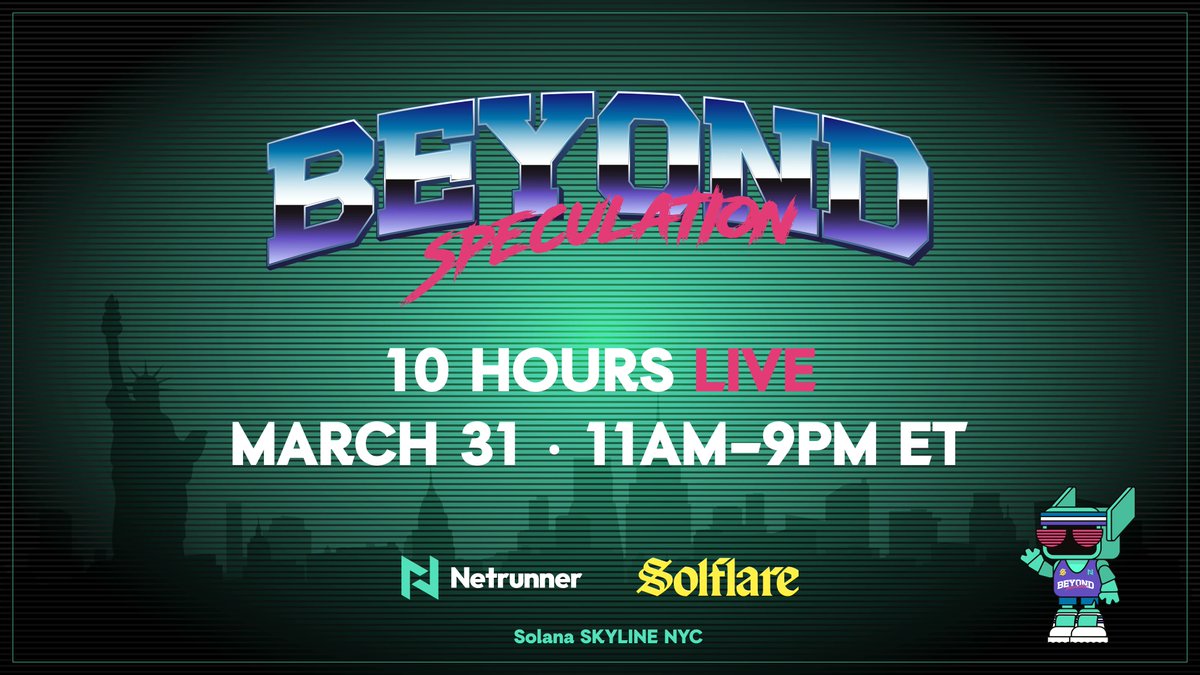
10 hours LIVE. March 31st. 11AM–9PM ET.
We’re taking over Solana SKYLINE NYC with @solflare, and we’re bringing the whole @solana ecosystem with us.
Every conversation goes deeper than price.
This is not your typical livestream. ↓