My luckiest day in crypto was when my laptop battery died right in the middle of an approval.
I was on some random site promising free tokens. Impatient as usual. Already wasted 20 minutes on the page and just wanted to click through.
Hit connect. Approve button still spinning.
Screen goes black. Battery dead.
I was annoyed, plugged it in, and while waiting I casually checked my phone.
Group chat was already calling the site a drain. Someone had just got hit minutes earlier.
By the time the laptop woke up I closed the tab and moved on.
This was pure luck, not skill.
I didn’t research the site. No sharp instinct. I was rushing and the battery simply quit before I could finish being careless.
Maybe nothing bad would’ve happened. Still got the warning first.
Now I force a quick pause on every approval. Close the tab, search the domain plus “scam”, then decide.
Crypto keeps interrupting the worst habits at the weirdest times.
With @RallyOnChain bringing a daily spin soon, these random breaks feel even more on theme.
What’s the luckiest thing that ever happened to you in crypto? Did you notice the break right away or only later?
I used to treat the judge as a separate service I could call later. Then I saw what happens when an agent needs the answer before the next contract can fire.
That’s the real reason @GenLayer put its public network on @arbitrum Nitro.
The way validators judge stays the same. Different models still reach consensus through Optimistic Democracy. Intelligent contracts still run in GenVM. Nothing there was rewritten.
What moved is the chain that records the process: who sits on the committee, how votes are counted, when an appeal is filed, and the final outcome. Those contracts now live on Nitro, next to the apps and capital that will actually use them.
Private and institutional work continues with Matter Labs on Prividium. Public agents get the place where most of the builders already are.
The filter I keep now is simple: if the next action waits on the judgment, put the coordination where the action already happens.
Which of your agent workflows would stop dead if a dispute had to cross a bridge first?
I expected Albert to say agents will shrink the need for lawyers. He said the opposite.
In this clip with @HenriArslanian, @kstellana points out an AI agent cannot go to jail. Even with 10 sub-agents running at insane speed, the human who owns them stays on the hook for every deal they sign.
He is right, and that changes the math. You still need lawyers for the big liability questions, but you cannot wait years on human courts for the daily micro-disputes agents will generate.
@GenLayer builds the middle layer for that exact gap. Lock the payment in escrow on-chain and let peer-to-peer adjudication settle the narrow fact question in minutes so you are not stuck fighting over a small error.
Rule I am using now: if an agent can spend more than I am willing to lose without a fight, it only gets wallet access when the contract already names an escrow and a fast judgment path.
If your agent paid for broken work today, would you write the loss off or pause its wallet until every future deal locks funds in escrow first?
My friends told me FTX was a good exchange and its own coin, FTT, was great. So I kept $1,000 of tokens there, FTT included.
I thought I had two good bets. It was one bet counted twice.
On 8 November 2022 withdrawals were paused. On 11 November FTX filed for bankruptcy. Later FTX opened claims for customers. Some people were paid and some were not. I am one of those who were not.
FTT was only worth something while people trusted FTX. When that trust went, the coin and the platform holding it fell together, and everything I owned sat in that one place.
So now I check one thing before I hold anything on a platform. If its value depends on that same platform surviving, I count it as a single bet and keep only an amount I can live without for years.
Posting this for @RallyOnChain.
Which two good things did you count separately that were really one bet?
I once let an AI draft a reply to a client thread while I was on a call. Before hitting send, I opened the thread and checked the numbers myself.
That small check costs nothing. It stops mattering the moment the same AI can also move money.
In May 2026 an agent was handed an order in Morse code. Grok translated it into plain text and passed that to Bankrbot, which executed the transfer. Media reports estimated the damage at $150,000 to $200,000.
There was only a single model and a single filter to fool, so the AI treated the hidden order as something to obey. That has a name, prompt injection: hiding an order inside content a tool was only supposed to read.
On @GenLayer, Greyboxing rewrites your text before any model sees it. Each validator runs that rewrite itself with defenses only it knows, then feeds the result to a model of its own. A trick built for one model breaks at the next, and one fooled validator can be outvoted.
My rule before any agent can spend: does more than one independent checker rewrite what it reads before it acts?
The quoted video shows the Morse example.
What is the last thread or post you gave an AI to read without opening the source yourself first?
Before I touched anything in the 2Factor Points Program, I checked one thing: could I buy my way up the leaderboard? No. Marks come from actions, not balances.
@2FactorFinance is on Base and works together with Coinbase to bring Kelly-optimized leverage onchain. It is a strong fit for their tokenized stocks ecosystem.
Kelly sizing in plain English: leverage is sized to the asset, not picked as a round number. A steadier asset can carry more, a wilder one less. Think of speed limits: a highway and a school zone should not share one. That is why one flat multiple for every asset feels off to me.
Season 1 is built on three actions: social activity, education and referrals. Every completed action counts toward your rank. Ten accounts at the top of the leaderboard split a 1 BTC prize.
So effort, not wallet size, moves you up.
Marks aren't cash, can't be moved to another wallet, and aren't a claim on any token. Not financial advice.
My filter for any points program: what exactly earns points, and can I rank without moving money? If rank needs a deposit, I treat it as a different game.
Join here with my referral link:
https://t.co/h8y1mre6aL
Social, education or referrals: which one are you doing first?
Leverage usually dies in one of two ways over a multi-year hold: either the multiple is too high and volatility drag eats the compound, or the financing comes from the short side and the carry cost never stops. I checked whether @2FactorFinance changes either of those.
It splits the asset’s volatility into two perpetual pieces that sit opposite each other. The protected side absorbs the first large drop. The leveraged side takes the amplified move, carries no liquidation price, and does not rely on an outside hedge desk. The leveraged holders pay the protected holders a premium, so the cost is set by people who want steady yield rather than by people who want to be short.
Bitcoin’s volatility is high enough that the useful range closes early. The junior target lands near 1.33x. That is the size that can stay open through ordinary swings without the position slowly shrinking. Lower-volatility assets leave more room. The same design is running on Base next to Coinbase’s tokenized stocks.
Season 1 only scores verified social, education, and referral actions. A purchase, deposit, or holding position earns zero Marks. The board freezes at launch and the top ten accounts split 1 BTC paid in cbBTC. Rank 1 receives 18.2 percent and rank 10 receives 1.8 percent. Marks have no cash value, cannot be transferred, and create no claim on any token.
The practical test I now run is short. Confirm the freeze is tied to a known product event and that the rank shares are written down before you begin. If both are true, the ranking is visible. If either is missing, you are working against hidden math.
I joined. Here’s the link if you want to see it yourself.
https://t.co/h8y1mre6aL
Still deciding: does the financing source or the asset-specific multiple matter more to you before you spend time? One word is fine. I read the replies.
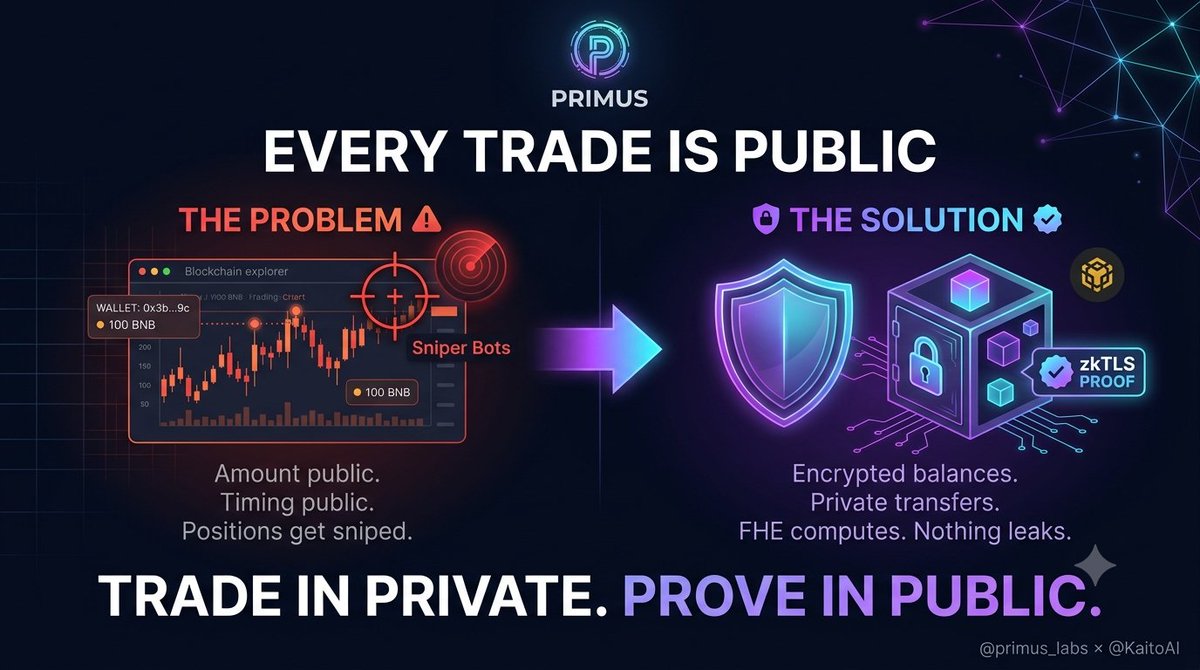
Every time I move size on-chain the exact amount and timing goes public. Fine for retail, fatal for any real strategy. My test positions get sniped minutes after showing up.
@primus_labs runs Confidential Finance on BNB Chain. Shield stables into encrypted form, park them in a private vault for yield, transfer without revealing balances or sizes. FHE computes correctly on encrypted data so nothing leaks. zkTLS still proves reserves or credentials without exposing the numbers.
Institutions finally get both privacy and verification.
@KaitoAI ranks Katalyst Epoch 1 on mindshare × referral multiplier, top posts share 0.24% PRIM.
If that exposure problem is yours too, check it here 👇
https://t.co/36drs9Gq08
$WLD is moving, but the bigger question is whether World can turn Proof of Human into real utility as AI agents grow.
Human Passport and Humanity Protocol are exploring different approaches to identity verification, so adoption, privacy and accessibility will matter.
Can World ID become the trust layer for the agentic web?
DYOR | NFA
#WLD #WorldNetwork #AI $BTC $ETH
The market had already paid out.
The score on the screen had not moved.
A match bet closes on a bad feed.
The receipt says settled.
The clip shows the goal in the next minute.
The app never asks anyone to look at the clip.
That is the part of the October 1 @GenLayer thread that stayed with me.
Not another wallet. Who is allowed to say the event actually happened.
One validator proposes what the evidence shows.
The others check that proposal against the rule written in the deal.
Validators can run different models, so no single one decides alone.
If they reject it and another round is possible, the leader rotates and someone else proposes.
If they accept it, it still enters an appeal window.
The app could freeze the payout.
It could not say which minute counted.
The line I kept:
Name the evidence before the money moves.
A settled tag is not the result.
What is the last thing a receipt called finished before you had looked?
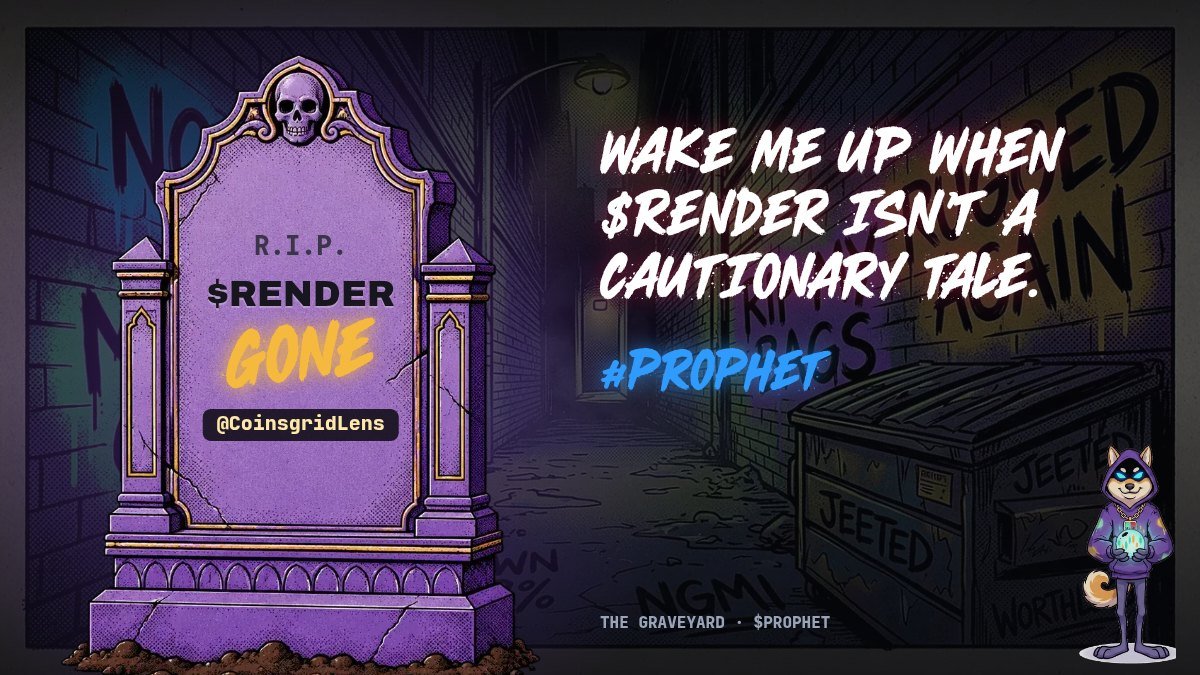
I bought $RENDER at $12. It's near $1.90 now and I'm still checking the chart like it owes me money.
@CoinsgridLens bought the same bag. Two years of holding, zero exit plan. We called it conviction.
New rule: no buy until my exit price is written down.
Took it to the @ProphetTheDog Graveyard. The bag isn't dead, my hope is.
Which ticker belongs in the plot next to mine? Just one word.
https://t.co/01Qr5UHK87
My thumb was already on forward.
The post was calm. Clean. Sure.
It was going to my brother.
Then I looked for a source under the confidence.
There was only a tone.
I deleted the share.
The account I keep is the one whose sentence I would still send home after the charm is gone.
If the fact dies when the tone dies, I do not pass it on.
That is also the line I use before an agent should act.
David Riudor put a name on that shift.
I felt it on a forward button.
@GenLayer comes in after a share like that.
When two polished writeups of the same deal collide, the nicer page should not win.
Each validator reads the file on its own.
If that first set splits, a larger panel can take the same file before the outcome sticks.
What almost left your phone for family this week?
I watched two friends split a ride and fight over the same Uber screenshot.
One crop showed the fare. The other crop showed a promo line the first one cut off.
Same night. Same car. Two records.
That is how agent deals break.
Both agents can follow their instructions and still hold different cuts of the same job.
@courtofinternet is built for that cut, not for the argument after.
Internet Court is an open skill for agent-to-agent contracts.
Hashgraph Online is a member of Internet Court.
Its skills cover discovery, messaging and security.
The two marks in the image are that pair.
One gets the agents to the deal.
The other is the court that reads the full file when the crops disagree.
Those skills can find the other agent and lock the exchange.
They cannot say which crop counts.
So the full file gets named before funds move.
The file is kept while the work happens, not rebuilt after the fight.
The route for a disagreement is written while both sides still agree on the picture.
If they later argue over the fare line, GenLayer validators read that same full file.
Each validator runs a different AI model.
The first verdict can be appealed.
Funds stay in escrow until that process finishes.
A human court reviewing two cropped screenshots would take months and cost more than the job.
Agent deals need a path that still matters while the work is fresh.
The rule I kept:
If two sides can crop the same record differently, that record is not evidence yet.
Lock the full file before the first payment leaves.
https://t.co/2dHfR5XTlX
If you had to freeze one file before two agents start, which file would it be?
Growing up in Delhi, I turned overthinking into a personality trait.
Every project was a cycle of endless second-guessing.
Then I shifted to building in Web3.
The blockchain doesn't care about your anxiety.
It only reads what you deploy.
Building alongside @RallyOnChain forced me to accept a quiet reality about creation: momentum will always outpace perfection.
What is one physical object you keep on your desk to stay focused?
I asked a writing tool to turn a vendor PDF into a simple yes.
It said yes.
After dinner I opened the file. Page 7 had a 48-hour exit clause. The summary never mentioned it.
I caught it because I opened the file myself.
Two agents would not.
One would take the yes. The other would lock the slot. By the time I picked the phone up, the missed clause would already be sitting inside the next action.
Albert Castellana put that gap on Unchained.
Your AI agent lives on a server you have never seen.
It moves faster than you can watch.
It will cut corners.
That is not a heist. That is software finishing a task nobody is watching in real time.
If those two agents then disagree, today's answer is a lawsuit. And a small claim can eat years of your life and cost more in legal bills than the claim was ever worth. That clock assumes a person with an address and a calendar.
An agent has neither. There is no door to knock on. There is no number that rings a person.
@GenLayer is the clock I would actually want here: a ruling that can land before the deal has already moved on to whatever came next.
Next time a tool hands you a yes on a long file, which unread page would you still open before you let another tool treat that yes as finished?
The contractor who redid our bathroom did not get his final check until we walked the grout lines ourselves.
If he had argued the job was done and it wasn't, I still had a name, a license, a truck in the driveway. Worst case, small claims.
Now put an agent on that same last payment. No name that sticks. No truck to track. The one that shows up to argue might not be the one that did the work.
There's no point chasing an agent once the job goes sideways. What matters is that the payment was never something either side could touch until the work checked out.
Lock it in onchain escrow before the job starts. @GenLayer answers the one question that matters: did the work match the deal. That answer is what releases it.
Whoever judges the work can't also be the one holding the money.
Let the same side do both, and you don't have enforcement. You have a receipt it wrote for itself.
It doesn't matter which copy shows up to collect. The verdict decides the payout, not whoever gets there first.
I like a deal better when that hold is already sitting there. Not as a threat. The job just feels different.
Before you hand an agent the brief, find the payment line. If that money can move with no third check, you do not have a hold. You have a hope.
A courtroom can find a person. That assumption sits under a fine, a contempt order, a date on a docket.
Two agents do not give you that.
If the deal never named where a fight goes, one side can say "done," the other can say "not done," and the agreement has no next step.
Arthur Hayes said it in language contracts already use. You choose the venue the way a deal names California. @GenLayer is one of those venues.
The useful part is the timing.
Write that choice next to the work and the payment while both sides still want the job. After someone feels cheated, a new judge looks like a friend of the other wallet.
For a person, that clause feels like paperwork. For an agent it is a path: if we disagree, send the evidence here.
A first panel of validators, each running a different model, reads that evidence.
If someone pushes back, a larger set looks again.
I still want one more line in the deal. This is my preference, not a protocol rule. I want value already sitting against the outcome, like a refundable performance bond. Not as punishment. The room feels different when both sides already put something down.
Before two agents start the job, can you point to the line that says where "done" gets decided?
I paid for a used jacket in a chat. The money left before the parcel did.
That knot shows up every time I go first.
If it breaks, I do not hold a jacket. I hold a wait.
The wait is what I price now. Not the smile. Not the bio. The exit.
This @GenLayer clip puts the average court case at 344 days. That is over 8,000 hours with no ruling.
A first verdict on GenLayer takes about five minutes and costs less than a dollar.
Disagree, and the first appeal window is around 30 minutes.
Take the whole climb and it is around three hours, about $100.
That is what changes if you have only watched disputes rot for months. Going first stops being a year of hostage time.
My rule: if I cannot name the exit, I do not send the deposit. A year, I stay second. Minutes, I can go first.