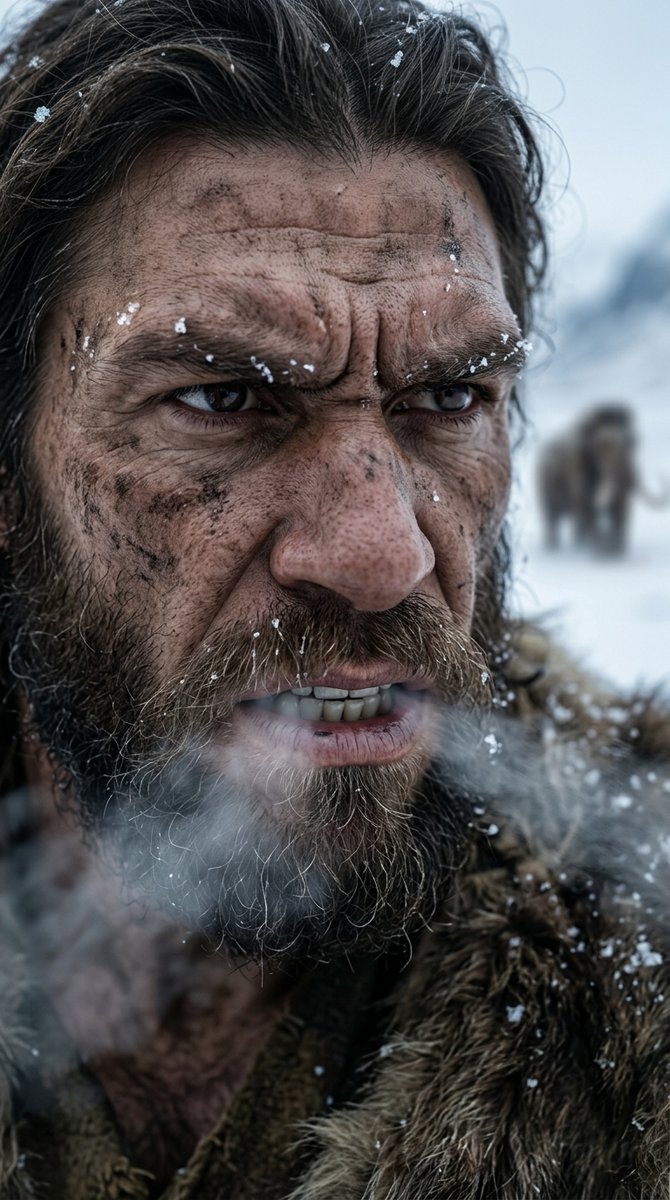
We didn’t just replace them.
We mixed with them.
Today, many humans still carry 1–2% Neanderthal DNA.
Which means…
They’re not truly gone.
So maybe evolution didn’t choose the strongest species.
Maybe it chose the one that could adapt faster.
They didn’t vanish suddenly.
They didn’t collapse overnight.
They slowly… faded away.
Over thousands of years.
Scientists still debate why:
Better communication in humans
Larger social networks
Climate pressure
But there’s one theory that changes everything…
There was a time when survival required more than intelligence. It required courage, coordination, and raw adaptability.
And Homo heidelbergensis had all of it.
Before modern humans ruled the planet. there was another species that mastered survival in a brutal world.
Homo heidelbergensis - one of the most powerful and mysterious human ancestors in history.
Homo heidelbergensis didn’t exactly go extinct.
Instead, they became the ancestors of other human species.
In Europe, they evolved into Neanderthals - known for their strength and resilience.
In Africa, they eventually gave rise to Homo sapiens - modern humans.
Homo erectus - the species that changed everything.
Around 1.9 million years ago, Homo erectus walked upright, crafted advanced tools, and became the first humans to control fire. This single discovery transformed survival - from raw meat to cooked food, from fear to protection.
They didn’t just live… they explored.
Homo erectus became the first human species to leave Africa, spreading across Asia and Europe, adapting to new environments, and shaping the future of humanity.
Around 2 million years ago, in places like Olduvai Gorge, a small, primitive human ancestor made a revolutionary leap - not in strength, but in intelligence.
Homo habilis, known as the handy man, was among the first to create and use stone tools.
These tools allowed early humans to cut meat, break bones, and survive in harsh environments filled with predators.
With a brain larger than apes but smaller than modern humans, this species marked the beginning of strategic thinking, problem-solving, and technological evolution.