Business. Entrepreneurship. Growth. 🇮🇳
Stories of the people & ideas shaping India's future — and the global trends defining tomorrow.
A @PagarBook initiative
But then one may argue that Apple has historically been brilliant at making people 'want' technology they didn't need. Will it play out the same way for Duo or is will it remain a dead horse, only time will tell.
Apple isn’t reinventing the smartphone. It is taking a seven-year-old failed idea, putting an Apple logo on it, and charging ₹2,99,900. Apple wants the 7.6-inch screen to make the Duo a productivity machine. But "a big screen does not turn an iPhone into a computer."
One can run demanding workloads on the Mac, keep the iPhone as communication and mobile-AI device, and let Apple’s ecosystem connect the two. The Duo instead asks you to pay nearly three lakh rupees to make your phone behave slightly more like a tablet.
The world's leading dairy scientists called it impossible: buffalo milk can't be powdered. One innovation proved them wrong, turned surplus milk into a national strategy, and built Operation Flood. By 1998, India overtook the US as the world's largest milk producer.
How a farmer agitation led to India's largest FMCG brand.
A 14-day strike stopped Bombay's milk supply. The British had to negotiate. What came out wasn't a settlement, it was a company owned by the farmers themselves. Today, it outperforms ITC, Tata, and Britannia.
#WhatWorked
90% India orders from their local Kirana, outdated and technologically handicapped. Kirana Club built the tech infrastructure for them, and eventually scaled its base to 4m+ stores.
Recently, Meesho acquired them for ₹202cr, even though their FY26 revenue was barely ₹33lacs.
One of the foremost Indian fintech success stories that enabled safe and secure online transactions Razorpay, founded in 2014, is about to go public. In 2026, with $180B+ worth transactions, it has reached a reported valuation of $6B, which is lower than its peak: $7.5B (2021).
For decades Reynolds 045 ballpoint pen ruled as the marker of salaried class, since its introduction in the 1980s.
On June 10, 2026, India's leading stationery manufacturing company, DOMS, acquired Reynolds India for ₹31 crore, marking its critical leap into pen manufacturing.
The race for 10 minutes delivery is gaining pace every passing moment. That means burning crores every quarter, simply to develop the customer's dependency on them.
But how long will it take & how much can they burn? Or is Dunzo like fate an inevitable eventuality?
Recently Huawei, banned from accessing world's best semiconductor chips, claimed they'll match it anyway.
They won't be smuggling machines or stealing designs but rather rewriting the rules of how chips work.
Back in 2019, Washington essentially ordered every stakeholder of semiconductor industry to ban China. The plan was simple, cut the supply chain & starve the company. Huawei's smartphone share collapsed from 20% globally to under 4%, and obituaries were penned.
Then in 2023, a phone appeared on Chinese shelves running a 5G chip the world had agreed China couldn't make. Analysts tore it apart and went quiet for a moment. SMIC, China's domestic foundry, had built a 7nm chip without the EUV machines.
The sanctions backfired as Huawei poured $170 billion in R&D. Now they are making an even more audacious claim. In next five years, they aim to produce a chip that is equivalent to 1.4nm chip in performance, without using the banned machines.
How they plan to do so without geometrically shrinking the transistors (as per the conventional Moore's Law)?
They rather argue what if chips got faster by moving signals through them quicker. That's the Tau Scaling Law. A different question than the one the entire industry has been asking for sixty years, with the deadline of 2031.
For context, TSMC, the best chipmaker on earth, won't hit actual 1.4nm until 2028. Equivalent to is doing a lot of work in that sentence, and Huawei knows it.
No independent lab has verified the Chinese claim. Until something concrete lands on the table, it seems to be an extraordinary promise. But this company does have a recent history of delivering on extraordinary promises.
The part that should make Washington uncomfortable is that the ban was supposed to be a ceiling.
Huawei built a staircase under it.
@bhash While gig ecosystem is the right place to start as its economics work with high daily runs, fixed routes. The bigger challenge is freight. Trucks alone consume 64% of India's diesel. Until we electrify freight corridors, we are far away from our goal of energy self-sufficiency.
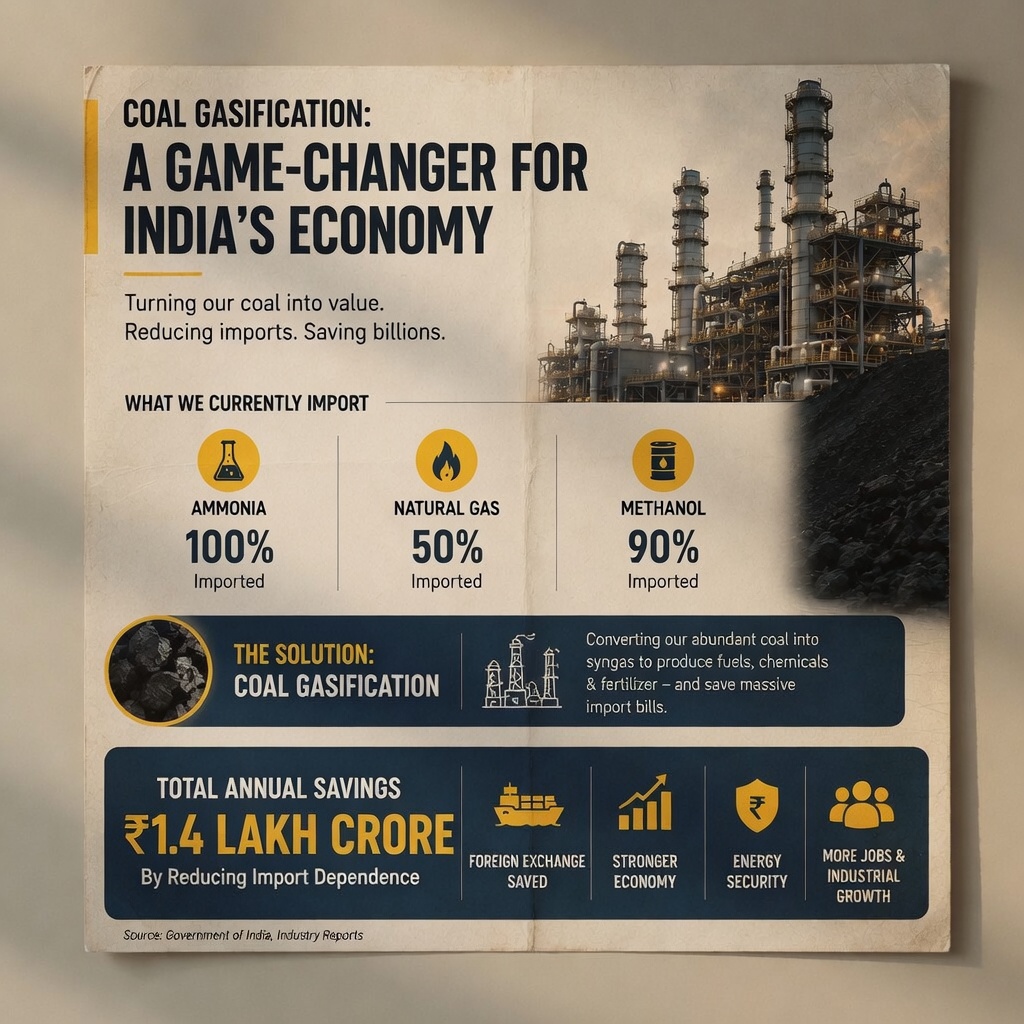
Fifth largest coal reserves in the world, and finally in 2026 we make the big move of harnessing them to their optimum potential.
The unintended consequence of the Iranian crisis has led to a major allocation of ₹37,500 crore for coal gasification, the process of converting coal into synthetic gas.
India's fertiliser subsidy is expected to balloon to ₹2.4 lakh crore this year, largely because fertiliser inputs are import-dependent. If domestically produced syngas replaced those imports, India could save over ₹60,000 crore annually and cut import exposure by ₹1.4 lakh crore.
But the real executors behind this push are private players and entrepreneurial giants. Jindal Steel's plant in Odisha has already displayed the potential of this endeavour as it is the largest coal gasification plant for steelmaking in the world. Running at 80% capacity, it posted a profit of ₹3,000 crore. Reports also suggest that Adani is developing a coal-to-chemicals complex in Odisha worth up to ₹70,000 crore.
With an ambitious target of gasifying 100 million tonnes, India has finally entered the race toward self-reliance.
Every generation gets to watch movie theatres die.
Ours has OTT. Endless libraries, zero commute, a screen in every pocket. The theatre, they say, is losing. And maybe it is. But somewhere in the 1990s, a different generation watched the same funeral. Cable television. VCRs. CDs. DVDs. The living room had swallowed the dark hall. The projector was flickering out.
It didn't die then either. But not because theatres are invincible. Someone simply transformed it to changing times.
India in 1990s didn't look like a country on the edge of a cinema revolution. Cable television was entering urban homes at a great pace. VCRs made Bollywood available on demand. Single-screen theatres, dark, crumbling, often unsafe, were losing the one thing they had always counted on: there was simply nowhere else to watch a film. That monopoly was gone. And with it, the logic that had kept 25,000 ageing theatres alive across India started to quietly collapse.
Most theatre owners saw a dying industry. Ajay Bijli saw a mistimed one.
Bijli hadn't come from cinema. His family built their wealth in road freight. Amritsar Transport Co., founded in 1939, was a North India logistics operation that had nothing to do with screens or stories. Cinema entered the picture only in 1978, when his father acquired Priya Cinema in Delhi as a diversification move. A single-screen theatre in South Delhi. Unremarkable. One of thousands.
When Bijli took over at 22, with no formal background in entertainment, Priya Cinema had weak film access, outdated interiors, and the kind of customer experience that made staying home feel like the better option. Then his father died in 1992. Then a warehouse fire destroyed the family's transport business in 1994. Every fallback was gone.
What happened next is the part that gets misread as desperation. It wasn't.
Bijli made a deliberate bet, not on cinema surviving, but on cinema being reframed. He poured money into Priya Cinema: Dolby sound, proper air conditioning, cleaner interiors, an upgraded lobby.
The transformation thesis was that affluent urban Indians weren't abandoning cinema because they preferred television. They were abandoning it because cinema had stopped respecting them.
The response confirmed it. Audiences from Vasant Vihar, Saket, RK Puram, South Delhi's prosperous belt, came back. Not out of nostalgia. Out of genuine preference.
In 1995, Bijli had taken the thesis global. PVR entered a 60:40 joint venture with Village Roadshow, one of the world's leading multiplex operators. India had zero multiplexes at the time. The partnership brought capital, international operational standards, and a model that had already transformed cinema-going in Australia and Southeast Asia.
In 1997, PVR Anupam opened in Saket. Four screens. Computerised ticketing. Multiple simultaneous screenings. India's first multiplex.
The number that tells the real story isn't the screen count. It's what happened to the industry around it. From one multiplex in 1997, India crossed 100 multiplex properties by the mid-2000s. Ticket yields at multiplexes ran significantly higher than single screens. Food and beverage became a revenue line, not an afterthought.
Cinema stopped being mass entertainment and started being a social occasion, something you dressed for, planned around, paid more for. This is the part that matters beyond the business history.
PVR didn't succeed because it built something new. It succeeded because it read something true, that India's urban consumer was not the same person she had been a decade earlier.
Liberalisation had raised disposable incomes. Global exposure had raised expectations. The Indian middle class had seen what a night out could feel like elsewhere, and was quietly measuring everything at home against that standard.
Single-screen theatre owners looked at cable TV and saw competition. Bijli looked at the same moment and saw a consumer waiting to be taken seriously. India was changing faster than the industry understood. PVR just understood it first.
Then came September 11, 2001. As hijacked planes rammed into the Twin Towers. The world froze. Everything was about to change.
But that story is for next time...