💻 ⚖️ Não cabem mais recursos, e as big techs terão 60 dias para se adequar às regras definidas pelo STF para operar no Brasil; redes sociais passarão a ser obrigadas a remover conteúdos considerados criminosos após notificação da suposta vítima e adotar medidas para proteger usuários contra crimes graves.
‼️🇨🇭👁️ La Suisse voulait faire passer une nouvelle loi de surveillance...
Elle visait les entreprises proposant des services privés comme :
- Les VPN
- Les e-mails chiffrés
- Les messageries sécurisées
1. Demander une pièce d’identité à chaque nouvel utilisateur (passeport ou permis de conduire)... Plus possible de s’inscrire sans donner son vrai nom !
2. Garder les données des utilisateurs pendant 6 mois (adresse IP, quand on se connecte, etc)
3. Pouvoir déchiffrer les messages ou données si la police le demande !!
Proton (l’entreprise suisse qui fait @ProtonMail et @ProtonVPN) a dit clairement : "Cette loi est pire que celle des États-Unis"
Résultat Proton a commencé à déplacer une partie de ses serveurs hors de Suisse !! (en Allemagne notamment) par précaution.
Mais l’entreprise reste basée en Suisse pour le moment
Ensuite beaucoup de monde s’est opposé à cette loi (d’autres entreprises, des associations et des politiciens)
ILe gouvernement suisse a donc revu sa copie et a atténué le projet !
- La version la plus sévère de la loi n’a pas été appliquée
- Proton a quand même commencé à diversifier ses serveurs !
- La réputation de la Suisse comme pays qui protège bien la vie privée a pris un coup
La surveillance de masse n'est qu'une question de temps ⏳
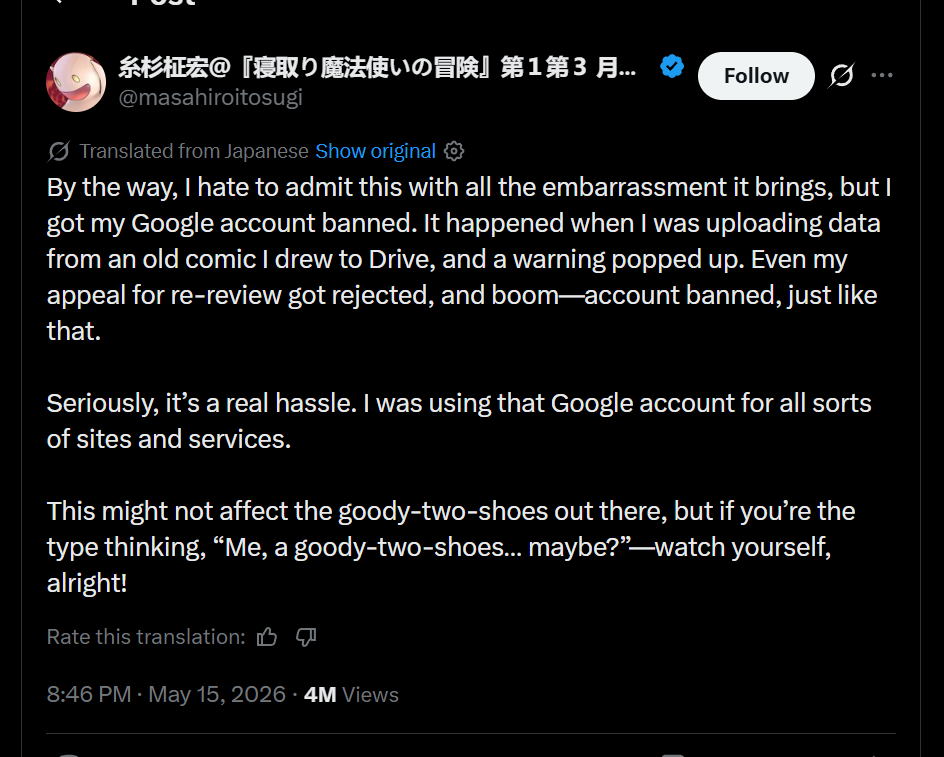
A Japanese manga artist lost his entire Google account forever after he uploaded private files from an old comic he drew to Google Drive.
Google’s AI checked the files and flagged them as not allowed. He asked Google to review it again, but they rejected his appeal and banned the account immediately.
He can no longer access years of his private drawings and lost access to many websites and services that used his Google login.
The artist said this is very embarrassing and causes him a lot of trouble. He warned that it might not happen to people who always follow every rule, but others should be careful.
So Google is scanning files that people upload to its cloud storage even if they are supposed to be private. I wonder how long they have been doing this.
What privacy-first software looks like — Part II:
Whonix(@Whonix) → security-focused operating system that routes all traffic through Tor to help isolate applications and reduce IP leaks.
SMSPool(@smspoolnet) → temporary phone number platform useful for compartmentalization and reducing exposure of personal numbers online.
Qubes OS(@QubesOS) → compartmentalized operating system that isolates tasks into separate virtual machines for stronger security boundaries.
LibreOffice(@LibreOffice) → open-source office suite that gives users local control over documents without dependence on cloud ecosystems.
SimpleX(@SimpleXChat) → messenger designed without user IDs or persistent identifiers, reducing metadata exposure by design.
ExifTool → powerful metadata analysis and removal tool for inspecting hidden information inside files and images.
Proton Drive(@ProtonDrive) → end-to-end encrypted cloud storage focused on protecting files from provider-side access.
Tails(@Tails_live) → portable live operating system that routes internet traffic through Tor and leaves minimal traces on the device used.
YubiKey(@Yubico) → hardware security key that adds phishing-resistant multi-factor authentication for accounts and devices.
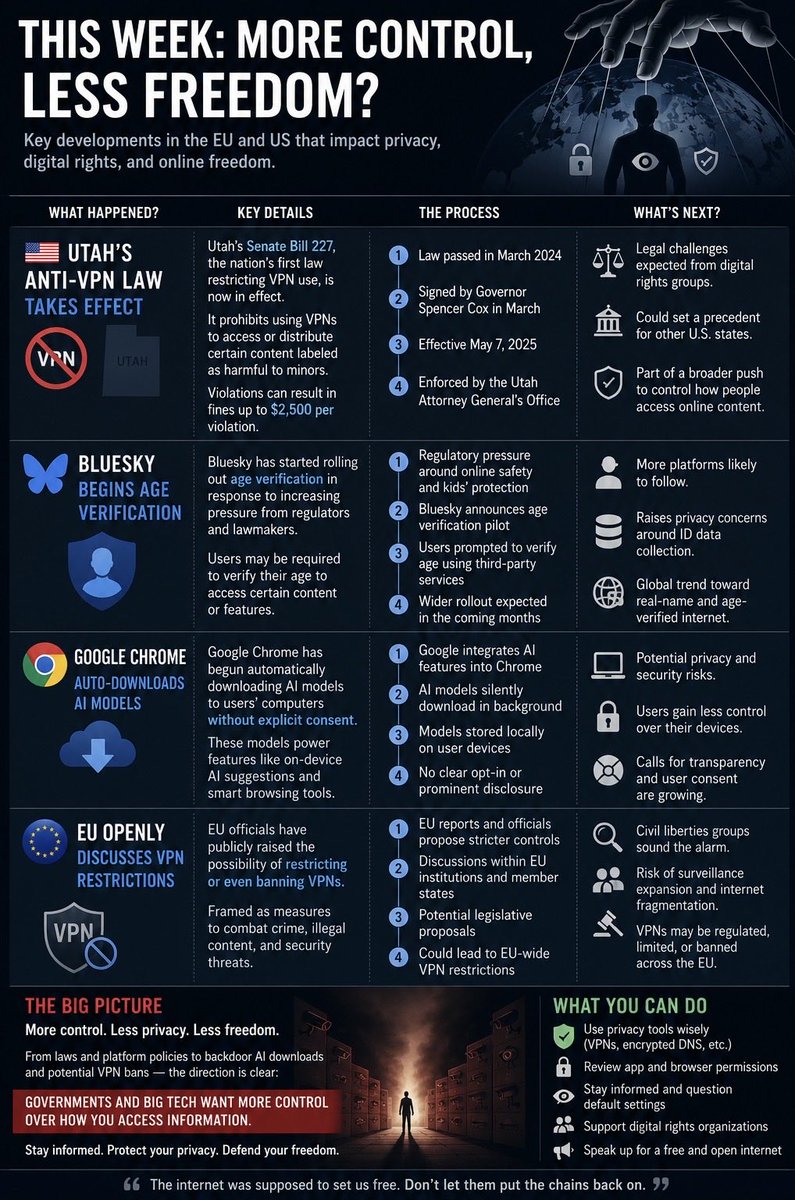
This week:
🇺🇸 Utah’s anti VPN law took effect
🔵 Bluesky began age verification
🤖 Chrome started auto downloading AI models without explicit consent
🇪🇺 The EU openly discussed restricting/banning VPNs
Do you see the direction this is going? More control.
More information:
‼️🚨 ALARMING: Google now treats privacy as suspicious behavior by default. Users of GrapheneOS, CalyxOS, /e/OS, and other deGoogled Android phones are being locked out of millions of websites unless they install the exact Google Play Services software they deliberately removed.
GrapheneOS is recommended by the EFF and used by journalists, lawyers, and activists in high-risk environments. The audience most likely to read Google's data practices and refuse its terms is now flagged as fraudulent for that exact decision.
What happened?:
▪️ Google announced "Cloud Fraud Defense" at Cloud Next on April 22-23, 2026, branding it "the next evolution of reCAPTCHA." Existing reCAPTCHA customers were auto-migrated.
▪️ When the system flags traffic as suspicious, the old click-the-bus puzzle is gone. Users get a QR code instead.
▪️ Scanning the QR code requires Google Play Services running on the device. Internet Archive snapshots show this requirement has been live since at least October 2025, silently rolled out for 7 months before anyone noticed.
▪️ No Play Services = no QR scan = locked out.
The bigger picture:
▪️ Google already tried this in 2023. It was called Web Environment Integrity (WEI), and it would have let Google decide which devices were "real enough" to access the web. Standards bodies and the public pushed back hard, and Google killed it. Three years later, the same idea is back, just hidden behind a QR code instead of a browser feature.
▪️ reCAPTCHA runs on millions of websites. Every developer who keeps using it is now, by default, telling deGoogled Android users they're not welcome...
REMINDER: Starting Friday, May 8th, Instagram DM's will no longer be end-to-end encrypted.
Instagram hasn't explained why they're dropping end-to-end encryption, which raises some pretty obvious questions about what they plan to do with your private messages.
O que acontece com o primeiro aplicativo do estudante, ou a ferramenta de privacidade criada por um voluntário? O registro obrigatório do Google bloqueia todos por padrão, a menos que sigam as regras do próprio Google. https://t.co/hSqDMB0fBA #KeepAndroidOpen