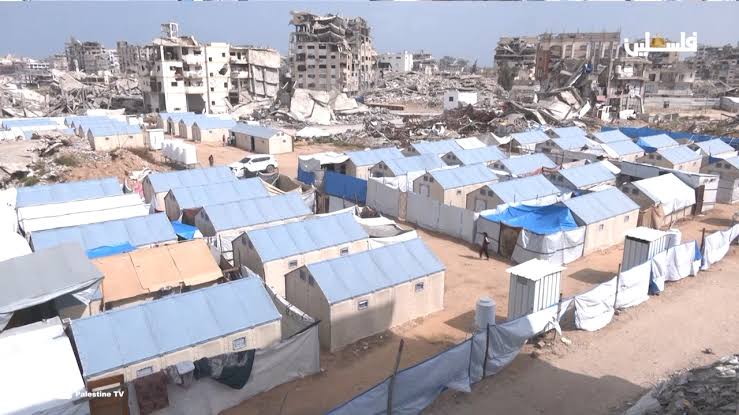
@DMiliband The Israeli government say they’ve sent 91,000 tents into Gaza on top of tons and tons of winter aid so far this autumn. Are you saying they are lying?
@johncusack A six year old could tell most of this video is Ai. It’s currently 22C, dry and sunny in Gaza and will be 27C by Saturday. Give your head a wobble and see if you can locate your brain! 🧠
REVEALED: The scandal surrounding Gaza's failed winterization efforts lays bare a grim reality: Hamas obstructed attempts to protect Palestinian civilians before the devastating winter storms that flooded tens of thousands of tents.
Palestinian Authority employees inside Gaza have reported that professionals from the Ministries of Public Works and Relief Affairs were intimidated, summoned, and coerced by Hamas into signing pledges not to undertake humanitarian projects without the group's approval. According to their accounts, those who defied Hamas risked so-called "field justice," including beatings and worse.
Several officials, including Najla Hammad, Ihab Al-Bahtiti, Khaled Abu Safiya, Wiam Aboul-Nasr, Dr. Adnan Hamouda, and Ahmed Abu Zaiter, have publicly stated that efforts to build more durable fiberglass housing and improve conditions for displaced civilians were blocked.
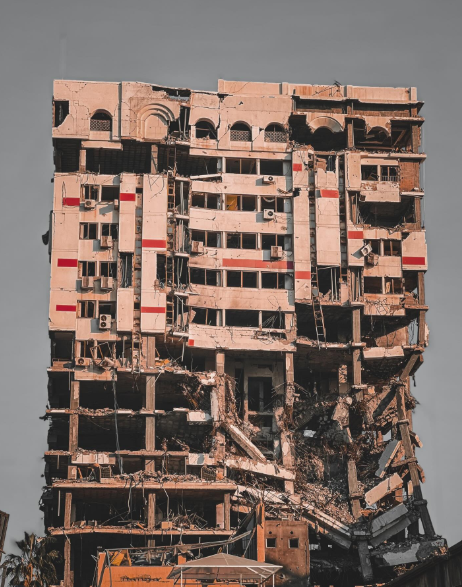
Another example was a proposal that was put forward to demolish several heavily damaged towers which were at risk of collapse from rainwater after extensive bombardment. According to those involved, Hamas blocked the removal of the “Bank of Palestine Tower” in Gaza City's Rimal neighborhood, reportedly arguing that it would "collapse from the rain anyway." The terrorist group did not show any concern for the civilian lives that would be lost when the tower eventually collapses on its own, because it wants dead Palestinians and news of tragedy to keep Gaza in the news cycle and to gain global sympathy, hoping for more incoming resources and donations for the Strip’s humanitarian and reconstruction needs that it could siphon.
Additionally, Hamas has also been accused of obstructing construction projects intended to create safer communities for displaced Gazans in southern Gaza, prioritizing political control over humanitarian relief.
This is a reminder that Gaza's suffering is not only a consequence of war. It is also the result of a fascist and ruthless governing power that repeatedly places its own interests above the welfare of the people it claims to represent. The same terror group that helped bring catastrophe upon Gaza continues to obstruct efforts to mitigate its consequences.
As floodwaters sweep through displacement camps and families endure another winter in misery, the question is unavoidable: how many Palestinian lives could have been spared had Hamas allowed humanitarian, housing, and reconstruction efforts to proceed unimpeded?
The vote count is complete. The Reservists and Economic Party received the support of approximately 152,000 voters, who appear to have come in roughly equal numbers from both political “blocs,” and from socioeconomic clusters reflecting the full political, economic, and identity spectrum of those who rushed to the front lines to defend the country on October 7. In doing so, we became the only party in these elections whose agenda and voters alike transcended the division into political “blocs.”
But it is possible that, despite not being represented in the Knesset, the election results will nevertheless allow us to achieve the very thing for which we sought to enter it. The results hold enormous political potential. Precisely because neither side got what it wanted, an opportunity has opened up to form the government Israel needs: a broad, centrist Zionist government that will finally begin confronting the country's fundamental challenges.
What do the results tell us?
Netanyahu's coalition does not have a majority to return in its current composition. That is over.
The change bloc does not have a majority to form a government without relying on parties and members of Knesset who hold explicitly antizionist and Palestinianist positions.
And it seems it will take time to fully grasp the significance of the scale of political support for anti-Zionist Arab and ultra-Orthodox parties, especially in a scenario of their full voter mobilization. The possibility of political cooperation between anti-Zionist Arab and ultra-Orthodox parties, and the emergence of an “antizionist bloc” that increasingly places the interests of these two groups above the shared Zionist interest, represents a strategic threat to the future of the State of Israel. For Zionist parties to rely on anti-Zionist parties in order to defeat a Zionist political rival is dangerous behavior.
And here lies the paradox: an outcome that makes almost nobody happy individually could turn out to be an excellent result for the State of Israel and Zionism. Precisely because neither side can get everything it wants, the necessity of working together has emerged.
The right government for Israel at this moment is a government of Likud, Yashar, Lieberman, and Bennett. A broad, centrist Zionist government, without the ultra-Orthodox and Arab parties, and also without the less centrist Zionist parties.
Such a government could, if it chose to, commit to preserving the existing legal situation, under which there are no longer any arrangements granting exemptions from service and the law currently in force is the Defense Service Law. It could ensure that state services and public-sector positions are reserved for those who serve and defend the country. It could guarantee state Zionist education, in Hebrew, for all Israeli children. And it could put an end to the economic mechanisms through which Israel's welfare state has, for decades, encouraged draft evasion and separation from the Zionist enterprise. (And it certainly wouldn't hurt to lower the electoral threshold to encourage Zionist Arab and Zionist ultra-Orthodox political representation.)
Such a government could confront the enormous diplomatic and security challenges ahead, finally begin working to dismantle Palestinianism at home and abroad, and return Israel to a Zionist and productive path.
There are no serious security or economic differences between the parties of Netanyahu, Eisenkot, Bennett, and Lieberman that justify continued paralysis or another election. They have far more in common than our political discourse allows us to see. If they wanted to, they could form an excellent government.
But for that to happen, both sides would have to give something up.
Netanyahu cannot insist on preserving every component of his current coalition and expect everyone else simply to join it. The election results neither allow nor justify that.
Conversely, the change bloc cannot insist on boycotting Netanyahu at the price of relying on antizionist and Palestinianist forces.
The danger now is that, instead of seizing the opportunity, both sides will choose escalation, which could look like this:
Netanyahu will entrench himself in a coalition that lacks a majority, while the other side will use its parliamentary majority to pass confrontational legislation and paralyze the government. Each side will respond with further escalation, and Israel will find itself in a prolonged political and institutional crisis, precisely when it needs a functioning government more than ever.
This is exactly where we wanted to play a political role.
We did not seek to be the kingmaker who determines who becomes prime minister. We sought to be the spearhead for establishing a broad, centrist Zionist government. A political force capable of standing up to either side that refused to compromise, and making it clear that refusal carries a price.
This was our message throughout the campaign: What, not who.
Israel is a parliamentary, coalition-based democracy. The prime minister, as the English name suggests, is the first among ministers, not a president and not a king. The identity of the prime minister matters, but the composition of the coalition and the policies it advances matter far more.
Therefore, the question of who will be prime minister is secondary to the question of what kind of governing coalition we will have.
Will it be a government that continues subsidizing draft evasion and separation from the rest of society, or one that restores service, Zionist education, and shared responsibility to the center of Israeli life? Will we continue postponing the confrontation with our fundamental problems, or will we seize the opportunity to halt processes that have been endangering our future for decades? These are the questions that truly matter. And if we fail to confront them now, the future price will be far higher — and the damage may not even be reversible.
We ran in these elections to change the direction in which Israel is heading. We had hoped to do so from within the Knesset, and we are disappointed that we will not be able to. But the results have created a genuine opportunity to achieve the very goal for which we embarked on this journey.
The responsibility now lies with the leaders who were elected. They can continue to entrench in political blocs that have led Israel into repeated election cycles and governments dominated by the extremes, or they can recognize that the new political reality requires them to do something different.
If a broad, centrist Zionist government is formed here, without the ultra-Orthodox and Arab parties, and finally begins confronting the fundamental questions facing the State of Israel, that will be the achievement we sought.
And that will be reward enough for us.
@FranceskAlbs The apartheid is in your brain. The right side won’t allow the left side to function.
Your brain is broken.
Palestinians vote in Palestinian elections (if they had had any in the last 20 years - try addressing that!!)
Israelis vote in Israeli elections.
Stop lying 🤥
@AdamRamsay 3% of Hebron is under Israeli rule. That would be where the polling station is.
The other 97% would vote in Palestinian elections if they’d had any in the last twenty odd years!
@mehdirhasan You’re so obsessed with the existence of Israel it’s pathetic. The Balfour Declaration was an acknowledgment of its existence. Its existence is all over your Koran isn’t and in the bible. It’s what the diaspora has been praying towards for thousands of years duh 🙄