$FET is trading around $0.148.
And this weekly chart is showing a setup that could become very interesting.
Back in 2024, $FET delivered an explosive 2,289% rally in just 168 days.
From a prolonged consolidation near the lows to above $3.
Then came the correction.
Lower highs. Failed recoveries. Nearly two years of persistent selling pressure.
But look at where price is now.
$FET has returned to the same broad historical price region where its previous massive rally began.
And that's exactly what caught my attention.
The market is consolidating near a long-term liquidity zone, while the descending resistance line is approaching the current price range.
Could another major expansion be developing?
Possibly. But the market still needs to confirm it.
Here's my roadmap.
$0.30 — First resistance to reclaim.
$0.75–1.00 — Next major recovery zone.
$2.00 — Potential continuation target.
$3.30 — Previous major high.
$4.30 — Long-term upside objective.
And $5? That's my extreme bull scenario.
The chart illustrates a potential 8,056% move from its marked historical base.
That's an extraordinary projection.
And it would require a complete reversal of the long-term bearish structure, sustained buying demand, and a major expansion in market liquidity.
First, I want to see $FET establish higher lows and reclaim $0.30 on the weekly timeframe.
Then a decisive breakout above $0.75 would strengthen the case for a larger trend reversal.
Without those confirmations, the broader bearish structure remains intact.
But here's what makes this setup interesting.
In 2024, traders were chasing $FET above $3.
Now it's near $0.15, and the excitement has almost completely disappeared.
That doesn't automatically make it undervalued.
But if buyers finally defend this historical base and break the sequence of lower highs, $FET could become one of the more interesting recovery setups to watch.
I'm not calling for an 80x rally.
I'm watching whether the market is finally preparing for a change in trend.
$FET is trading around $0.15.
And this weekly chart is starting to look like a setup we've seen before.
Back in 2024, $FET delivered an explosive 2,289% rally in just 168 days.
From a prolonged consolidation near the lows to above $3.
Then the momentum disappeared.
Lower highs. Failed recoveries. Nearly two years of selling pressure.
Now look at where price is sitting.
$FET has returned to the same broad historical demand region where its previous major rally began.
And that's what makes this setup interesting.
The weekly chart shows price compressing near a long-term liquidity zone, while the descending trendline continues to approach the current range.
If buyers start absorbing supply here, we could eventually see a significant change in market structure.
Here's what I'm watching.
$0.30 — First resistance to reclaim.
$0.75–1.00 — Next major resistance zone.
$2.00 — Potential continuation target.
$3.30 — Previous major high.
And $4.30? That's my extreme bull scenario.
The chart illustrates a potential 7,074% move from its marked historical base.
But there's a big difference between a projected 70x and a confirmed bullish trend.
I want to see $FET break the descending resistance, establish higher lows, and attract sustained buying volume.
Until then, the broader bearish structure remains intact.
Still, market psychology is fascinating.
In 2024, traders were chasing $FET above $3.
Now it's near $0.15, and the excitement has almost completely disappeared.
That doesn't automatically make it a bargain.
But if this long-term base holds and buyers finally regain control, $FET could become one of the more interesting recovery setups to watch.
$AERO is back at $0.56.
And this weekly chart is approaching a very interesting area.
Remember when $AERO was trading above $2?
Since then, it's been a difficult market for holders.
Lower highs. Failed recoveries. Months of consolidation.
But look at the bigger picture.
Price has spent most of 2026 building a base above a long-term liquidity zone.
We recently saw buyers push $AERO toward $1, but that move was rejected.
Now price is returning to an important level around $0.55–0.63.
And that's where I'm paying attention.
Here's my roadmap if buyers regain control.
$0.63 — First resistance to reclaim.
$1.00 — Initial confirmation of bullish momentum.
$1.58 — Second major target.
$2.22 — Previous major high.
And $4.60? That's my extreme bull scenario.
The chart illustrates a potential 1,325% rally from its marked historical base.
Sounds ambitious?
Of course. But the interesting part isn't the percentage.
It's the possibility that this extended consolidation could eventually develop into a genuine accumulation structure.
First, I want to see $AERO reclaim $0.63 and hold above it.
Then a break through $1 would strengthen the case for a larger trend reversal.
Without those confirmations, the downside risk remains.
But here's what makes this setup worth watching.
After months of sideways price action, the market is approaching another important decision point.
If buyers finally establish higher highs and higher lows, the entire weekly structure could start looking different.
And that's exactly what I'm watching.
$SEI at $0.05 is looking absolutely ridiculous.
Everyone wanted it above $1.
Now it's down near the bottom, and suddenly nobody wants to touch it.
My targets:
$0.39 → $0.73 → $1.14
And $1.60 if things get really crazy.
That's over 3,000% potential upside.
The funny part? If $SEI starts pumping, the same people ignoring it now will be screaming BUY.
Every. Single. Time.
$XLM is trading around $0.146.
And there's something about this weekly chart that keeps catching my attention.
Look at the bigger picture.
Every major rally over the past several years has ended with a brutal correction.
But there's one detail worth noticing.
Despite all those sell-offs, the long-term support structure has gradually been moving higher.
That's what makes the current setup interesting.
$XLM is once again approaching a major historical demand zone after another prolonged decline.
And if buyers step in, we could be looking at the early stages of a new cycle.
Here's my roadmap.
$0.3469 — First major resistance.
$0.6377 — Second target.
$0.7929 — Previous major high.
And $1.40? That's my extreme bull scenario.
The chart outlines over 1,300% potential upside from its marked historical base.
But there's one thing I need to see first.
$XLM has to reclaim $0.20–0.25 and start building higher highs on the weekly timeframe.
Otherwise, this is just another bounce inside a larger consolidation.
What makes this setup interesting isn't simply how far price has fallen.
It's the possibility that years of higher lows are creating a foundation for the next major expansion.
Of course, that structure can still fail.
But if buyers finally break through the overhead resistance, things could get interesting very quickly.
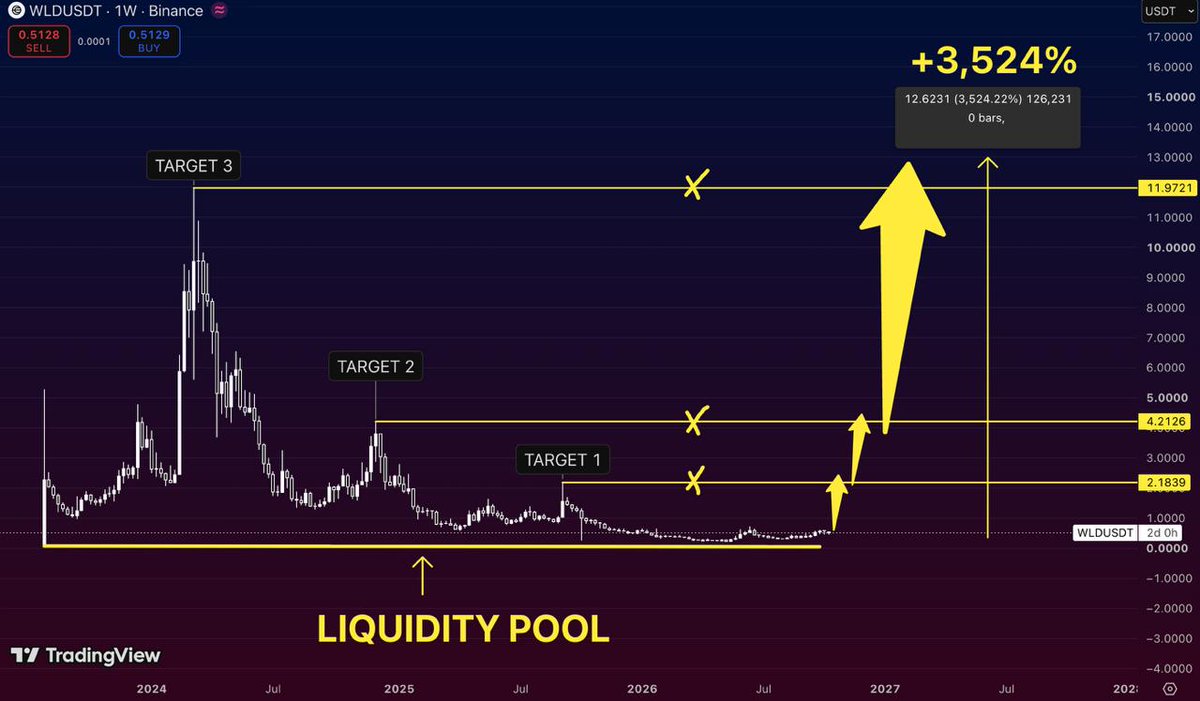
$WLD TO $12? +3,524% POTENTIAL.
Everyone was excited about $WLD when it traded above $10.
Now it's sitting near $0.50, and suddenly nobody wants to touch it.
Funny how that works.
I'm watching three major targets:
$2.18 → $4.21 → $11.97
The weekly chart shows a massive base forming after years of selling.
If the market gives altcoins another serious run, I think $WLD could surprise a lot of people.
The biggest opportunities rarely look obvious at the bottom.
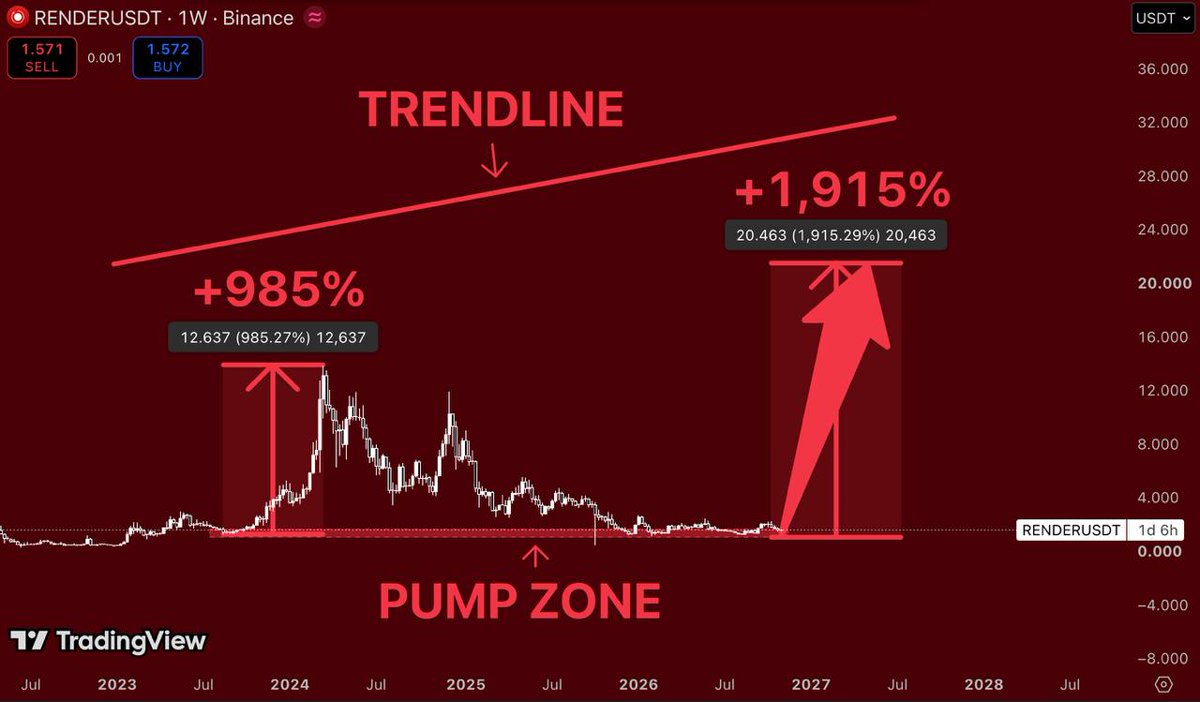
$RENDER TO $25? I WOULDN'T RULE IT OUT.
Look at the weekly chart.
$RENDER has been crushed for years, but the price is still holding above its historical liquidity zone.
That's exactly where I'm paying attention.
My targets: $6 → $11 → $14 → $25
+5,046% from the marked bottom if the full scenario plays out.
Sounds ridiculous? So did plenty of crypto rallies before they happened.
I'm watching $RENDER closely.
$ZEC is trading around $1,200.
And while most altcoins are still struggling to recover, this chart is showing something completely different.
Look at the daily timeframe.
After a powerful rally toward $1,600, $ZEC pulled back and started consolidating around $1,200.
But here's what caught my attention.
The broader bullish structure is still intact.
Higher lows are forming, and price is holding near a rising support trendline.
That's exactly what I want to see during a healthy correction.
If buyers reclaim $1,500–1,600, the next area I'm watching is $2,000.
Then $2,500.
And $3,000? That's my aggressive bull target.
But the key isn't the target itself.
It's whether $ZEC can defend its rising support and break above the previous high.
Lose that structure, and the bullish setup starts looking much weaker.
Because the strongest trends aren't the ones that never pull back.
They're the ones where buyers keep stepping in at higher prices.
And right now, $ZEC is testing exactly that.
$LUNC is either completely dead…
or sitting at one of the craziest asymmetric setups I’ve seen.
Years of bleeding brought it back into the same liquidity pool again.
And look at what happened every time $LUNC escaped these lows before.
My levels are simple:
$0.00017693
$0.00027718
$0.00064799
If this structure actually starts expanding, the full move on the chart is around +4,500%.
Sounds insane from here.
That’s exactly why I’m watching it.
$AERO is trading around $0.61.
And this weekly chart is starting to look like a major decision point.
After falling from above $2, $AERO spent months building a base near its long-term support.
Then buyers finally pushed price toward $1.
But that rally didn't last.
Now we're back at $0.63, testing a level that could determine the next major move.
Here's what I'm watching.
$0.63 - The first level buyers need to reclaim.
$1.00 - Initial resistance.
$1.58 — Second major target.
$2.22 — Previous highs and a critical breakout zone.
And $4.50? That's my extreme bull scenario.
The chart outlines nearly 1,300% potential upside from its marked base.
But here's what matters more than the projection.
$AERO needs to hold support and start printing higher lows.
Because there's a huge difference between a temporary bounce and a genuine trend reversal.
And right now, the market hasn't decided which one we're getting.
If buyers step in here, this setup could become much more interesting.
$PYTH is sitting at $0.063.
A coin that once traded above $1 is now being completely ignored.
And this is exactly why I'm watching it.
Look at the weekly chart.
Months of lower highs, a brutal downtrend, and now price is barely moving near its historical lows.
No excitement. No momentum. Just a market that's seemingly lost interest.
But there's something worth paying attention to.
The selling pressure appears to be slowing, and price is attempting to establish a base.
If buyers return, $0.24 is my first major target.
Then $0.54 and $1.15.
And $2? That's my extreme bull case.
The chart outlines over 3,100% potential upside from its marked base.
Does that mean a 30x is coming? Of course not.
First, I want to see a confirmed breakout and a change in the weekly trend.
But here's what always fascinates me about crypto.
People spend months searching for the next massive opportunity.
Then a chart like $PYTH shows up, and nobody even wants to look at it.
$RAY was trading near $18 in 2021.
Today? Just $1.82.
And somehow, I think this chart is getting more interesting, not less.
Look at the bigger picture.
After years of selling, price has returned to a long-term zone where buyers have stepped in before.
The market has tested this area multiple times.
And it's still holding for now.
Here's what I'm watching.
First, I want to see $RAY reclaim $3–4.
Then $6–8 becomes the next serious challenge.
Above that, the old $17.87 ATH comes back into focus.
And $38? That's my extreme bull scenario.
The chart shows over 7,200% potential upside from its marked historical base.
Sounds crazy. And it absolutely is an aggressive projection.
But here's the thing.
Nobody needs to believe in a 70x to recognize an interesting setup.
The real opportunity starts if buyers can turn this long-term base into a genuine trend reversal.
That's what matters to me.
$RAY
$RENDER is back near $1.57.
And there's something almost ridiculous about this chart.
The last time price built a base around this region
it went on a 985% run.
Now, after another brutal selloff, we're back testing that same territory.
Different market. Same price zone.
Coincidence? Maybe.
But I find it hard to ignore.
If $RENDER can establish a higher low here and reclaim $3–4, I'd start looking toward $8–10.
The previous highs around $14 would be the next major challenge.
And $22? That's my aggressive bull case, not a prediction.
The chart maps out nearly 2,000% potential upside.
But first, I want proof that buyers are actually taking control.
Because the best trades aren't about believing history will repeat.
They're about recognizing when the conditions for another big move are starting to appear.
$TAO is back at $224, and this is where things get interesting.
While everyone waits for a breakout, price is quietly testing a support level that's held through multiple selloffs.
Look at the weekly chart.
Lower highs pressing against the same support zone. The range is getting tighter. Something has to give.
If buyers defend $200–220 and break that descending resistance, $400 becomes the first level I'll watch.
Then $700.
And in a full-blown AI market rally, $1,500 is my extreme bull case.
That's over 800% potential upside from the chart's projected entry.
But there's one thing that matters more than any price target.
Whether buyers can actually hold this floor.
Because the difference between a massive opportunity and a nasty breakdown is sometimes just one support level.
$TAO
$FET at $0.14.
The last time this coin traded around these levels, it went on to rally over 2,200%.
Now we're right back where it all started.
And the market couldn't care less.
That's what makes this chart interesting to me.
Years of price action, a brutal downtrend, and now a potential accumulation zone forming near historical support.
If buyers return and the AI narrative catches fire again, $2–3 becomes a serious area to watch.
$4.25? That's my extreme bull case.
Nearly 7,000% potential upside on paper.
But there's a big difference between a cheap coin and a good opportunity.
I'm watching for the market to show me which one $FET actually is.
Everyone wants $SUI after a 5x.
Almost nobody wants it while it's building the base.
Last time, this kind of structure led to an 837% rally.
Now we're seeing a very similar setup on the weekly chart.
I'm not saying history will repeat exactly.
But I wouldn't ignore this.
$TAO at $224 is sitting at a pretty interesting crossroads.
Every rally has been met with selling pressure.
Every lower high has kept the downtrend alive.
But there's something the bears should be watching.
Price keeps returning to the same support area without completely breaking down.
And now weekly RSI is back near the buy zone.
If buyers defend $200 and $TAO breaks above that descending trendline, things could change quickly.
$500 is the first big test.
$800–1,000? That's my aggressive bull case.
Everyone wants to buy a breakout.
I'm more interested in what happens right before one.
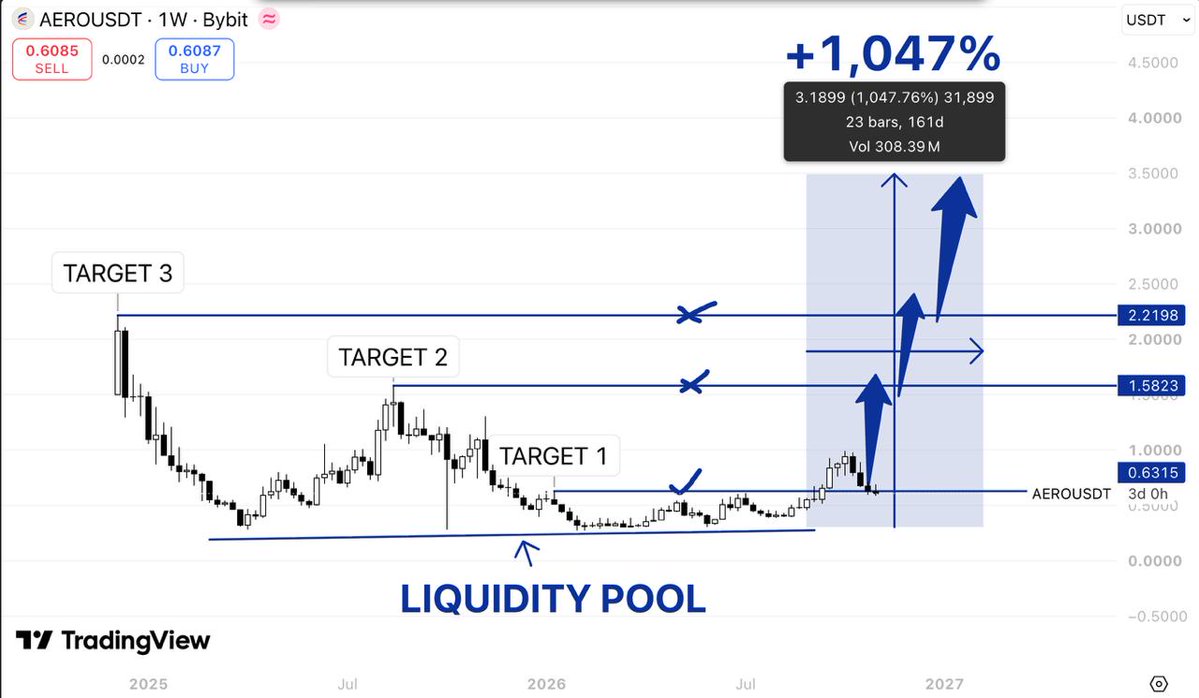
$AERO is sitting right at a level that could decide its next big move.
After pushing toward $1, price has pulled back to the $0.60 area.
And that's where things get interesting.
Previous resistance is being tested again. Buyers have an opportunity to prove this breakout wasn't just another fakeout.
If $0.60–0.63 gets reclaimed and holds, I'm watching $1.58 and $2.22 next.
$3.50 is my aggressive bull-case target.
But here's the thing.
The best setups aren't always the ones making new highs.
Sometimes they're the ones that survive the retest while everyone else loses interest.
$XLM has a strange relationship with patience.
It spends years doing absolutely nothing, then suddenly moves like everyone needs to buy it at once.
And looking at this weekly chart, I wouldn't be surprised if history repeats itself.
$0.15 right now.
$0.35 is the first real test.
$0.64 and $0.79 are where things get interesting.
Break through those levels, and $1.30 becomes a scenario worth watching.
Of course, none of that happens without buyers showing up.
But the funniest part about crypto?
The same people ignoring $XLM today might be begging for a dip at $0.80.
$ASTER might be setting up for something much bigger than people expect.
The weekly chart has spent months going absolutely nowhere around $0.70.
But look closer.
Selling pressure has faded, the base is holding
and RSI is trying to reclaim bullish territory.
That's where things get interesting.
If momentum confirms, I can see $2.42 coming back into play
with $3.40 as the aggressive target.
The market doesn't need everyone to believe in $ASTER.
It just needs buyers to start proving it.