Aprendiendo a ganar en forex, stock, etf, commodities, crypto y poker. Sólo busco donde invertir, puntos entrada y salida, y buenos torneos freeroll📈💯♦
Por salud mental y tiempo toca bloquear o silenciar a aquellos que publican sobre inversiones y trading simulando éxito solo por ego, ganar like o rt, publicitaro defender tokens, vender cursos sin aportar info o análisis relevante.
#Bitcoin#altcoin#ada#SolanaNFT
La IA está marcando la diferencia nuevamente entre técnica, tecnología e ingeniería. El problema es que hoy existen pocos verdaderos ingenieros con solido background. Muchos fueron formados como técnicos o tecnólogos.
La industria del Software está pasando por una brecha de cambio curiosa, se está construyendo más a tiempo récord, pero se nota que la calidad se está deteriorando, solo basta con ver como todos los días apps famosas fallan en cosas que antes no fallaban.
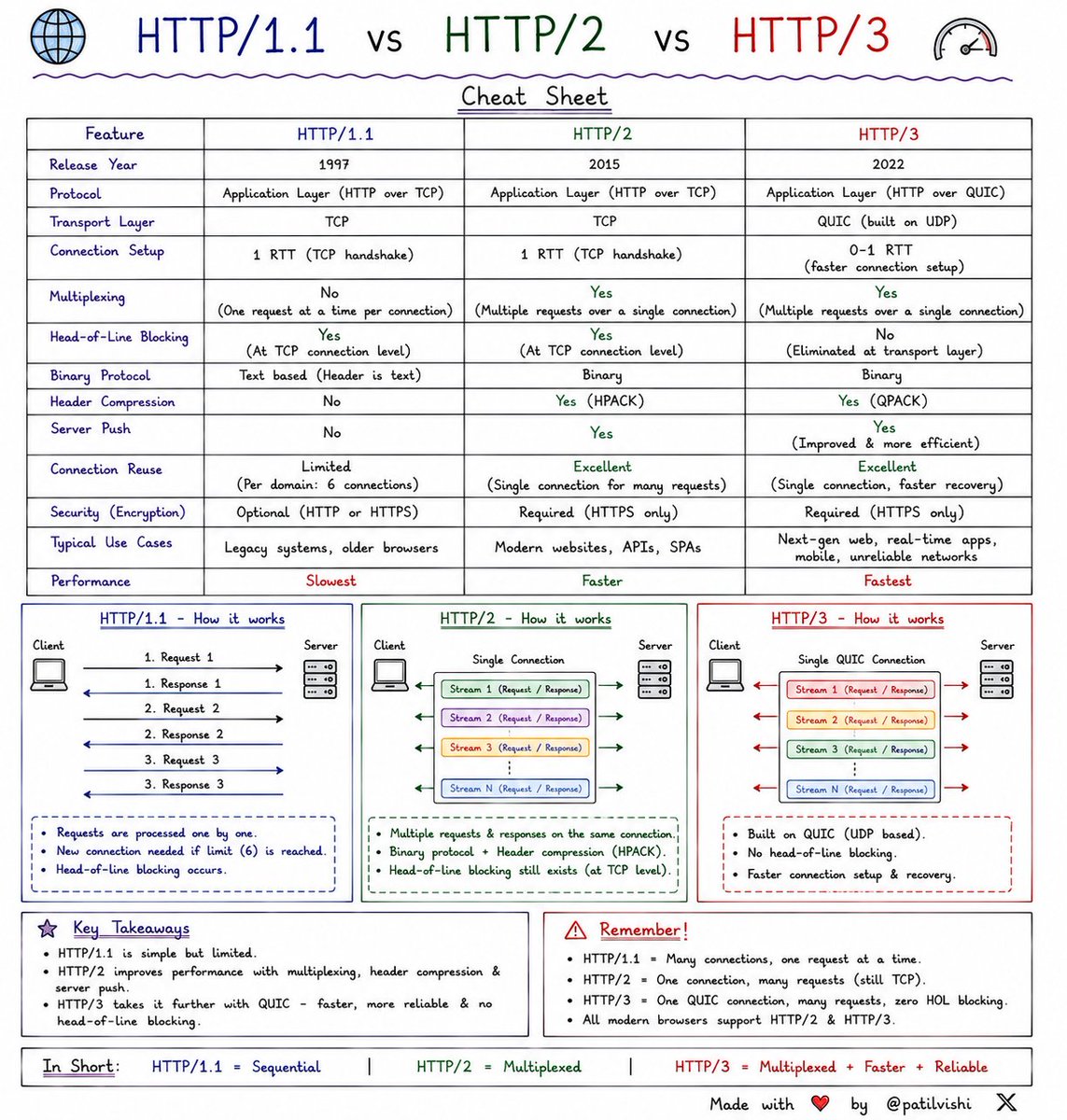
HTTP/1.1 ≠ HTTP/2 ≠ HTTP/3
They all transfer web pages…
But each generation solved a major performance bottleneck.
Here's the easiest way to remember them:
HTTP/1.1
➜ One request at a time per connection. Simple, but slower for modern websites.
HTTP/2
➜ Multiple requests can share a single TCP connection using multiplexing.
HTTP/3
➜ Runs on QUIC (built on UDP), reducing latency and avoiding transport-level head-of-line blocking.
Quick memory trick 👇
- HTTP/1.1 = Sequential
- HTTP/2 = Multiplexed
- HTTP/3 = Multiplexed + Faster Recovery
Why did each version evolve?
🔹 HTTP/1.1
- Multiple TCP connections needed for many assets
- Text-based protocol
- Head-of-line blocking at the application level
🔹 HTTP/2
- Multiplexing over one TCP connection
- Binary protocol
- Header compression (HPACK)
- Fewer connections, better performance
🔹 HTTP/3
- Built on QUIC instead of TCP
- Faster connection establishment
- Better performance on unstable or mobile networks
- Improved resilience to packet loss
Common interview question:
If HTTP/2 already supports multiplexing, why was HTTP/3 needed?
Because HTTP/2 still relies on TCP. If a packet is lost, TCP can delay other streams on that connection. HTTP/3 uses QUIC over UDP, allowing streams to recover more independently and reducing latency on unreliable networks.
One sentence to remember forever:
HTTP/1.1 = One by one
HTTP/2 = Many at once
HTTP/3 = Many at once, even on poor networks
Saved this handwritten cheat sheet for anyone learning networking, backend development, or preparing for system design interviews.
Antes de que mis agentes escriban una sola línea de código, les doy una carpeta de documentación.
En los proyectos en los que trabajamos, el agente la lee antes de tocar nada: arquitectura, decisiones con su porqué (ADRs), modelo de datos, convenciones y un AGENTS.md con las reglas que no se pueden romper.
Esa documentación guía al agente y lo mantiene dentro de tus límites.
El paso que sigue: que esas reglas no solo se describan, sino que se verifiquen solas. Un agente puede leer un documento y romperlo igual. Un check automático, no.
Hemos estado explorando Architecture as Code, de Neal Ford y Mark Richards, y lo recomendamos. Va justo en esa dirección.
Te dejo el link al libro en la respuesta.
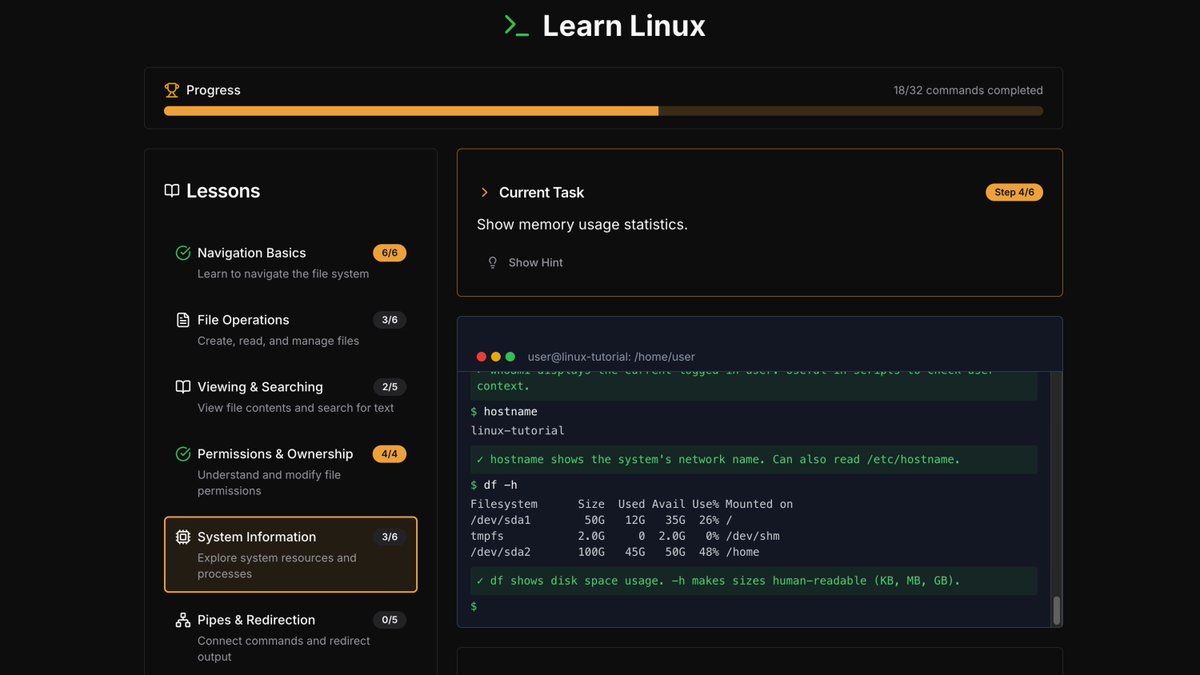
Domina los comandos esenciales de Linux en la terminal con lecciones interactivas
Practica pwd, ls, cd, cat, grep, chmod, pipes y mucho más con 6 lecciones progresivas.
Es gratuito:
→ https://t.co/PIWSkfrSUS
AI AGENT LAYERS
INPUT AND PERCEPTION LAYER
→ Collects and interprets user input from text, voice, images, or sensors
→ Processes natural language and external data sources
→ Converts raw input into structured information for decision-making
→ Technologies: NLP, Speech Recognition, Computer Vision
MEMORY LAYER
→ Stores short-term and long-term contextual information
→ Maintains conversation history and user preferences
→ Enables personalization and contextual reasoning
→ Technologies: Vector Databases, Embeddings, Knowledge Bases
REASONING LAYER
→ Analyzes information and makes intelligent decisions
→ Applies logic, inference, and contextual understanding
→ Helps the AI agent determine the best action to take
→ Technologies: LLMs, Rule Engines, Knowledge Graphs
PLANNING LAYER
→ Breaks complex goals into smaller actionable tasks
→ Creates workflows and execution sequences
→ Optimizes task completion strategies
→ Technologies: Task Planners, Workflow Engines, Agent Frameworks
TOOL USAGE LAYER
→ Connects the AI agent with external tools and APIs
→ Enables actions like web search, database queries, and automation
→ Expands the capabilities of the AI system beyond text generation
→ Examples: APIs, Browsers, Calculators, Code Interpreters
EXECUTION LAYER
→ Performs tasks and executes planned actions
→ Handles automation and task orchestration
→ Interacts with external systems and environments
→ Technologies: Python Scripts, Cloud Functions, Automation Pipelines
LEARNING AND FEEDBACK LAYER
→ Improves agent performance using feedback and interactions
→ Learns from previous outcomes and user corrections
→ Enhances decision-making accuracy over time
→ Technologies: Reinforcement Learning, Fine-Tuning, Feedback Loops
SECURITY AND GOVERNANCE LAYER
→ Ensures safe, secure, and ethical AI operations
→ Implements permissions, authentication, and policy enforcement
→ Prevents harmful or unauthorized actions
→ Technologies: Access Control, Encryption, Monitoring Systems
COMMUNICATION LAYER
→ Delivers responses and updates to users clearly
→ Supports multi-channel communication platforms
→ Ensures smooth human-AI interaction
→ Examples: Chat Interfaces, Voice Assistants, Messaging Platforms
OBSERVABILITY AND MONITORING LAYER
→ Tracks agent behavior, performance, and reliability
→ Logs activities, errors, and execution metrics
→ Helps improve system stability and debugging
→ Technologies: Logging Systems, Monitoring Dashboards, Alerts
FLOW OVERVIEW
USER
→ INPUT AND PERCEPTION LAYER
→ MEMORY LAYER
→ REASONING LAYER
→ PLANNING LAYER
→ TOOL USAGE LAYER
→ EXECUTION LAYER
→ COMMUNICATION LAYER
→ USER
This layered AI Agent architecture ensures intelligent automation, contextual reasoning, scalability, and reliable task execution.
Grab the AI Agent ebook: https://t.co/sv0fSvM3JV
100 Backend Engineering Concepts: The Complete Tutorial-Style Series for Mastering Backend Development
→ Understanding Backend Engineering and Server-Side Development
→ Client vs Server Architecture in Backend Systems
→ Understanding How the Internet Works for Backend Engineers
→ HTTP vs HTTPS in Backend Communication
→ Understanding DNS and Domain Resolution
→ Request and Response Lifecycle in Backend Systems
→ REST API Fundamentals in Backend Engineering
→ GraphQL Basics and API Querying
→ gRPC and Remote Procedure Calls (RPC)
→ SOAP APIs and XML-Based Communication
→ Understanding API Endpoints and Routing
→ CRUD Operations in Backend Development
→ Understanding Middleware in Backend Frameworks
→ Authentication vs Authorization in Backend Systems
→ Session-Based Authentication in Backend Engineering
→ Token-Based Authentication with JWT
→ OAuth 2.0 and OpenID Connect Basics
→ Password Hashing and Encryption Techniques
→ Role-Based Access Control (RBAC)
→ API Security Best Practices
→ Introduction to Databases in Backend Engineering
→ SQL vs NoSQL Databases
→ Relational Database Fundamentals
→ Database Normalization and Relationships
→ Writing SQL Queries for Backend Applications
→ Database Indexing and Query Optimization
→ Transactions and ACID Properties
→ Database Migrations and Schema Management
→ Connection Pooling in Backend Systems
→ ORM vs Raw SQL Approaches
→ Introduction to MongoDB for Backend Development
→ Redis for Caching and Session Storage
→ Understanding In-Memory Databases
→ Backend File Storage Systems
→ Uploading and Handling Files on the Server
→ Background Jobs and Task Queues
→ Message Queues (RabbitMQ, Kafka, SQS)
→ Event-Driven Backend Architecture
→ Microservices Architecture Fundamentals
→ Monolithic vs Microservices Architecture
→ Service Discovery in Distributed Systems
→ API Gateway in Backend Systems
→ Load Balancing in Backend Engineering
→ Reverse Proxies and Nginx Basics
→ WebSockets for Real-Time Communication
→ Server-Sent Events (SSE)
→ Backend Rate Limiting Techniques
→ Caching Strategies in Backend Applications
→ CDN Integration for Backend Performance
→ Logging and Monitoring in Backend Systems
→ Error Handling and Exception Management
→ Backend Debugging Techniques
→ Unit Testing for Backend Applications
→ Integration Testing in Backend Engineering
→ API Testing with Postman and Insomnia
→ Backend Performance Optimization
→ Scalability in Backend Systems
→ Horizontal vs Vertical Scaling
→ Stateless vs Stateful Backend Services
→ Containerization with Docker
→ Introduction to Kubernetes for Backend Engineers
→ CI/CD Pipelines in Backend Development
→ Infrastructure as Code (IaC) Basics
→ Cloud Computing Fundamentals for Backend Engineers
→ Deploying Backend Applications to AWS
→ Deploying Backend Applications to Azure
→ Deploying Backend Applications to Google Cloud Platform
→ Serverless Backend Architecture
→ Backend Environment Variables and Secrets Management
→ Understanding Backend Configuration Management
→ Building Secure APIs
→ HTTPS Certificates and SSL/TLS
→ Cross-Origin Resource Sharing (CORS)
→ CSRF and XSS Protection Techniques
→ API Versioning Strategies
→ Idempotency in Backend APIs
→ Pagination Techniques for APIs
→ Filtering and Sorting API Data
→ API Documentation with Swagger/OpenAPI
→ Backend Design Patterns
→ Dependency Injection in Backend Applications
→ Clean Architecture in Backend Systems
→ Repository Pattern in Backend Development
→ MVC Architecture Pattern
→ CQRS (Command Query Responsibility Segregation)
→ Event Sourcing Fundamentals
→ Backend Data Validation Techniques
→ Scheduled Tasks and Cron Jobs
→ Webhooks and Callback Systems
→ Distributed Systems Fundamentals
→ CAP Theorem in Distributed Computing
→ Consistency Models in Backend Systems
→ Fault Tolerance and High Availability
→ Backend Observability Concepts
→ Tracing and Metrics in Distributed Systems
→ Feature Flags in Backend Applications
→ Multi-Tenant Backend Architecture
→ Backend Engineering with Node.js
→ Backend Engineering with Python
→ Backend Engineering with Java
→ Backend Engineering with Go
→ Backend Engineering Career Roadmap
→ System Design Basics for Backend Engineers
→ Building Maintainable and Scalable Backend Systems
Grab the Backend Engineering Handbook: https://t.co/t9mqUuRbjx
List Of 20 Common Thesis Defense Questions You Should Be Prepared For
1���⃣ The most common question you may be asked is what you learned from the study you have done. You have to sum up your entire study in a few sentences and remember the technical terms you have mentioned in your research because that is what your examiner wants to hear from you.
2️⃣ The next question to follow by default is why you chose this particular topic or what your inspiration behind this study was. This is one of the trickiest questions as you have to prove your convincing power to the panel of the teachers that what you did is valuable for the society and was worth their time. Tell about how zealous you were about this particular problem.
3️⃣ What is the importance of your study or how will it contribute or add up to the existing body of knowledge?
4️⃣ You may be asked to summarize your key findings of the research.
5️⃣ What type of background research have you done for the study?
6️⃣ What are the limitations you have faced while writing?
7️⃣ Why did you choose this particular method or sample for the study?
8️⃣ What will you include if you are told to add something extra to the study?
9️⃣ What are the recommendations of your study?
🔟 Who formed your sample and why you selected this particular age group?
1️⃣1️⃣ What was your hypothesis and how you framed it?
1️⃣2️⃣ If given a chance, would like to do something different with your work?
1️⃣3️⃣ What are the limitations you faced while dealing with your samples?
1️⃣4️⃣ How did you relate your study to the existing theories?
1️⃣5️⃣ What is the future scope of this study?
1️⃣6️⃣ What do you plan to do with your work after you have completed your degree?
1️⃣7️⃣ What are the research variables you used?
1️⃣8️⃣ Do you have any questions to be asked?
1️⃣9️⃣ Did you evaluate your work?
2️⃣0️⃣ How would you improve your work?
These are some of the very general but a bit complicated questions you may be asked during your interview.
Concuerdo con esta apreciación, viniendo de la época de los sistemas expertos y pasando por los inicios de los sistemas expertos y atravesando la época de los LLM estoy seguro que cuando se llegue cerca a la IA pura habrá menores errores en programación a los que vemos hoy.
@IngenieroSeed Agujeros de seguridad ha habido toda la vida hechos a mano. La diferencia es que ahora tendremos IAs auditando código 24/7 para cerrar esos agujeros antes de que aparezcan. Es cuestión de que evolucionen las herramientas de control, no crees??
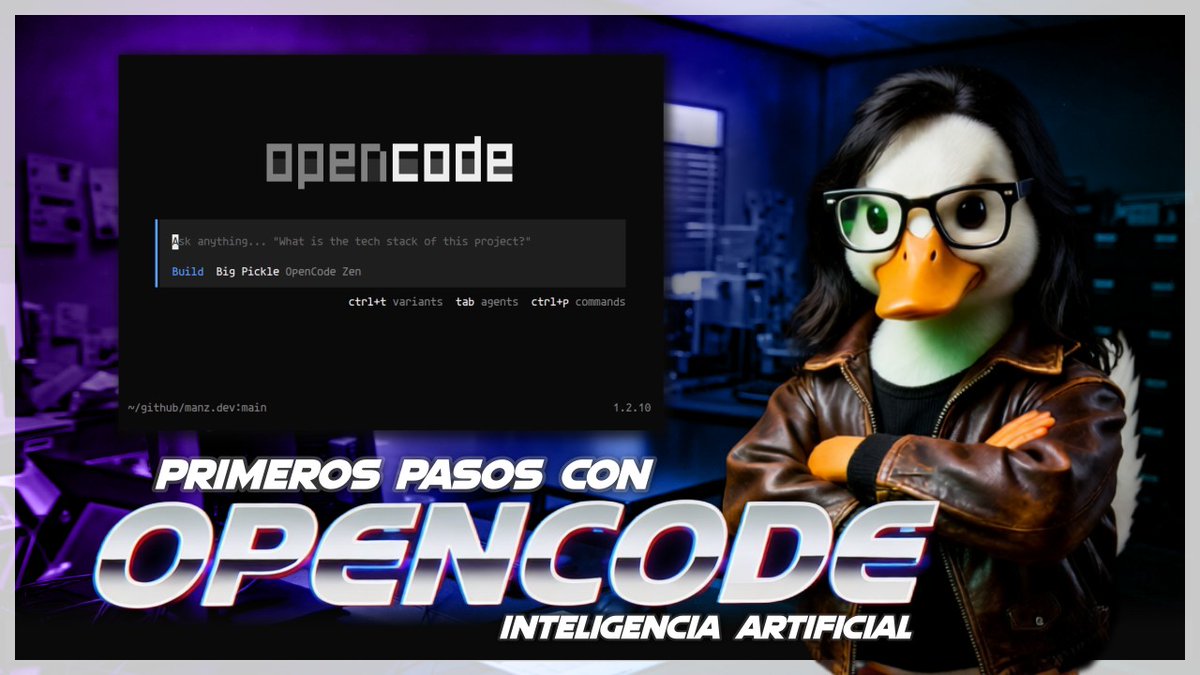
¡Recuerden que por mi canal de Youtube tienen un curso completito para aprender a utilizar OpenCode!
✅ Programación agéntica con Opencode
✅ Utilizar modelos, plan/build y skills
✅ Comandos personalizados y ejemplos
✅ Uso de modelos IA en local mediante Ollama
✅ Uso de Qwen 3.6 en local mediante llama.cpp
👇 Links
15 SYSTEM DESIGN PRINCIPLES
1. SCALABILITY
→ Design systems to handle growth in users and traffic
→ Use horizontal scaling (adding more servers)
→ Avoid single-machine limitations
A good system should grow without breaking.
2. AVAILABILITY
→ Ensure your system is always accessible
→ Use redundancy and failover strategies
→ Minimize downtime
High availability = better user trust.
3. RELIABILITY
→ Systems should perform consistently over time
→ Handle failures gracefully
→ Ensure data correctness
Users should depend on your system without surprises.
4. PERFORMANCE
→ Reduce latency and response time
→ Optimize database queries
→ Use caching strategies
Fast systems improve user experience.
5. FAULT TOLERANCE
→ Design systems to continue working even when parts fail
→ Use backups and replication
→ Implement retry mechanisms
Failures are inevitable — plan for them.
6. LOAD BALANCING
→ Distribute traffic across multiple servers
→ Prevent server overload
→ Improve system responsiveness
No single server should carry all the load.
7. CACHING
→ Store frequently accessed data temporarily
→ Reduce database load
→ Improve speed
Examples: Redis, in-memory caching
8. DATABASE DESIGN
→ Choose the right database (SQL vs NoSQL)
→ Normalize or denormalize based on use case
→ Index for faster queries
Data design is the backbone of your system.
9. CONSISTENCY VS AVAILABILITY (CAP THEOREM)
→ You can’t have full consistency, availability, and partition tolerance at once
→ Choose trade-offs based on system needs
Understanding trade-offs is key in distributed systems.
10. MICROSERVICES ARCHITECTURE
→ Break systems into smaller independent services
→ Each service handles a specific responsibility
→ Enables scalability and flexibility
Avoid tightly coupled monoliths when scaling.
11. API DESIGN
→ Use REST or GraphQL
→ Keep APIs consistent and predictable
→ Version your APIs
APIs are the communication bridge between systems.
12. MESSAGE QUEUES
→ Handle asynchronous tasks
→ Improve system resilience
→ Decouple services
Examples: RabbitMQ, Kafka
13. SECURITY
→ Encrypt data (HTTPS, TLS)
→ Implement authentication & authorization
→ Protect against attacks (SQL injection, XSS)
Security must be built from day one.
14. MONITORING & LOGGING
→ Track system performance
→ Log errors and events
→ Use tools like Prometheus, ELK
You can’t fix what you can’t see.
15. DEPLOYMENT & CI/CD
→ Automate builds and deployments
→ Use pipelines for testing and release
→ Ensure smooth updates
Faster delivery with fewer errors.
System design is about making the right trade-offs while building systems that are scalable, reliable, and efficient.
If you want to master system design in depth:
Grab the System Design Handbook:
https://t.co/WIMretRdFc
Pedro "Ramayá" Beltrán es uno de los exponentes del folclor del caribe colombiano. Hijo Ilustre de la isla de Mompox interpretó con maestría la flauta de Millo y compuso obras que se inmortaliza en su amado Carnaval de Barranquilla. QEPD
🌿 #Regiones 🇨🇴 | Este sábado se confirmó el fallecimiento del maestro Pedro “Ramayá” Beltrán, reconocido como el rey del millo, instrumento esencial en la interpretación de la cumbia y figura clave en la creación de la Cumbia Moderna de Soledad. Su legado marcó profundamente la música tradicional del Caribe colombiano.
🎶 Pedro Agustín Beltrán Guzmán, nacido en 1930 en el corregimiento de Patico, en Talaigua Nuevo (Bolívar), dedicó su vida a la preservación y renovación del folclor. Su sonido, su maestría con el millo y su capacidad para fusionar tradición y modernidad lo convirtieron en un referente indispensable del pentagrama nacional.
💬 Su esposa, Cielo Ricaurte, expresó en redes sociales: “Es y será siempre nuestro baluarte. Pongan música, mi gente, pongan su música.” Un mensaje que resume el espíritu alegre, creativo y profundamente musical del maestro.
🎼 Para músicos como Pedro Tapias “Dripe”, director del Grupo Cumbia Caribe, Ramayá fue un juglar del folclor, un creador que dejó huella en generaciones de intérpretes y en la memoria cultural del país.
@codemiadot Ese símil es falaz, no es nada similar la situación sucedida con los programadores que nos tocó el tiempo de las tarjetas perforadas a lo que sucede hoy con la IA. Los codificadores desaparecerán como cenizas, los ingenieros de sistemas y computación volverán como el ave f��nix