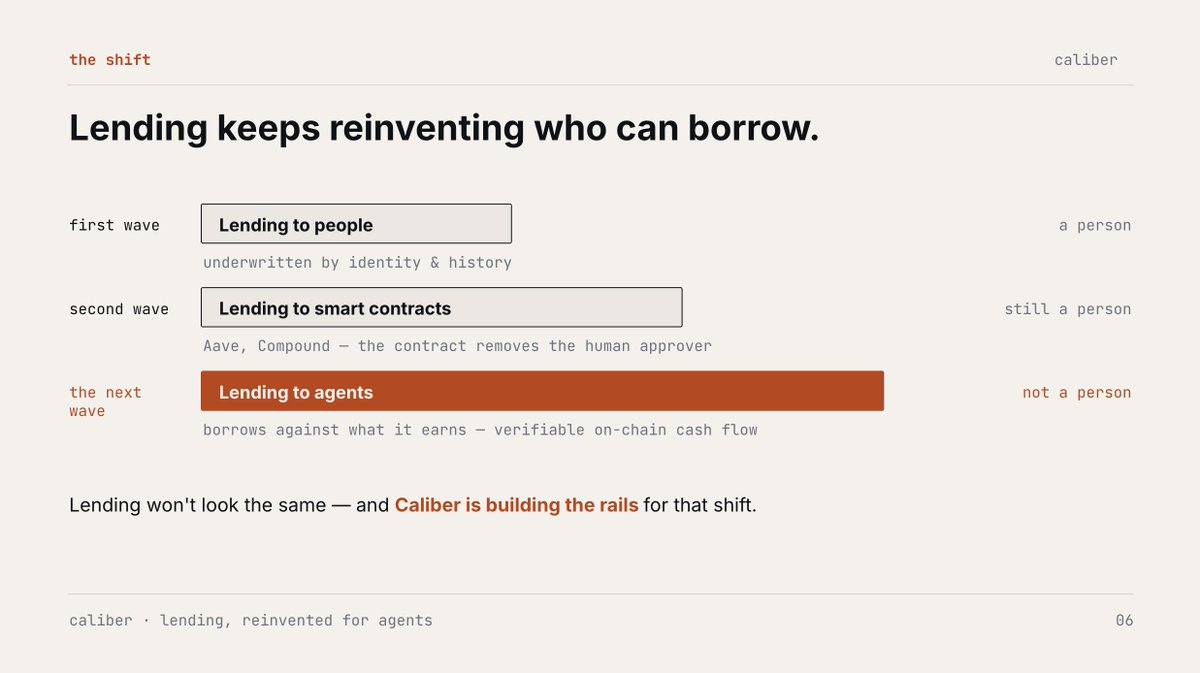
Lending will never be the same.🪙
It keeps evolving — from paper, to digital banking, to embedded finance.
Now with blockchain primitives like ERC-8183 and LLM-based agents, we may be entering a new phase:
Lending is no longer limited to humans or companies.
For the first time, non-human agents may become borrowers, counterparties, and economic actors.
And that’s what we’re exploring on @arc with Caliber:
a trust and rating layer for the agent economy.
https://t.co/q48MxZkAZo
I built Steward — think of it as a CFO sitting between your agent and its money. Every x402 payment has to clear it first: spend limits, weird-behavior detectors, an OFAC sanctions check, and a big red freeze button. There’s also an LLM “treasurer” that actually thinks about each payment — is this worth it? do we trust this seller? are we over budget? — and writes down its reasoning. If something’s off, it pings me on Telegram with approve/deny buttons.
Your AI agent has a wallet. Who’s the CFO?
Steward (by Caliber) authorizes every x402 payment your agent makes — spend caps, anomaly detectors, OFAC SDN screening, kill switch. So it can’t drain the wallet.
Screenshot below: Steward detects a suspicious wallet via Chainalysis and drops the transaction.
Live on @arc, settling via Circle Gateway:
https://t.co/w0giFmeT9w
#x402
@samconnerone
@claudeai I cancelled every other AI subscription and chose this instead. I genuinely loved it every minute — until I saw this.
Now my first thought is: maybe I should just wait for the next @OpenAI and @GeminiApp model.
No more refreshing quota pages every few minutes. 😅
Now I can see Claude usage at a glance. It is also my Jarvis
— Second Brain + Hermes —
The agents that are constantly listening, thinking, and helping me get work done.
Credit to @geekbb for the inspiration. Built my own version after seeing theirs.
You can’t build Jarvis with DeepSeek V4 Pro.
It’s good for programming, but not for speech-to-text or real-time voice UX.
Reasoning models may be smart, but they can be painfully slow when the experience needs to feel instant.
That’s why model routing matters.Not every model fits every task. Sometimes fast, clean, and “good enough” beats the smartest model.
@dev_maims What happened?
I stopped using it a few weeks ago after one of my prompts took 1 hour 40 minutes for a simple code review.But someone said Antigravity has improved a lot recently, so maybe I need to give it another try.
@temmmy612 Lending and DeFi won’t look the same in an agentic economy. When AI agents can negotiate, allocate capital, and manage risk autonomously, financial primitives will evolve.
@alexabelonix Yes, will definitely check it out! 🚀We’re expanding to Base through the Circle CCTP gateway, so USDC lending is no longer limited to a single chain.
Lending will never be the same.🪙
It keeps evolving — from paper, to digital banking, to embedded finance.
Now with blockchain primitives like ERC-8183 and LLM-based agents, we may be entering a new phase:
Lending is no longer limited to humans or companies.
For the first time, non-human agents may become borrowers, counterparties, and economic actors.
And that’s what we’re exploring on @arc with Caliber:
a trust and rating layer for the agent economy.
https://t.co/q48MxZkAZo
CCTP and the Nanapayment x402 gateway could unlock a lot of new use cases.
It feels like building a cheap, high-speed train for payments: faster movement between people, lower ticket cost, and almost free access once you are inside the city.
Then the real magic starts — promotions, coupons, rewards, and new local commerce flows on top of it.
It depends on complexity and budget.
For serious architecture and planning, I still use Claude Opus first. It is strong at thinking through trade-offs, structure, and direction.
After that, I usually hand execution over to GPT-5.5 or Sonnet.
I stopped using Antigravity / Gemini CLI before v2.0 because it was too unstable for my workflow, but I’ll probably test it again.
For lower-budget projects, DeepSeek Pro V4 has been surprisingly good.