We’re excited to announce that Nichole Bauer of LSU will be the next Editor-in-Chief of Political Behavior, beginning January 1, 2027.
We’re grateful for our wonderful PB community and encourage everyone to welcome Dr. Bauer to the role!
Learn more here: https://t.co/Nt5OE4QNr6
Across nine European countries, Hegewald finds that urban and rural residents hold distinct stereotypes of one another, with people tending to project their own traits onto their place-based in-group.
Read more:
https://t.co/ZTCcr9e8xp
Guess, McGregor, Pennycook, and Rand show that nearly any digital media literacy tip improves sharing decisions, but only source-focused tips reliably boost accuracy judgments.
Read more:
https://t.co/5JqWocAhDW
Slaughter, Burge-Hicks, and Brown show that Black women voters are far from monolithic, revealing diverse perspectives on Kamala Harris despite strong Democratic support.
Read more:
https://t.co/eUwUW50UeW
We have published an Expression of Concern regarding Margaret Perez Brower’s "Reframing Gendered Issues: Intersectional Identity Frames and Policy Agendas.” See full exchange between author and critics, as well as editorial commentary, here: https://t.co/cNMVhBqXre
Using decades of European Social Survey data, Schönheit finds that attitudes on cultural issues have become modestly more interconnected since 2012. The increase is driven largely by right-leaning, older, and politically engaged individuals.
Read more:
https://t.co/6zxbSqrFvo
Amoah finds that support for political vigilantism in Ghana depends not only on partisanship, but also on whether the action is seen as advancing the public good.
Read more:
https://t.co/WhLgdg5aC2
Osei, Schädler, & Kibirige find that well-connected MPs with stronger parliamentary networks and access to party funding are more likely to win re-election. Meanwhile, constituency service, shows little relationship with electoral success.
Read more:
https://t.co/WhLgdg4CMu
Badrinathan, Kapur, & Vaishnav examine how group status shapes political attitudes, finding that Indian Americans express different policy preferences depending on whether they are considering the U.S. or India.
Read more:
https://t.co/HzaXefo5Og
How do partisan social norms influence conversations about race? West finds that co-partisan discussions increase racially resentful rhetoric among white Republicans.
Read more:
https://t.co/aNh9MqruLa
Paksoy & Huddy explore strategies to reduce affective polarization, showing that perspective-getting improves attitudes toward political opponents across two polarized democracies.
Read more:
https://t.co/CVjuH3io6w
Who trusts government? Chudy & Engelhardt find that perceptions of group status and marginalization help explain political trust across racial groups, beyond which party holds power.
Read more:
https://t.co/fmgwZ1dQkz
Crabtree examines how racial identity shapes reactions to civilian-perpetrated violence, finding that Black Americans respond with greater anger and punitiveness when violence targets their racial in-group.
Read more:
https://t.co/QnmOUHByNz
How much do campaign text messages matter?
Haenschen, Mann, & DeMora find that SMS mobilization can increase voter turnout, with message content and timing shaping effectiveness.
Read more:
https://t.co/2foBcqe1Iq
Using data from 2006–2020, Cassella & Shepherd examine how partisan policy threats influence firearm purchases following presidential elections and mass shootings, highlighting the role of political context in shaping gun owner behavior.
Read more:
https://t.co/ViTH4iDoWM
What are the long-term political consequences of economic reform?
Using evidence from China's state-owned enterprise privatization, Xingchen Lan & Hongshen Zhu examine how large-scale layoffs shaped political trust and political behavior.
Read more:
https://t.co/DyxguOrS6W
How do Muslim citizens evaluate fundamentalist Muslim immigrants?
Using a conjoint experiment in Kazakhstan, Masaaki Higashijima, Akira Igarashi, & Yujin Woo examine how religion and religious intensity shape attitudes toward immigrants.
Read more:
https://t.co/ZhW28RqJjl
Using a novel dataset of 450 U.S. sermons, Paul Lendway examines how local sermon rhetoric relates to political attitudes and behavior, highlighting the role of religious messaging in American politics.
#ReligionAndPolitics#VotingBehavior
Read more:
https://t.co/kFLk5UuNrL
What explains opposition to teaching about racism in higher education?
Using survey experiments, Adam Thal examines the factors shaping White Republicans' views.
#AmericanPolitics
Read more: https://t.co/0Lns6bkgZE
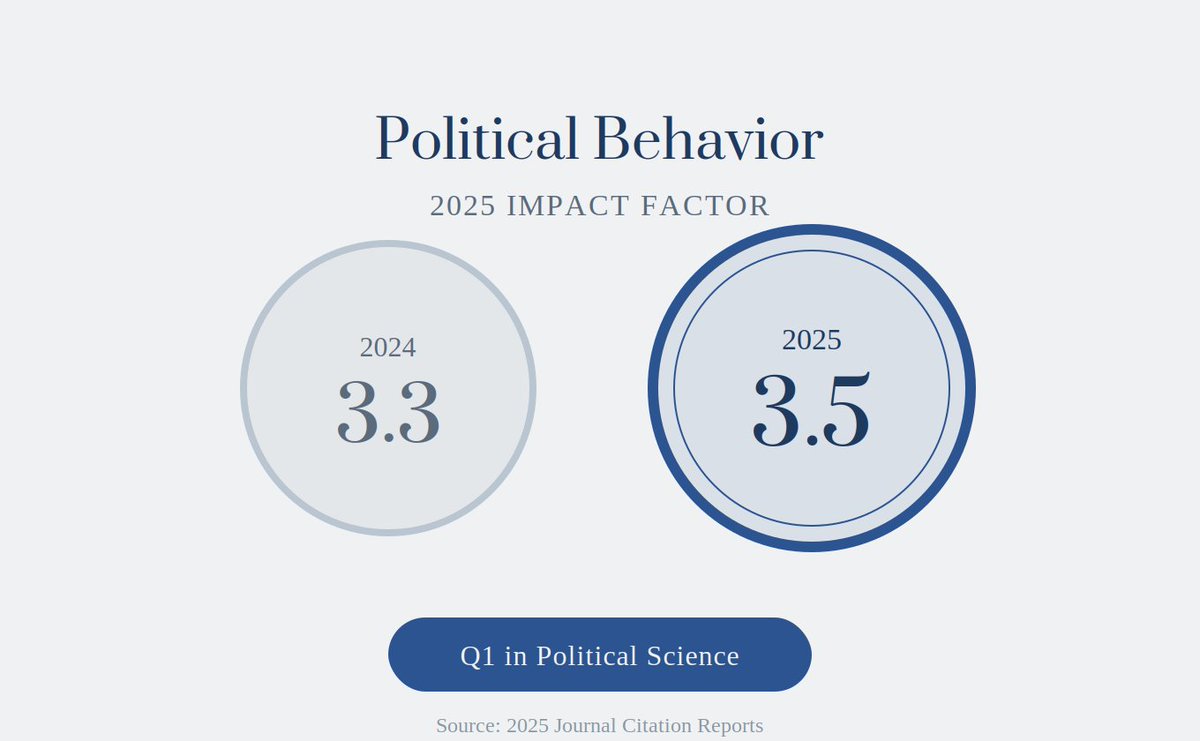
📈 Excited to share that Political Behavior’s Impact Factor climbed to 3.5 in 2025 (up from 3.3), keeping us a Q1 journal in Political Science. Thank you to our incredible community of authors and reviewers! 🎉
#PoliSci#AcademicTwitter