The deadline for PhD review proposals is very soon.
We know of intentions to submit from fresh PhDs from BE but we're still looking for submissions, especially from new PhDs from the NL and LUX.
Can you think of an aspiring ECR that may benefit from exposing their work in PLC?
Do you know a recent PhD from BE, NL, or LUX seeking exposure of their work? We are extending the deadline for our call for PhD Reviews. The reviews are twofold, with a summary by the PhD student and a critique by a reviewer. For details see: https://t.co/0wIw9xg8Xb
For all new doctors in political science in Belgium, the Netherlands or Luxembourg : we launch a new call for PhD reviews for @PolLowCountries !
⏳Submit your proposal by Sept 15
For any question or concern : contact me or @MauritsMeijers 😀
@scpo_be@vpw
Do you know a recent PhD from BE, NL, or LUX seeking exposure of their work? We are extending the deadline for our call for PhD Reviews. The reviews are twofold, with a summary by the PhD student and a critique by a reviewer. For details see: https://t.co/0wIw9xg8Xb
📢 If you are working on affective polarization and you want to present your research in a symposium with in-depth disscussions, look here 👇
@FasosMaastricht is hosting an event in October 🍂
Thanks 🙏 to co-sponsors @PolLowCountries and @ECPR!
The SI on "Affective Polarisation" aims to advance our understanding of the dynamics, causes, consequences, and potential remedies of affective polarisation. The call with a detailed list of possible themes is found here: https://t.co/Ag2czKPdpR
PLC is inviting contributions for our issues in 2023/24. We are looking for PhD Reviews as well as papers for two exciting special issues. Proposals and abstracts are due on 15th July. We also continue to welcome papers on any political issues in the Low Countries at any time. /1
The SI on "Communication in envrionmental politics in the low countries" will be guest edited by @anais_auge and Ramon van der Does. It aims at an interdisciplenary approach combining insights from political sciences and linguistics. For full info see: https://t.co/BesrYbRznH /3
📢Recently defended your PhD thesis in an university in 🇧🇪🇳🇱🇱🇺?
We're looking for PhD reviews in @PolLowCountries !
New two-in-one format :
🗨️PhD summary by the PhD student (ca. 1000 words)
💭 PhD critical review by one reviewer (ca. 500 words)
⏳Submit before 10 July
The deadline for abstract submissions for our special issue on "Women and Politics" is fast approaching. Make your submission by Friday 31st March 2023.
On #InternationalWomensDay#IWD2023 we are launching a call for papers for a special issue on "Women and Politics in the Low Countries". We seek submissions that highlight the various ways in which women participate in politics. The deadline for abstracts is 31st March 2023. /1
Call for papers! ✍️✨
@PolLowCountries invites submissions of original research articles for a special issue on women and politics in the Low Countries (Belgium, the Netherlands, Luxembourg).
Read more here 👉 https://t.co/HucBeeUv9h
📢 Submit your proposal for the upcoming special issue of @PolLowCountries on "Women and Politics" ♀️
📅 Deadline for abstracts : 31/3
📅 Deadline for papers : 1/6
@scpo_be@VPW_be
Focal points for papers could include active and passive electorates, turnout, social movements, leadership, symbolic representation and much more. Submissions should have a relevance to the Low Countries. Full details for the call are available here: https://t.co/EkVc5xWuLv /2
On #InternationalWomensDay#IWD2023 we are launching a call for papers for a special issue on "Women and Politics in the Low Countries". We seek submissions that highlight the various ways in which women participate in politics. The deadline for abstracts is 31st March 2023. /1
To conclude PLC 22-02, Ekaterina R. Rashkova’s research shows that non-citizen residents’ party support in the Netherlands tends to be rather skewed towards non-established parties. 6/6 https://t.co/ozRUsMrvze
The second contribution to PLC 22-02 by @s_azabar and Thijssen focuses on Belgium and explores the voting behaviour of the Muslim religious minority based on structural equation techniques. https://t.co/2iD1isFKaD 4/6
The 3rd contribution by @j_sijstermans and
@Adrian_Favero examines how immigrants are portrayed in parties’ public discourses, focusing on two cases of so-called populist radical right parties (PRRP). #OpenAccess 5/6 https://t.co/A30y4d4W6e
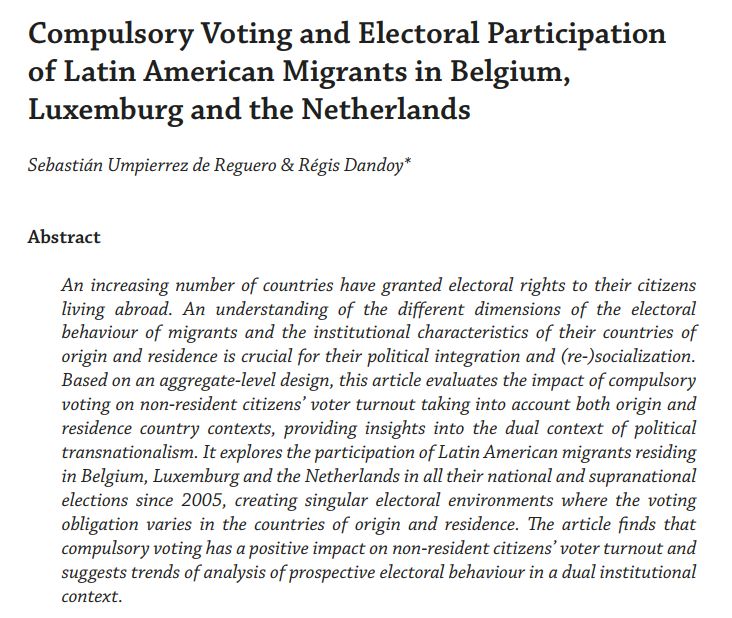
The 1st piece of PLC 22-02, by @rdandoy and @sumpierrez1, uses a quasi-experimental design to show that political-institutional factors such as compulsory voting matter for transnational political participation. https://t.co/8z8UKodxIC 3/6
We proudly present our 2nd issue of the year, a special issue titled "Demand- and Supply-side Approaches to Migrant Political Integration: A Focus on The Low Countries" edited by @Scamatarri and @Pbaudewyns https://t.co/CZwuMIV9lM 🧵 1/6