“I don’t like unopposed elections. I’ve already gathered money, so find someone to contest me. When I pay, the person will also pay.” - MP for Kwahu Mpraeso, Davis Ansah Opoku, tells NPP delegates.
Ghanaians Must Change: Our roads and pavement/pedestrian walkways not your shop floor or trading points
When you walk through any of our cities like Accra or Kumasi, you will realize that traders have occupied roads and pedestrian walkways for their trading activities.
Woe betide you if you step on the items of any of these traders, the insults you will receive your whole mood will change for the day.
"We cannot progress as a country if you keep portraying these behaviors"
believe this things can change if firstly, we as a people change our behavior.
Secondly, the necessary authorities need to educating our traders and market women about the dangers of selling on pavement and on the median of roads.
Thirdly, the authories should start enforcing the laws to prevent traders from selling at those places.
Finally, the government should do well to build better bigger markets that can accommodate all of these traders and market women so that they won't be selling on the roads or pavement.
Ghanaians Must Change!
#ElikemTheGossip_Official
You wake up. You sit in traffic. You do your job. You pay the bills. You go to sleep.
The next day? You press repeat.
You think you’re just "being an adult." You think this is what responsibility looks like. But there is a reason the last five years of your life felt like they vanished in five minutes. It’s not just because you’re busy. It is because your brain is shutting down.
Let’s look at the biology of it. Your brain doesn't age strictly because of time; it ages because of repetition. When you live the exact same day over and over again, your neurons stop firing with intensity. They quiet down. Your brain builds neural pathways based on experience, but when the experience is 100% predictable, your brain stops recording new memories. It stops encoding. It just goes on autopilot and references the old files.
Think back to when you were still a child. A single holiday felt like a lifetime. Why? Because everything was new. Every day was a discovery. Your brain was lit up, building new connections every hour.
Now you are 25,30,40. January turns to December in the blink of an eye. Why? Because you are living in a loop. Everything is familiar. Your brain is bored.
And I need to speak to the men specifically because this is the silent tragedy of modern masculinity.
Society has scammed you. We tell men: "Be consistent. Be stable. Don't take unnecessary risks. Just provide." We praise you for being predictable. So you turn yourself into a machine. You sacrifice your spontaneity for stability. You kill your sense of wonder just to keep the lights on.
That is why you see men who are only 45 but their eyes look 70. The routine is eating them alive from the inside out. You are trading your perception of time, your actual life for a paycheck.
But here is the truth they don't tell you: Neuroplasticity doesn't stop just because you have a stable job or source of income. You can still grow new neurons. You can still learn. You can still slow time down.
But you have to break the algorithm.
You have to shock your system.
Take a route to work that doesn't make sense. Quit the safe index fund and learn the market strategy that scares you.
Your brain will only wake up when it doesn't know what is going to happen next.
Don't let the "Grind" turn you into a zombie. If you don't break the loop, you’re going to wake up old one day realizing you didn't live a life. You just lived the same boring year 40 times in a row.
Wake up.
If you casually flirt with every woman you meet and greet random guys with a “what’s up bro” energy, you'll go far in life. Everyone’s just a kid in an adult body. They want complements and connection. Be that guy and you’ll never be broke or lonely.
BITCOIN EDUCATION: Does Bitcoin Consume Too Much Electric Power?
A common complaint against #Bitcoin is that Bitcoin mining consumes more electric power than medium-sized countries like Argentina, Poland, and Norway.
But, actually, Bitcoin mining is both pro-environment and pro-energy production. Bitcoin miners search for the cheapest energy possible, even free energy to power their mining computers.
This incentivizes the spreading out and decentralization of the power grid to remote locations, which then incentivizes the spreading out of the population away from cities, which takes pressure off the grid.
And this incentivizes the production of clean, renewable energy (essentially free energy) -- such as solar, wind, and hydro.
Bitcoin miners also capture and use methane gas from oil drilling, which would otherwise just be released into the atmosphere.
Power companies must produce more power than they use. Bitcoin miners help stabilize the power-grid by purchasing excess electric power that would otherwise just be wasted.
WHAT IS BITCOIN MINING?
Specialized computers are in worldwide race every 10 minutes to guess a number. The difficulty of the number to guess increases as the number and power of the mining computers increases. The winning computer every 10 minutes receives a reward (currently 3.125 Bitcoins) plus transaction fees.
Bitcoin mining serves two purposes:
1) To confirm the validity of transactions; and
2) To secure the network.
The network is secured by an enormous wall of electric power plus a double-layer of SHA-256 cryptography, which was developed by the NSA to secure America's military networks.
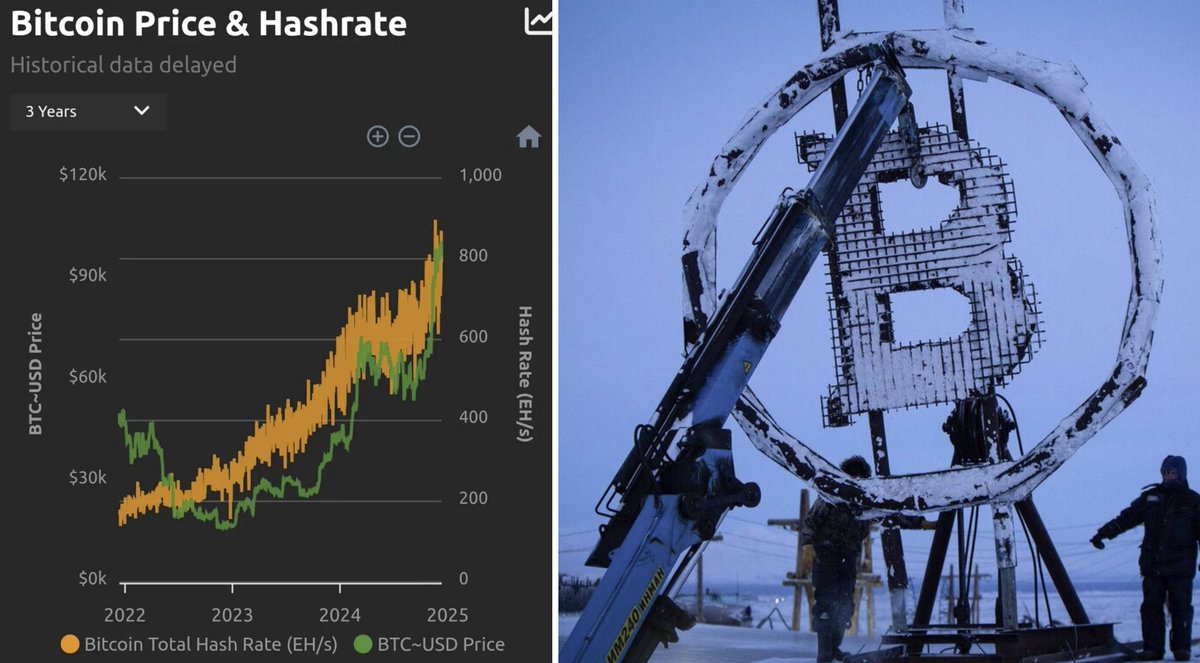
This chart shows the "Hash Rate" in relation to Bitcoin's price. The Hash Rate is the amount of compute power used by Bitcoin miners to confirm transactions and secure the network (win race to guess the number every 10 minutes).
Every Bitcoin owner and miner is also incentivized by the profit motive to protect the network.
The bigger the network, the more it electric power it consumes, the more difficult the hashing number becomes to guess, the more secure the network becomes.
There are more possibilities for private key codes than there are atoms in the known universe. And that's just one layer of security.
The Bitcoin network has never been successfully hacked. People have lost their Bitcoin by being careless with their private key code.
But Bitcoin's underlying technology has never been successfully hacked.
BUT IS THIS A WASTE OF MONEY AND RESOURCES?
Currently, the worldwide Bitcoin mining network is paid about $35 Million per day (or about $13 BILLION for the year) for their work: Processing transactions and securing this $1.7 TRILLION network.
How much do we spend on the military, on police, on courts, banks, law firms, etc to protect our property in the physical world? Trillions and trillions of dollars every year.
Viewed this way, the Bitcoin network is extremely efficient at protecting wealth.
Bitcoin's proof-of-work system (the mining process) is the most secure method ever devised to protect a decentralized, permissionless computer network, which anyone can join and where there is no central authority.
The competing method is proof-of-stake -- which is much less secure and incentivizes centralization.
How to build wealth slow and steady, without get rich quick schemes:
Buy $150 of Bitcoin per month for 30 years, 25% return
Your annual expenses are $60,000
You would have invested $54,000 in that 30 year period
In 2056, your portfolio would be worth ~$7.3M
You would have ~11.4M Satoshis
Your expenses would be up to $456K/year, up 660%
Your portfolio would have grown by 13,350%
It would cover you for 15.9 years of expenses at that point
You can also choose to increase the amount you invest and build your portfolio even bigger or retire much sooner!
I understand many Accra residents hardly travel beyond the region. But it's obvious a lot of kids in Accra who disrespect Kumasi on this app have never been to Kumasi before. I once hosted someone from Accra and after giving her a tour of the city, she called her mom back home at
“If I put $100 in Bitcoin in 2010 I’d have $2.8B now.”
No.
If you bought $100 of Bitcoin in 2010 and watched it go to:
$1k → $100k → $1.7M
and did nothing
Then watched $1.7M go to $170k
and still did nothing
Then watched $170k go to $110M
and still did nothing
Then watched $110M wither to $18M
and still did nothing
Then watched $18M surge to $390M
and still did nothing
Then watched $390M deteriorate to $85M
Then watched $85M climb to $1.6B
and still did nothing
Then watched $1.6B shrink to $390M
and still did nothing
Then watched $390M surge to $2.8B
and then for some reason finally decided to do something…
Then yes, $100 in 2010 would be worth $2.8B today.
For the next 5 days, I’ll break down the stock market from scratch.
Part 1: What stocks really are
Part 2: How markets work
Part 3: How to choose stocks
Part 4: Risk & mistakes to avoid
Part 5: Building your first portfolio
Follow, engage, retweet, and drop your questions.
Ghanaian 🇬🇭 architect Sir David Adjaye is the creative mind behind numerous powerful global landmark projects, including:
The National Museum of African American History and Culture in Washington in the US
The Children’s Cancer Centre in Rwanda 🇷🇼
The Sycamore & Oak in Washington, America.
The Moscow School of Management in Russia
The Abrahamic Family House in Abu Dhabi, UAE, and a 160-acre urban development project in Uganda.
In Ghana, his notable works include the proposed New Parliamentary Chamber, the International Cancer Centre for Children, the Marine Drive project, the Trade Fair Centre redesign, the National Petroleum Corporation’s Head Office, and many more!
BAN SPORTS BETTING IN GHANA
BAN SPORTS BETTING IN GHANA
BAN SPORTS BETTING IN GHANA
BAN SPORTS BETTING IN GHANA
BAN SPORTS BETTING IN GHANA
BAN SPORTS BETTING IN GHANA
BAN SPORTS BETTING IN GHANA
BAN SPORTS BETTING IN GHANA
BAN SPORTS BETTING IN GHANA