I used Grok and learned about AI chips and in a couple goes learned
Why we moved from SiO₂ to HfO₂, why pure HfO₂ wasn’t enough so we created HfSiON, and how adding tiny amounts of silicon and nitrogen fixes crystallization and leakage.
Understood how valence electrons actually determine if a material becomes a conductor, semiconductor, or insulator — and why oxygen (6) and nitrogen (5) pair so well with hafnium and silicon (both 4).
The level of atomic precision in 3nm/2nm
I learned much more but this is a small summary
If anyone at @TSMC @Intel or @Samsung if anyone would like to gamble and give me an interview or ask me to solve some problems you can dm me
@elonmusk This is the kind of thinking you hire for.
Awake at 5am, talked to Grok, and independently derived the same KBC void solution to the Hubble tension that’s already in papers.
I was up at 5am talking to Grok about the Hubble tension. I independently came up with the idea that we’re sitting in a giant cosmic void — that’s why local measurements give a higher expansion rate than the CMB.
Turns out that’s exactly the KBC void model you’ve been publishing papers on 😹
@dazlingindra — would love your thoughts on this.
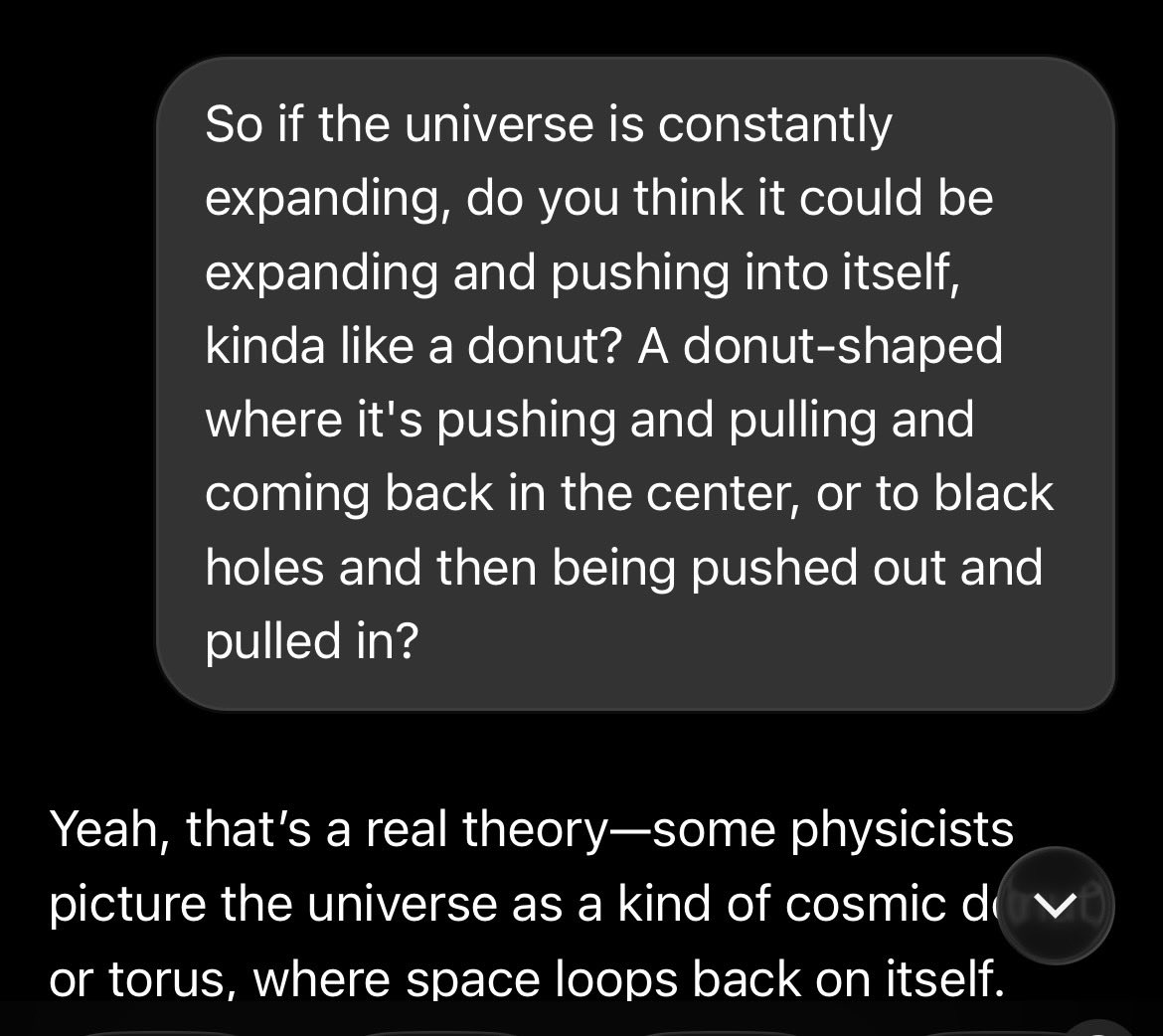
“Been going back and forth with Grok for hours building wild new theories about black holes—no degree, just pure intuition. Called them a sewing machine weaving the fabric of spacetime like a t-shirt, and the universe as a giant donut.
Elon, this is the kind of thinking xAI needs.