Hiring | PolyClick (One-click Polymarket arbitrage) | RemotePolyClick is officially live.
We’re turning Polymarket arbitrage from “hunting scripts + manual monitoring” into a true one-click workflow. We’re now expanding the strategy pool and upgrading automation and 24/7 stability. Open roles:
Arbitrage Strategist (1)
Compensation: 3,000–5,000 USDT/month
Responsibilities: design and validate executable arbitrage strategies (opportunity → rules → risk controls → execution loop); write implementation-ready specs for engineering; build strategy metrics/monitoring; continuously iterate and expand markets/windows.
Requirements: strong logic; can clearly separate facts/assumptions/inferences; comfortable reading English sources; genuine interest in prediction markets and arbitrage.
Frontend Engineer (1)
Compensation: 3,500–6,000 USDT/month
Responsibilities: own the frontend (dashboard, strategy subscription, execution status, PnL, positions); simplify user flows; deliver clear visualization and state feedback with high usability.
Requirements: ability to ship independently; solid frontend fundamentals; strong product sense.
Backend Engineer (1)
Compensation: 4,500–6,500 USDT/month
Responsibilities: own the execution backend (job scheduling, state machine, risk controls, logs/reports, monitoring/alerts); ensure 24/7 reliability; build observable, replayable, accountable execution with fund safety.
Requirements: strong backend fundamentals (idempotency, retries, queues, consistency); trading/on-chain/high-availability experience is a plus.
Work style: remote collaboration; weekday (Mon–Fri) responsiveness.
To apply: DM me with the role, portfolio (repo/demo/strategy outline), availability, and timezone. I will review applications personally.
Day 2 Our Polymarket arbitrage strategy has been running 24/7 for 48 hours with a starting capital of 2,000 USDT and 20 USDT per trade, successfully completing 74 arbitrage wins. So far, we’ve steadily made 29.35 USDT, with a 1.46% ROI over two days. If you’re into risk-free Polymarket arbitrage but don’t know where to start, stay tuned for our product launch—one click to turn on the strategy.
See you soon.👀 #Polymarket @Polymarket
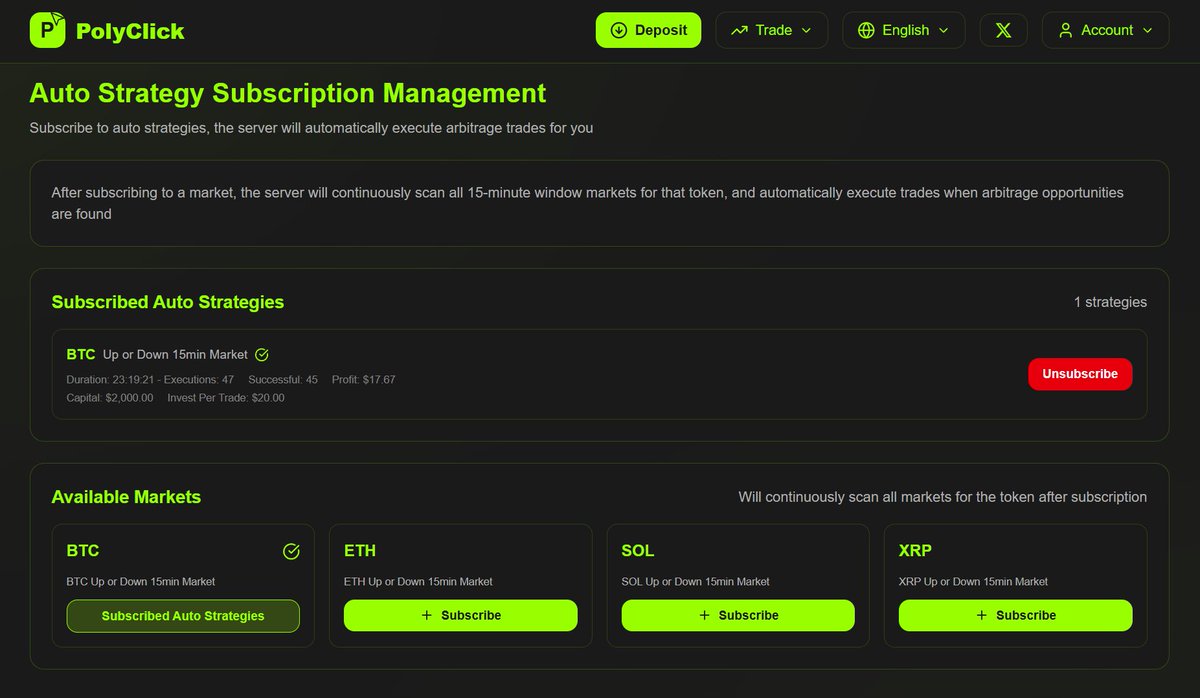
Our Polymarket arbitrage strategy is already running steadily: it operates 24/7 with a starting capital of 2,000 USDT, uses 20 USDT per trade, and has successfully captured arbitrage 45 times; it consistently earns 17.67 USDT per day, which is a 0.88% daily return—if you can do the math, that’s 26.4% monthly. We welcome sigma investors who love low-risk, steady arbitrage; but if you’re chasing high-risk, high-return plays, we’re not for you.
See you soon.👀
Our one-stop Polymarket arbitrage product is almost ready ✅
The core strategy has been proven live and has successfully captured arbitrage (not just backtests).
Key features👇
• One-click deposit/withdraw for smoother fund management
• Paste a market URL to trade instantly
• Subscribe to markets → run arbitrage automatically
• Strategy Dashboard: transparent tracking of every execution + PnL
• Positions: see holdings/exposure at a glance
Launching very soon 🚀👀
#Polymarket
7/7
Roadmap: start with lower-complexity single-venue/simple hedge strategies → expand to cross-market multi-leg execution + full dashboard → launch a strategy marketplace (tiers, labels, author reputation, performance attribution).
If you’re a strategy builder, a prediction-market power user, or a non-coder who wants access—tell me: what risks matter most to you, and what info would you need before clicking “Deposit”?
1/7
Prediction-market arbitrage is in an awkward “scavenger era”: the opportunities exist, but most of the edge gets picked up by people who can code. It’s not that others don’t understand prediction markets—execution is just locked inside scripts, infrastructure, routing, and risk management. Engineers win, everyone else watches.
Here’s the thread outlining our product concept and roadmap .👇👇👇
6/7
We’ll make it a “white box” through transparency + risk controls:
Transparency: strategy contracts/params/permissions are inspectable, every trade hash is traceable, PnL attribution is clear (edge vs fees vs slippage vs failure rate), plus health metrics (drawdown, utilization, stability).
Risk controls: per-vault max exposure, per-trade caps, max slippage, stop rules, exit rules; critical changes guarded by multisig + timelocks; non-custodial structure + least-privilege permissions.