🤖 NEW: German humanoid robotics startup Neura Robotics raised up to $1.4 billion from Nvidia, Amazon, Qualcomm, Tether, and others, reaching a reported $7 billion valuation.
Europe’s population may shrink by 2100.
But I think the whole debate around “more people = more future” is fundamentally wrong.
The real question is not only:
How many people will Europe have?
The real question is:
What kind of people will Europe have?
A highly developed society does not need endless population growth to function.
It needs highly capable people.
You can already see this everywhere:
In tech.
In industry.
In logistics.
In finance.
In research.
In the entire economy.
The more advanced a system becomes, the less it depends on mass labor, and the more it depends on knowledge, skill, creativity, engineering, automation, AI, and innovation.
Progress replaces quantity with capability.
Of course, every society needs a minimum demographic base. If the population collapses too far, institutions, infrastructure, pensions, defense, and communities come under pressure.
But the idea that a country only has a future if its population keeps growing forever is outdated.
The future will not belong to the country with the most people.
It will belong to the country with the most capable people.
So the real question for Europe is not:
“How many are we in 2100?”
The real question is:
“How developed, skilled, creative, healthy, educated, and innovative are the people who remain?”
This is the contradiction:
The U.S. wants to run larger deficits from October onward.
But larger deficits at higher yields are dangerous.
More debt
→ more Treasury issuance
→ higher yields
→ higher interest costs
→ even larger deficits
That is the debt-service loop.
So Trump does not need higher rates going into a larger borrowing cycle.
He needs controlled yields before that cycle begins.
That is why September/October matters.
It is not just a political window.
It is a financing window.
Before the new fiscal year starts, the system needs relief:
lower oil stress,
a calmer bond market,
and a clearer Fed path.
If not, the bond market becomes the real opposition.
#Macro #Crypto #Liquidity
🚨 NVIDIA Just Opened a Door to the Quantum Future
What if the secret to unlocking quantum computers was AI?
NVIDIA has launched ISING, the world's first open AI models designed specifically for quantum computing. These models help reduce errors and improve performance, bringing scientists one step closer to practical quantum computers.
It may sound like science fiction, but this breakthrough could speed up discoveries in medicine, cybersecurity, and materials science. The race toward the quantum future just got a lot more interesting.
Source:
NVIDIA. (n.d.). NVIDIA launches ISING, the world's first open AI models to accelerate the path to useful quantum computers. NVIDIA Newsroom.
This is the policy trap.
The economy is weakening and needs credit, liquidity, and easier financial conditions.
But inflation pressure is returning through energy, raw materials, tariffs, supply-chain delays, war costs, deficits, and the bond market.
Covid showed the pattern:
Policy supports the system first.
It fights inflation later.
The question is when the damage becomes large enough that policy is forced to support the system again, not because inflation has disappeared, but because financial and economic stress becomes the bigger risk.
ZRO Updates
More ZRO has been bought back and locked up than sold into the market. Institutions and buybacks have taken 19.77% of supply in 18 months, while 63.8% of ZRO unlocked to investors still hasn't moved. $112.7M has gone into ZRO buybacks since September 2025, one of the largest programs in crypto.
ZRO is the only asset in the LayerZero ecosystem. All economic value from Zero, LayerZero, and Stargate flows back to it.
Every token expresses a view. ZRO's first was that there'd be many chains, no single winner, and value would accrue to whatever connected them. Now LayerZero has moved $267B across 165 chains.
The next view is bigger. Money and markets are the two largest waves finance will ever see, and both are already onchain. Zero was built for this moment. Coming this fall.
I watched a PhD student use NotebookLM to do in 3 hours what took me 3 months.
I asked him how. He showed me his setup. I have not studied the same way since.
Here is exactly what he did.
He did not use NotebookLM as a search engine.
He did not type questions like "explain this concept."
He uploaded an entire field.
12 textbooks. 40 research papers. Every review article published in the last 5 years on his
topic. All uploaded at once. Into a single notebook.
Then he asked one question that changed how I think about learning:
"If you could only teach this subject using 7 sentences — one for each core idea — what
would they be?"
Not a summary. Not an overview.
Seven sentences. For the entire field.
NotebookLM produced them. He read them.
He asked a follow-up:
"For each sentence, what is the single experiment or paper that proved it was true?"
Now he had the skeleton of an entire field — and the exact evidence underneath each bone.
Then he did something nobody told me about.
He uploaded his own notes alongside the source material.
Then asked:
"Where am I wrong? What have I misunderstood compared to what the literature actually says?"
The system found three misconceptions he had carried for two years. Two of them would
have cost him his PhD defense if they had gone uncorrected.
He called this the Misconception Audit. He runs it on every subject before any exam, any
paper submission, any conference presentation.
Then the final step.
"Generate 10 questions a hostile expert would ask someone who claims to understand this
field. Then answer each one using only the sources I uploaded."
He was not studying to pass.
He was studying to survive interrogation by the smartest people in the room.
He passed his qualifying exam on a subject he had started studying 11 days before.
I have been studying the wrong way my entire life.
Here is his exact setup if you want to replicate it:
1.Upload the entire field — not one source
2. Ask for the 7 core sentences
3.Find the evidence under each one
https://t.co/IXovyuvPfc the Misconception Audit on your own notes
Survive the hostile expert interrogation
The information was always available.
The framing was the unlock.
He passed his qualifying exam on a subject he had started studying 11 days before.
I have been studying the wrong way my entire life.
Here is his exact setup if you want to replicate it:
1.Upload the entire field — not one source
2. Ask for the 7 core sentences
3.Find the evidence under each one
https://t.co/IXovyuvPfc the Misconception Audit on your own notes
Survive the hostile expert interrogation
The information was always available.
The framing was the unlock.
Because I constantly engage with very different topics. I often encounter many things I do not yet know or fully understand.
That is exactly why I find this logic so powerful.
It is not about having immediate answers.
It is about systematically making sense of a complex information landscape.
First, I ask:
What is the real question?
What assumptions am I making?
What cognitive biases could mislead me?
What alternative explanations might exist?
After that, I try to put this into transparent structures:
What data do I need?
Which sources are reliable?
What connections exist?
What system states can be identified?
Which statement is a fact, an interpretation, a hypothesis, or just an assumption?
For me, this is a very useful way of thinking because it does not hide uncertainty, it organizes it.
You do not need to understand everything immediately.
But you need a method to gradually transform complexity into clarity.
That is where I see the real value of Data Intelligence:
Not just collecting data.
But understanding systems.
Preparing better decisions.
And making visible how reliable a statement actually is.
Yeah, Crypto is tanking again because the CLARITY Act got delayed…
But that should tell us something.
The market already understands how important regulatory clarity really is.
The CLARITY Act is bigger than headlines or short-term price action.
And despite the delays, the groundwork is already being built everywhere:
Stablecoin regulation advancing
Tokenization infrastructure expanding
Major banks and asset managers entering the space
The U.S. moving toward formal crypto market structure
Too many powerful forces are pushing in the same direction now.
Tokenization is coming.
At the same time, the macro backdrop keeps getting stronger.
- ISM PMI just pushed back into expansion territory for the first time since the last cycle.
- Altcoins vs BTC just flashed bullish momentum signals not seen since 2020.
- TOTAL2 confirmed a breakout with multiple weekly green candles and a major MACD crossover.
- The Russell 2000 is sitting at all-time highs as risk appetite explodes across traditional markets.
And now this chart:
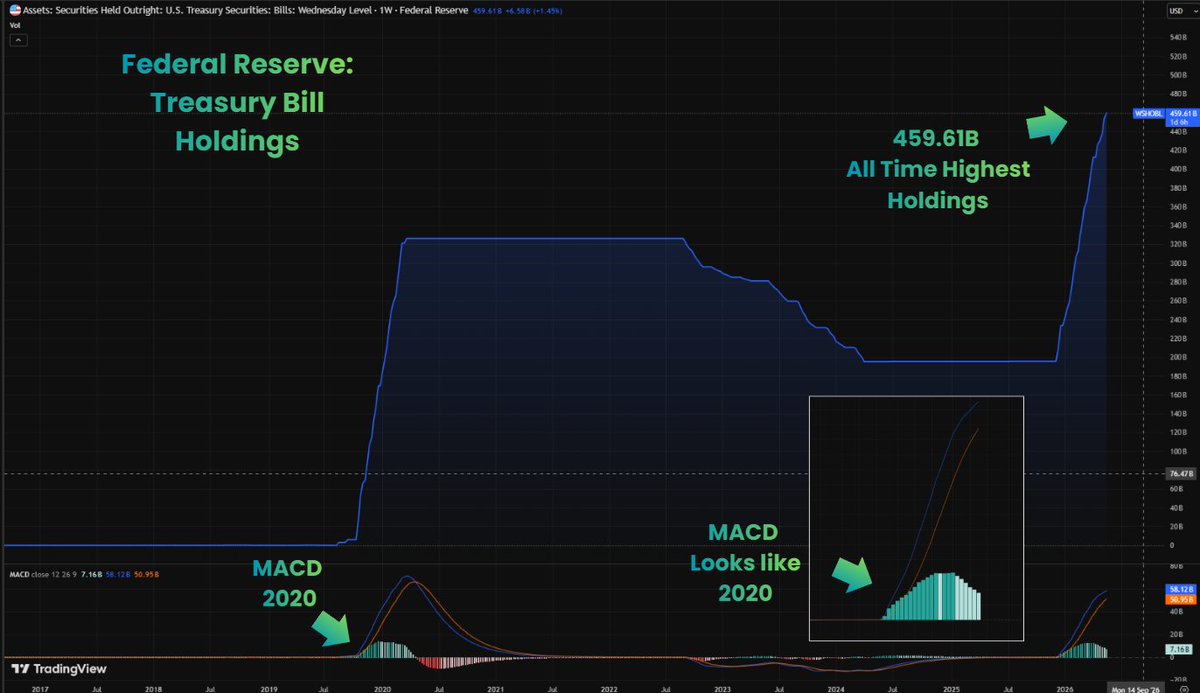
Federal Reserve Treasury Bill holdings just hit an all-time high at $459.6B.
That liquidity is already showing up in equities and small caps.
Crypto has historically been the last major market to fully react.
But once it does, it tends to move the fastest.
The impatient get shaken out during consolidation.
The patient usually get rewarded.
Another crazy breakthough
"Scientists developed ultrathin semi-transparent solar cells that are about 10,000 times thinner than a human hair."
"The new perovskite-based cells can generate electricity while still letting visible light pass through, making them suitable for windows, skyscrapers, and glass façades."
"In experiments, the transparent devices achieved 41% visible light transmission with 7.6% power conversion efficiency, while thicker versions reached efficiencies up to 12%."
The solar cells were also able to generate power under indirect and diffuse light conditions, which could make them useful in dense cities where direct sunlight is limited.
It's powerful step towards clean energy generation!
This is also where the macro-cycle perspective becomes important.
Ray Dalio and Martin Armstrong, from different frameworks, both point toward the idea that we may be in a late-stage macro cycle.
High debt, internal division, institutional distrust, and geopolitical rivalry often appear near the end of old orders.
Historically, these phases often create tension between the dominant power and rising powers.
That is why engagement with China matters.
Trying to improve communication and cooperation is not naive.
It may be one of the few rational ways to reduce conflict pressure inside the global system.
#SystemsThinking #Geopolitics #MacroCycle
https://t.co/SJ4kVCr9K2
Trump’s visit to China should not only be seen as daily politics.
It is not just about tariffs, Taiwan, Iran, trade deals, or diplomatic optics.
It is about something much larger:
Can the United States and China manage their rivalry without letting it escalate into a destructive conflict?
In a fragile world order, direct communication between the established global power and the rising power is not weakness.
It is system stabilization.
#Geopolitics #China #Economy
https://t.co/7QVZtua3E0
Warsh can say “Fed out of markets,” but the debt math says otherwise.
The U.S. is projected to run a ~$1.9T deficit this fiscal year, total federal debt is just under $39T, and net interest outlays are already running at roughly $3B/day. Permanently higher rates + real balance-sheet shrinkage are politically and fiscally hard to sustain.
So the shift may not be “no monetization.”
It may be quieter monetization: Treasury buybacks, more bank balance-sheet capacity via eSLR relief, and a form of YCC-light without calling it QE.
Less Fed printing, maybe.
But fiscal dominance does not disappear.
🚨 QUANTUM COMPUTING JUST HIT A NEW LEVEL
Europe’s JUPITER supercomputer has reportedly achieved a world-record 50-qubit quantum simulation.
That may sound small…
But simulating 50 interacting qubits pushes classical computing close to its limits.
Why this matters:
Quantum systems become exponentially harder to simulate as they grow.
At a certain point… even the most powerful traditional supercomputers struggle to predict what quantum systems are doing.
That’s where quantum computing changes everything.
Researchers are now building machines capable of:
• simulating new materials
• designing future medicines
• solving optimization problems impossible for classical computers
• modeling reality at the quantum level itself
The race is no longer just about faster computers.
It’s about building entirely new forms of computation.
The next technological revolution may not run on silicon alone…
but on quantum states existing in multiple possibilities at once.
Follow for more future physics and quantum breakthroughs.
Small update on my Earth-Atmosphere-System project:
I wrote before about building a layered Earth Field model, from external drivers, surface/ocean conditions and atmosphere to ionosphere, Global Electric Circuit and Schumann-resonance logic.
https://t.co/Vc28FRBNC4
Now Layer 8 is implemented.
Layer 7 creates time-stamped system-state snapshots.
Layer 8 reads the growing history and starts looking for patterns, transitions, field-operator behavior and first research hypotheses.
The project is slowly moving from “collecting states” toward “understanding system dynamics.”
https://t.co/snR8heyfyM
#EarthSystem #DataScience #ComplexSystems
I started building Earth Atmosphere System, a layered Earth-system framework for mapping field states, atmospheric coupling, the Global Electric Circuit and Schumann-resonance patterns.
The goal is not to predict weather.
The goal is to analyze Earth as a connected system:
External drivers
→ planetary body
→ surface / oceans
→ atmosphere
→ ionosphere
→ Global Electric Circuit
→ resonance field
→ Earth Field State Engine
→ system analysis
Layer 0–6 describe physical/data-based Earth-field states.
Layer 7 creates a snapshot of the total system state.
Layer 8 will later analyze patterns, transitions and hypotheses over time.
This is the beginning of an experimental Earth-field observatory.
GitHub: https://t.co/snR8heyfyM
#EarthSystem #DataScience #ComplexSystems