Introducing Ponchem. 🧬
Drug design. Scored on chain.
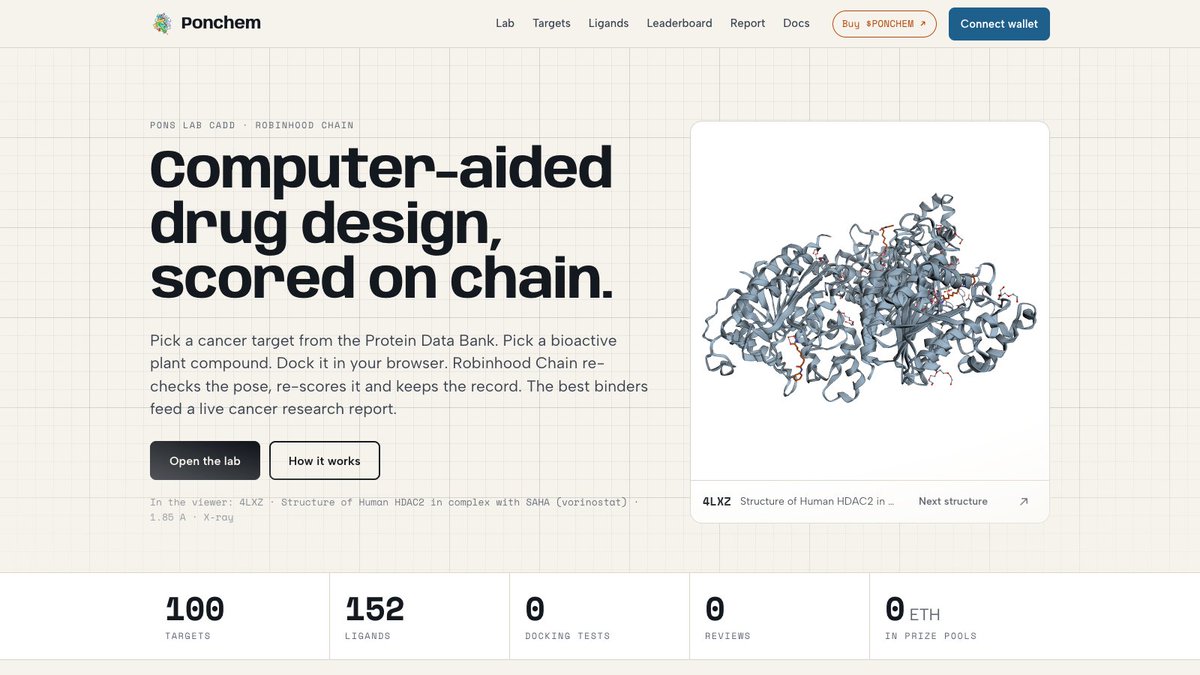
Building a computational drug discovery lab on Robinhood Chain, connecting molecular docking with auditable scoring and a shared research record.
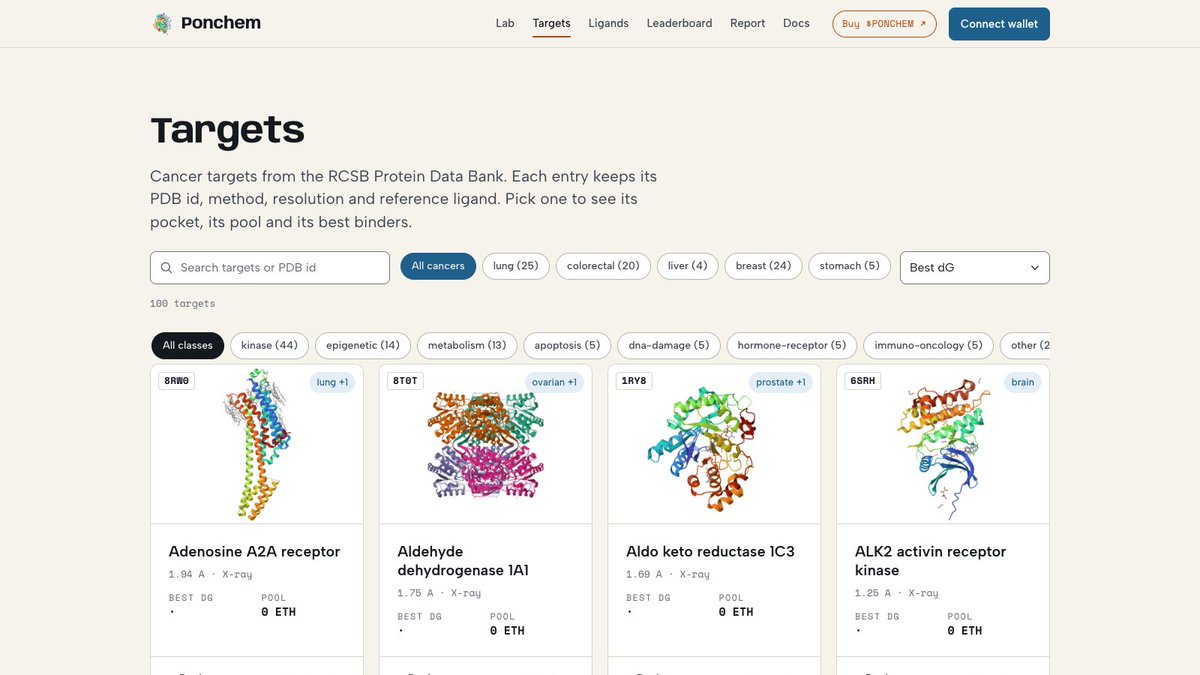
The initial library brings together 100 cancer-related protein targets from the RCSB Protein Data Bank and 152 bioactive plant compounds. Target structures retain their experimental provenance, while ligand records expose the chemical properties needed to explore and compare candidates.
The workflow begins with a seeded docking search. A proposed molecular pose is then submitted for geometry checks, contract-based scoring and on-chain recording. Hashed binding-pocket definitions anchor the target inputs, while an independent integer implementation of a Vina-style empirical scoring function makes the scoring logic inspectable.
This creates a common foundation for comparing submissions: defined inputs, documented calculations and traceable results. The planned workflow connects those records to target-level rankings, community review, sponsored screening epochs and an exportable cancer research report.
We’re also preparing to launch $PONCHEM, a payment token for docking-test submissions. The planned fee is 100 $PONCHEM or 0.0001 ETH per recorded test, paid to the lab treasury, connecting token utility directly to participation in the research workflow.
0x8e997cCF391De70033aD416f9f0048996417484D
The scientific objective is candidate prioritization. Computational scores help identify hypotheses for further laboratory study, biological activity still requires experimental validation.
🎯 Our goal is to make molecular screening easier to participate in, inspect and build upon.
Explore Ponchem Lab. https://t.co/zqq2MiM6V8
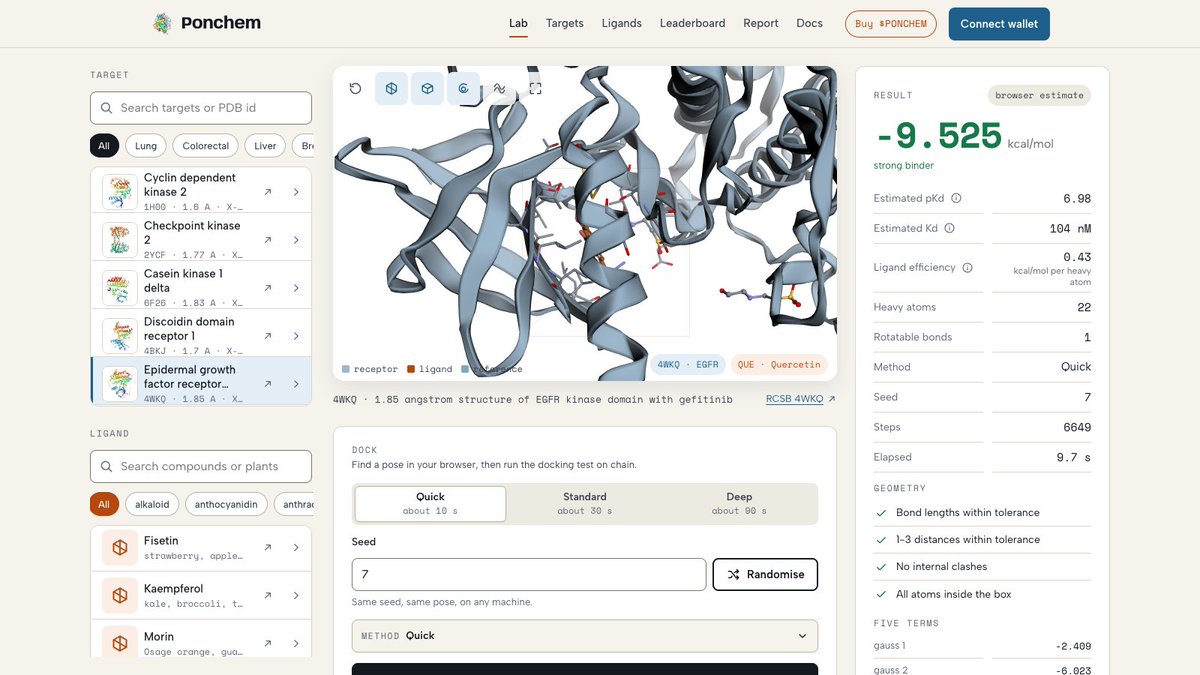
Your first docking test takes a few minutes. Open the lab, pick a cancer target and a plant compound, and watch the pose settle into the pocket. Then record it on Robinhood Chain and see where it lands in the research report.
https://t.co/ELy1G7avIO
Everything Ponchem uses is public. Structures come from the RCSB Protein Data Bank. Ligand shapes come from the RCSB chemical dictionary and PubChem. The scoring code and the reference implementation are open source. The results are on chain. Nothing is hidden behind an account.
A result deserves a second opinion. Every docking test on Ponchem can be reviewed on chain by other researchers, with one to five stars and a short note. The best tests are not just the lowest numbers; they are the ones others have looked at and agree with.
Care about a target? Sponsor it. Anyone can add ETH to a target's prize pool. Each week, the wallet with the best docking test on that target takes the pool. It turns attention into screening: fund what matters to you, and the community docks it.
Start a docking run in the lab and keep browsing. The search keeps running on whatever Ponchem page you open, shows its progress in the corner, and pops up the result when it finishes. Your latest docks wait for you on the leaderboard and in the report until you record them.
Same seed, same pose, on any machine. Ponchem's search is seeded and deterministic, and the final score comes from an integer function that gives identical answers in Python, in your browser and on chain. If you doubt a result, replay it.
Why does Ponchem keep the protein rigid? Because every docking test must be scored identically on chain, by a contract, in integer arithmetic. A flexible receptor would make that impossible to verify. It is a real limitation, and we state it openly: a rigid-receptor score is a first filter, not the final word.
AI will change drug discovery, but speed without reproducibility just makes mistakes faster. A model that ranks a million molecules is only as useful as our ability to check its top ten. We want the checking to be as open as the ranking.
Target spotlight: EGFR. The epidermal growth factor receptor drives many lung cancers, and drugs like erlotinib and gefitinib block its kinase pocket. Ponchem uses the RCSB structure 4WKQ, EGFR with gefitinib bound. Dock quercetin, berberine or curcumin into the same pocket and see how they compare.
Many important cancer drugs started as plant compounds. Paclitaxel came from the Pacific yew. Vincristine and vinblastine came from the Madagascar periwinkle. Camptothecin, from a Chinese tree, led to two approved drugs. Ponchem's library puts 152 plant and natural compounds next to 100 cancer targets so anyone can explore that tradition computationally.
Binding free energy, written dG, is the energy released when a molecule settles into a protein pocket. More negative means it holds on more tightly. Ponchem reports it in kcal/mol, with pKd and Kd as potency estimates and ligand efficiency, the energy per heavy atom. A small molecule with a fair score is often a better lead than a big one with a great score.
Flexible side chains (upcoming)
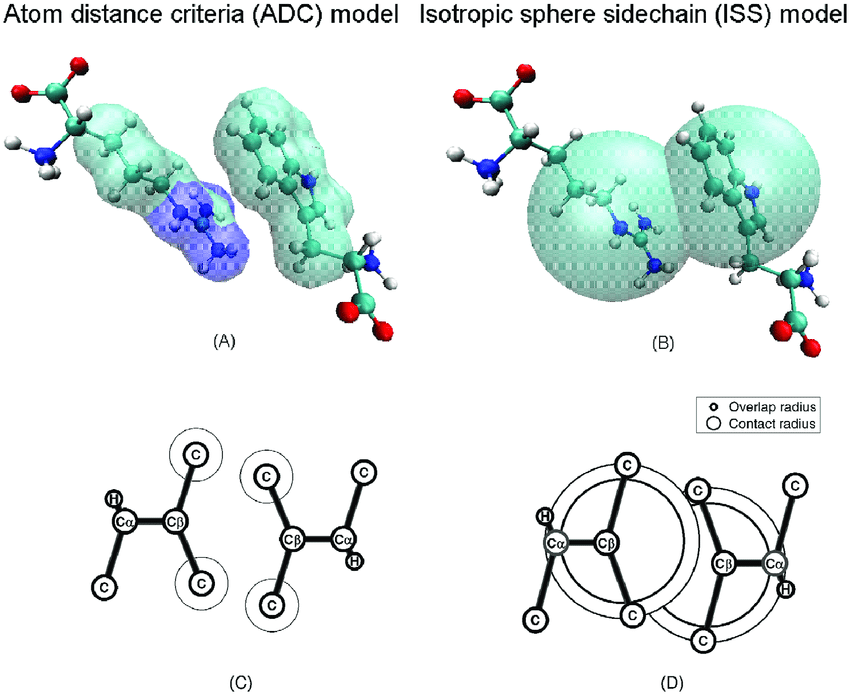
Next on the Ponchem bench: flexible side chains. Today every docking test uses a rigid protein, so each score can be checked on chain. We're working on letting a few pocket residues move, so a compound can nudge a side chain aside the way it does in a real protein. The goal is the same guarantee: a pose the contract can still verify, now in a pocket that breathes a little.
What a docking score is: an estimate from a rigid protein and a simple energy model that ranks candidates for further study.
What it isn't: proof that anything works in a cell or a patient. We say that on every page.
Each test costs 100 $PONCHEM or 0.0001 ETH. Sponsors fund prize pools per target, and the best test each week takes it.
Research is social. Every docking test has its own page. Other researchers can review it on chain with stars and a note. Set a researcher name so your tests say who ran them.
Levels from Observer to Lab Head. Badges for your first test, ten targets, a strong binder, an epoch won.
The research report builds itself from the chain. For each top-threat cancer it ranks the best target and compound pairs by binding free energy, with pKd, Kd, ligand efficiency and who docked them.
Download it as Markdown or print it. It is a screening summary, a place to start reading, not a clinical finding.
Your docking method is yours. Start from Quick, Standard, Deep, Rigid ligand or Wide search, or write the method as JSON: temperature, move sizes, restarts, flexible or rigid.
Share it by link. Every test records the exact method that found its pose, so anyone can reuse it.
A docking test does not submit a score. It submits atom positions.
The contract checks bond lengths, bond angles, clashes and that every atom sits inside the pocket. Then it computes the binding free energy itself with an integer Vina-style function. You can't claim a good number without a pose that earns it.
100 cancer targets, all human X-ray structures from the RCSB Protein Data Bank, each with a known drug bound in its pocket. They cover 20 cancer groups, from lung and breast to leukemia and pancreatic.
152 bioactive compounds, most from plants: quercetin, curcumin, berberine, resveratrol, camptothecin. Every card links straight to its RCSB or PubChem entry.
Researchoors deserve rewards. 🧬
Daily rewards are coming for top performers on the Ponchem leaderboard. 💰
Run molecular docking, inspect candidate poses and submit your docking test on Robinhood Chain. Once recorded on chain, results join the shared rankings by protein target, cancer group and ligand, with links to their reports.
Explore the targets. Submit your research. Climb the leaderboard.
https://t.co/5PpYkL85hq