Starting today, you don't lock a single ADA for collateral on Minswap. We sponsor it 🫡
We're the first dApp on Cardano to sponsor collateral for our users.
No more 5 ADA frozen in your wallet. No more "no collateral found" errors. No setup. You just trade.
Here's how it works: every smart contract transaction on Cardano needs a 5 ADA collateral, a kind of "safety deposit". Normally that comes from your wallet. Instead, we keep a pool of ready-made collateral UTxOs on our side and plug one in for you automatically, then recycle it after each trade.
One of Cardano's most notorious onboarding papercuts, gone ⏩
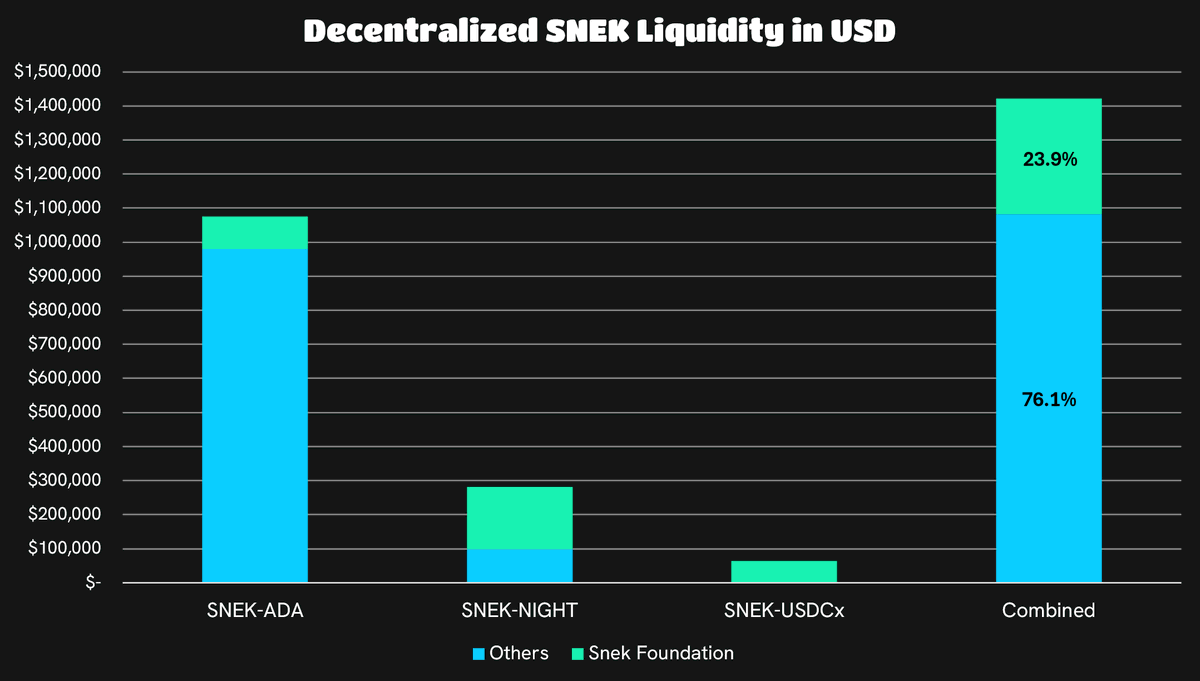
snek:native decentralized liquidity is healthier than 99% of cryptocurrencies in existence.
Not only do we have a solid decentralized liquidity-to-market-cap ratio of approximately 5%, but our largest holder owns less than 1.7% of the supply, making the token more resilient and better positioned to withstand periods of high market volatility.
With 76.1% of all DEX liquidity provided by hundreds of independent holders, liquidity providers are consistently earning approximately 30% APR without any token emissions or supply incentives. This means snek:native has achieved self-sustainability from a trading liquidity perspective, which is very difficult to accomplish.
As for the remaining 23.9% managed by the Snek Foundation, we will strategically allocate liquidity across pools as the prices of $ADA, snek:native, and $NIGHT evolve over the coming years.
And that's without accounting for the liquidity available across our 25+ centralized exchange listings.
SNEK is positioned in a way that most projects can only dream of. It is truly a decentralized, community-owned token, and we can be proud of that.
All that to say: the job's not finished. Exciting times ahead.
A significant shift is happening in Cardano.
ADA holders are no longer passive participants in someone else’s roadmap. They now have direct influence over the direction, funding priorities, and future of the protocol.
The holders have spoken clearly in the recent budget cycle.
They want progress. They want accountability. They want delivery tied to discipline. When capital comes from the treasury, it is entirely reasonable for ADA holders to ask hard questions, challenge poor execution, and expect spending to translate into measurable value for Cardano.
That changes the incentive structure.
As a result, we have already seen treasury spend fall. In my opinion, the value of that spend has increased. Less capital is being treated as automatic entitlement, and more attention is being placed on delivery, relevance, risk, and return to the ecosystem.
I believe this will continue.
As global competition around value output increases, proposals will need to become sharper. They will need to justify cost more clearly, explain the mechanism of value creation, and show why the treasury should fund them.
The personal attacks, emotional outbursts, and increasingly strange behaviour we are seeing from some corners are a confirmation of that shift. When informal control starts to weaken, the reaction often becomes louder, less rational, and more personal.
Until people accept that power and control is moving back towards ADA holders, those social outbursts will likely continue.
That is what happens when influence moves away from closed circles and towards the people who carry the economic risk.
I think this is extremely beneficial to Cardano.
Healthy governance should apply pressure. It should force clarity. It should make capital allocation more difficult, more accountable, and more closely linked to outcomes. That is how a decentralized ecosystem matures beyond personalities, relationships, and legacy influence.
The powerful thing is that absolutely anybody can contribute to that change.
A holder, builder, stake pool operator, developer, researcher, business owner, or ordinary user can bring information into the system. They can question assumptions, expose weaknesses, improve proposals, challenge poor incentives, and help force positive change.
That is where collective global intelligence starts to create real value.
Different people bring different experiences. Some understand infrastructure. Some understand markets. Some understand governance, risk, compliance, enterprise adoption, product delivery, or community behaviour. When those perspectives are allowed to surface, the system becomes harder to control, but much stronger over time.
Disappointment is not a weakness in governance. It is often the first sign that the system is beginning to correct itself.
What matters is that frustration is being converted into action. Holders are voting, questioning, organising, analysing proposals, and pushing for a more serious and accountable ecosystem.
The old model of quiet influence, unclear control, and decisions shaped away from the people who bear the economic risk is weakening every day.
This is where Cardano becomes different.
Its strength is the ownership structure, the incentives, the treasury system, and the fact that every ADA holder has the same fundamental rights within the system.
No special class. No permission gate. No hidden entitlement.
Cardano’s future will be shaped by the people who hold it, use it, build on it, and are prepared to defend its long term value.
Exciting times.
@KagameLee When you say moderated for quality what do you mean? You can reply to posts on here with the facts, add community notes etc for accuracy.
Will we just see community members like myself being blocked or refused access? Like we are on here.