Oldest modern human #genomes sequenced. These seven early #Europeans belonged to a small, isolated group that left no present-day descendants. Study @Nature led by @arevsumer, Kay Prüfer, Johannes Krause @MPI_EVA_Leipzig. https://t.co/thySPSDXyR & https://t.co/IDwbcYjkkF
Today is a very big day for our research group, with two of my students, @arevsumer and @IasiLeonardo publishing papers on the same day! https://t.co/i2ViZLKPju https://t.co/RDzL1cR04H #Neanderthals#Geneflow
Out today in @sciencemagazine, we've journeyed into our shared history with Neandertals by analyzing over 300 present-day and ancient modern humans, including 59 individuals who lived between 2,000 and 45,000 years ago.
https://t.co/V9OBe4VTjC
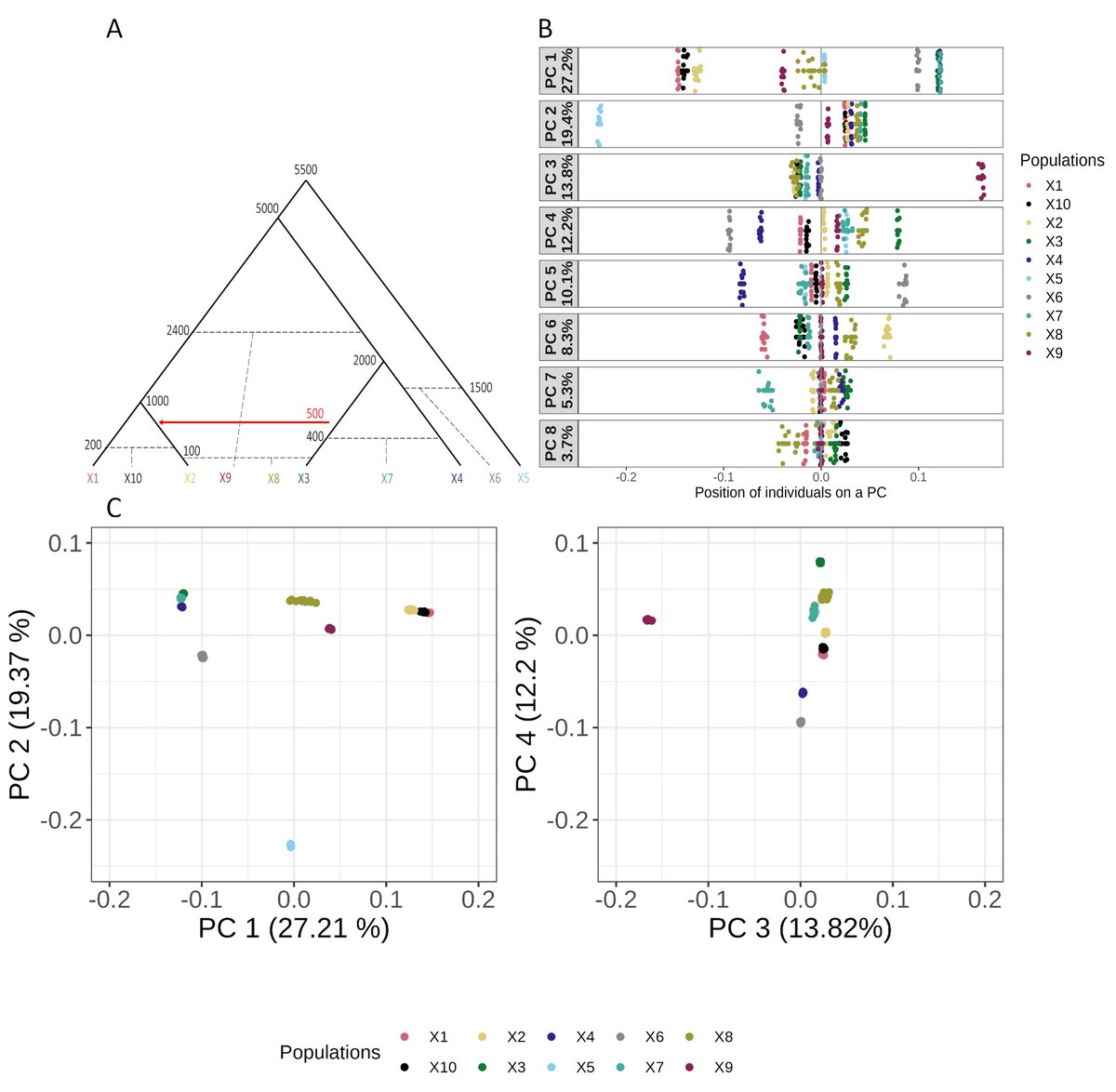
The estimation of PCA and F-statistics in a joint framework enables a quantitative interpretation of PCA plots. This gives us some insights
for when different PCA methods should be used. We also discuss how PCs should be plotted when displaying population genetic variation.
PCA and F-statistics are routinely used in population genetic studies. We provide a statistical framework to combine them into a joint analysis, and show that this addresses some of the limitations of estimating them independently. Check out our preprint: https://t.co/LzjL55FZkA
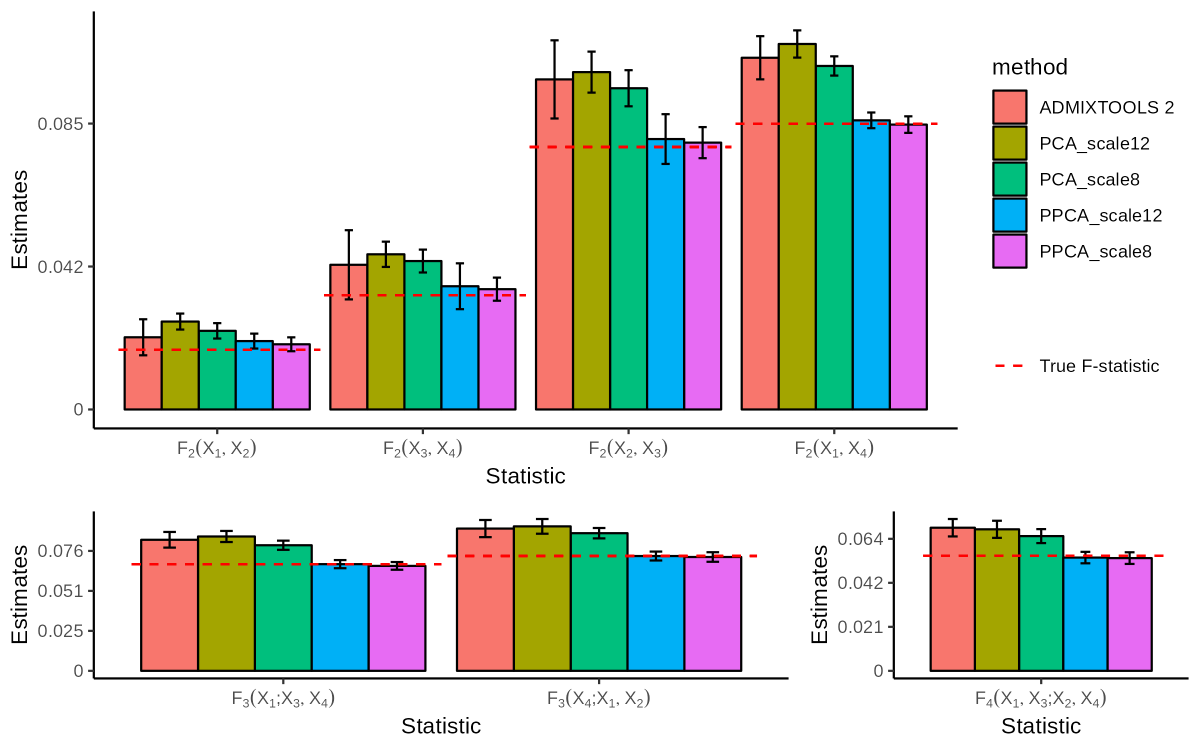
Finally, we apply the probabilistic PCA-based framework to re-analyze a published Neandertal dataset. We find that our framework has advantages when estimating individual-based F-statistics using pseudohaploid sequences.
With simulations we show that F-statistics can be accurately estimated using a probabilistic PCA-based framework, even when only few samples are available for analysis, population assignments are not known a priori, and large amounts of the genotypes are missing randomly.
In particular, we discuss the differences in the modeling of sampling noise in genetic datasets by 3 PCA methods: classical PCA, Latent Subspace Estimation and probabilistic PCA, and show that F-statistics are more naturally interpreted in a probabilistic PCA framework.
Very happy that the new paper on imputation and selection in ancient Japan, from myself, @shige_nakagome and our collaborators has finally been published in iScience @iScience_CP : https://t.co/y7YCR9VgP2 Here’s a thread of the highlights:
In a collaboration between @M_Chintalapati ,@SkovLaurits , Alba Bosoms Mesa, @MatejaHajdi , @benmpeter and @moorjani_priya , we've journeyed into our shared history with Neandertals by analyzing over 300 genomes spanning 50,000 years. A thread 🧵🧬
https://t.co/tMc8t46HSj
So incredibly proud of @ElenaEssel and @ElenaIreneZ ❤️ and the entire team behind this wonderful research, led by Matthias and @MarieSoressi.
If you haven't had a chance yet, see the 🧵👇
Excited to share that we are developing a method to detect relatives in ancient DNA up to the 20th degree using epigenetics. By analyzing joint methylation at CpG sites, we can infer genetic relationships even when no actual DNA is shared. More details in our upcoming preprint!
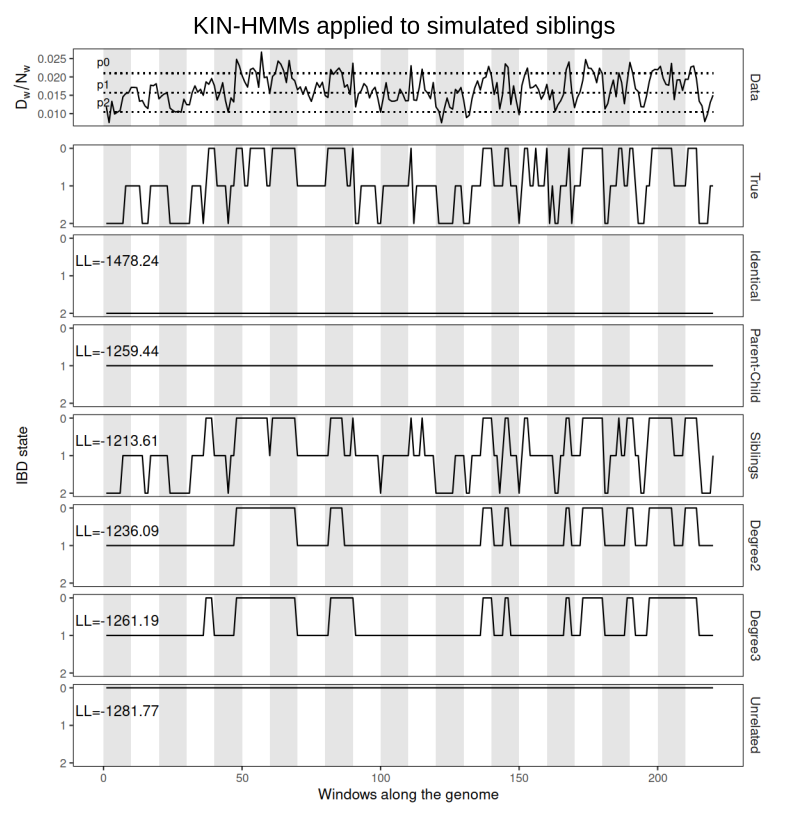
Check out our new paper in @GenomeBiology with @StephPeyregne@benmpeter describing a novel method to infer relatedness from low coverage ancient DNA data: https://t.co/ITYld6bePK
@ShaiCarmi Thank you, in future we can add an option to input pseudo-haploid data as well. For now we compare all reads from a pair of individuals, and for libraries with ~1x coverage we utilize more data compared to random sampling, resulting in better confidence level.
@Mick2474 Thanks, KIN can work for any diploid species. If the avg. recombination rate is similar to humans, it can be run directly. If not, then transitions need to be estimated as explained in our method section. You can specify the number of chromosomes as explained on the github page.
Relatedness inference with low-coverage ancient DNA data is still a hard problem. Today, we posted a preprint presenting a new method called KIN that identifies close relatives up to 3rd-degree while differentiating parent-child from siblings: https://t.co/0K7nowvH0p (1/3)
@EranElhaik Thanks, I'll add my email ID.
1) The script takes bam files as input, and does not randomly sample. Instead, all reads for first individual are compared to the other. In case of very low coverage, this is equivalent to pseudo haploid seq.
2) We report genomic windows in IBD.
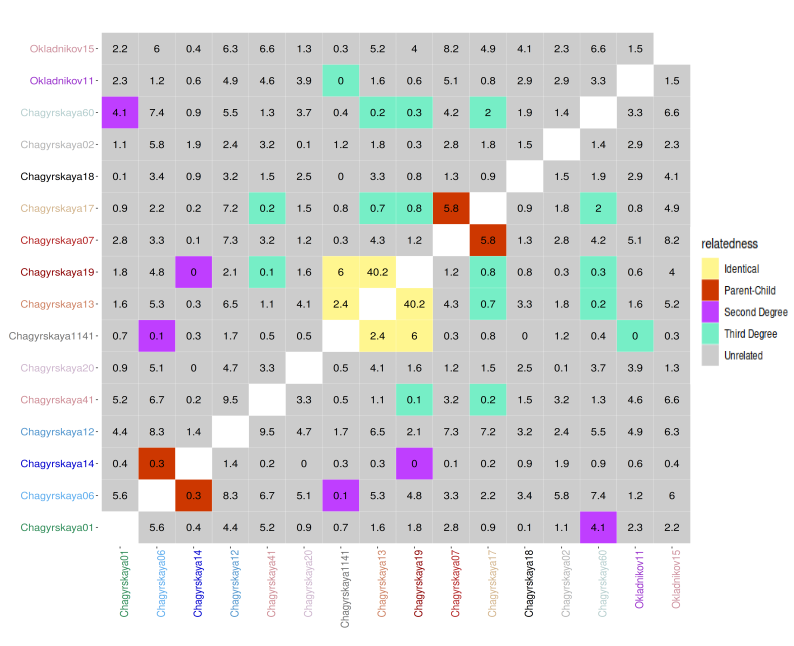
When applying our new method to the recently published Neandertal-family-data (https://t.co/otwHRohO3S), we confirm their results and find an additional third-degree relatedness! (3/3)
KIN uses an HMM to fit different relatedness categories to the genome, and we have added a few features tailored specifically to ancient DNA; for example we built in a contamination correction and an adjustment for runs of homozygosity. (2/3)