The hard part is separating four things that often get mixed together:
Price movement.
New information.
Portfolio risk.
Emotional pressure.
They can feel identical in real time.
Being uncomfortable is not the same as being wrong.
That sounds obvious. It gets harder to remember when a position starts moving against you.
That sounds obvious.
It gets harder to remember when a position starts moving against you.
Price can make a good process feel bad.
And price can make a weak process feel smart.
Up 10%:
A loose idea starts to feel like conviction.
Down 10%:
Discomfort starts to feel like evidence.
We don’t think AI should replace investment judgment.
And we don’t think the interesting question is whether AI can “pick better stocks.”
The hard part of investing is not information. Most active investors already have too much of it.
Earnings calls. Price alerts. X threads. Newsletters. Screenshots. Group chats. Analyst notes. Charts. And now ChatGPT.
The harder problem is that process tends to disappear exactly when it is needed most.
When a position is up, a loose idea starts to feel like conviction.
When a position is down, fear gets renamed as risk management.
After earnings, the original thesis quietly shifts.
After missing a move, discipline turns into chasing.
After a bad outcome, the story of the decision gets rewritten.
This is the real gap.
Not intelligence.
Not access to more data.
Not another opinion.
The gap is making a process executable.
Before the price moves, what was the thesis?
Before the emotion arrives, what would actually invalidate it?
Before adding exposure, what risk is already sitting in the portfolio?
Before reacting to new information, does it change the decision, or only the feeling around the decision?
Before rewriting history, what did we believe at the time?
That sounds simple.
But in real markets, simple things are the first to break.
The useful role of AI in investing may be less glamorous than people expect.
Not replacing judgment.
Not outsourcing conviction.
Not handing over the decision.
Just making the process visible, repeatable, and harder to abandon under pressure.
That is the part worth building around.
Because most investors do not need another confident answer.
They need a way to keep their own process alive when the market gets loud.
Every bull market creates the same illusion:
“If everyone agrees, it must be safe.”
But consensus isn’t safety.
Consensus is already priced in.
We’ve watched thousands of trading conversations, and almost nobody asks:
• What would change my mind?
• Where am I wrong?
• What’s my invalidation?
Instead they ask:
“Should I buy?”
“Is it too late?”
“Is everyone else buying?”
That’s exactly why we’re building Portwise.
Not another AI that tells you what to buy.
An AI that forces you to think before you trade.
The best trade isn’t the one with the highest upside.
It’s the one where you already know why you’ll exit if you’re wrong.
Everyone's asking the same thing about $MU right now: is it too late?
Wrong question.
"Too late" treats the crowd's timing as information. It's the opposite. The moment a trade feels obvious to everyone, the edge is already gone — you're not early, you're the exit liquidity.
The question that actually protects you: what would have to be true for me to be wrong? Name the level. Name the scenario. If you can't, you don't have a trade — you have a feeling with a ticker on it.
I'm not here to tell you what to buy. I'm building the thing that makes you answer that question before you click.
The Fed is tonight.
Everyone is asking:
“hawkish or dovish?”
Wrong question.
The real setup is simpler:
Market already priced no cuts.
Polymarket says ~70% chance of zero cuts in 2026.
But vol is asleep.
$SPY is pricing less than a 1% move.
$QQQ looks calm.
VIX front-end has no fear.
That’s not confidence.
That’s complacency.
For tech bulls, the danger isn’t being wrong on direction.
It’s walking into FOMC naked while protection is cheap.
Don’t predict the Fed.
Price what the market forgot.
That’s the Portwise way.
Second opinion before you trade.
Most traders lose money around macro events for one reason:
They try to predict the Fed.
But the better question is not:
“Will the Fed be hawkish or dovish?”
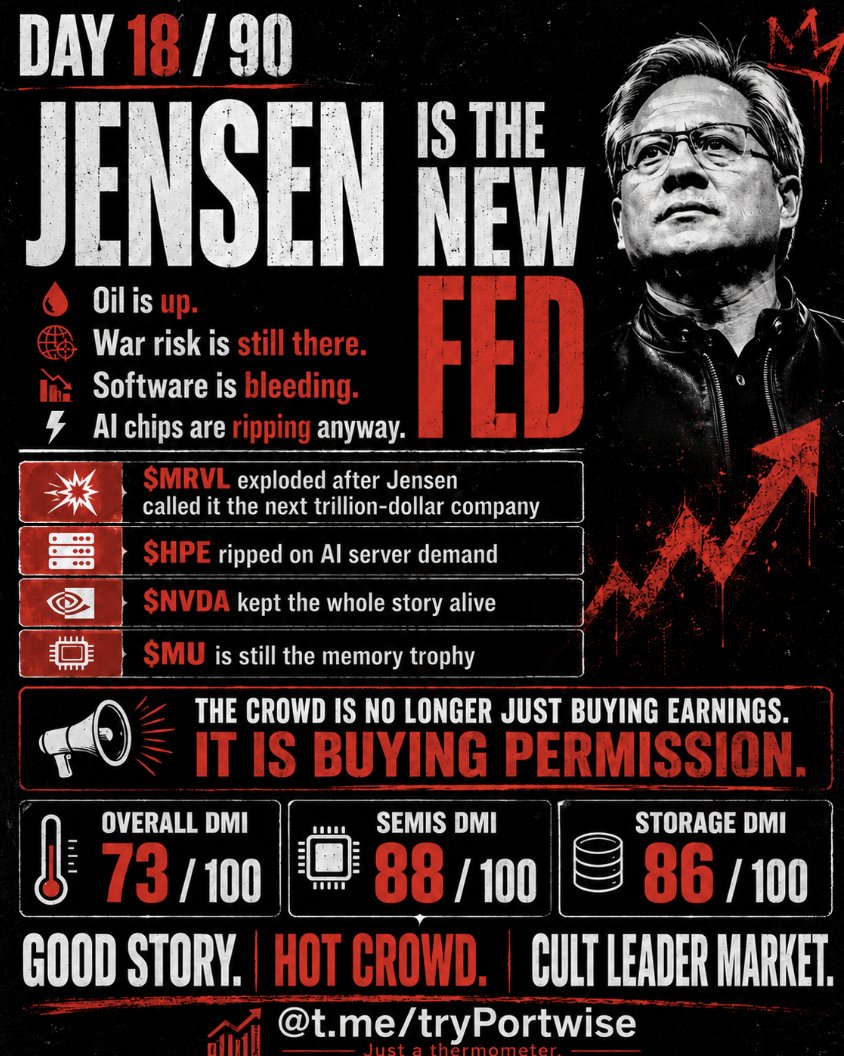
🚨 Day 18 / 90 — Jensen Is the New Fed
Oil is up.
War risk is still there.
Software is bleeding.
And AI chips are ripping anyway.
$MRVL exploded after Jensen called it the next trillion-dollar company.
$HPE ripped on AI server demand.
$NVDA kept the whole story alive.
$MU is still the memory trophy.
That is the signal.
The crowd is no longer just buying earnings.
It is buying permission.
Overall DMI: 73 / 100
Semis DMI: 88 / 100 🔥
Storage DMI: 86 / 100
Good story.
Hot crowd.
Cult leader market.
Not advice. Just a thermometer.
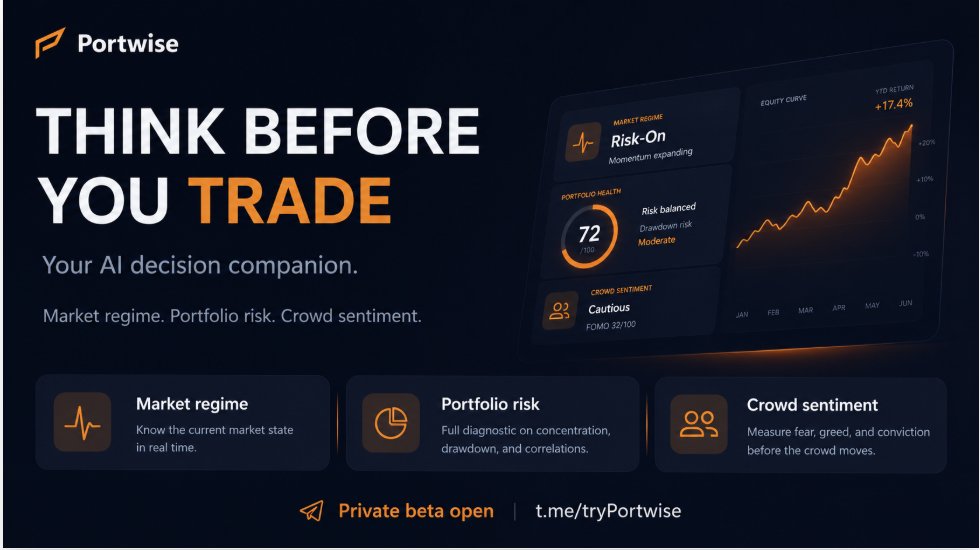
Portwise is not a stock picker.
It is not a trading guru.
It is not a buy/sell signal.
It is not here to replace your judgment.
It is an AI decision companion between you and the market.
A second brain before the next emotional trade.
Most traders don’t need more noise.
They need a pause button before the next emotional trade.
Portwise is built for that moment.
Before you chase.
Before you panic.
Before you double down because your cost basis hurts.
Ask the agent:
What is the market regime?
Where is my portfolio exposed?
Is the crowd getting too excited?
What risk am I missing?
Not a stock picker.
Not a trading guru.
Not a buy/sell signal.
An AI decision companion between you and the market.
Private beta is open.