Are you a club in need of a full curriculum for your coaches, players and teams? We support clubs worldwide with models for all ages and stages of development. We also off a player/parent learn & practice at home away from team sessions. DM us for more info! #SoccerClubDevelopment
Coaches and Team Development ⬇️
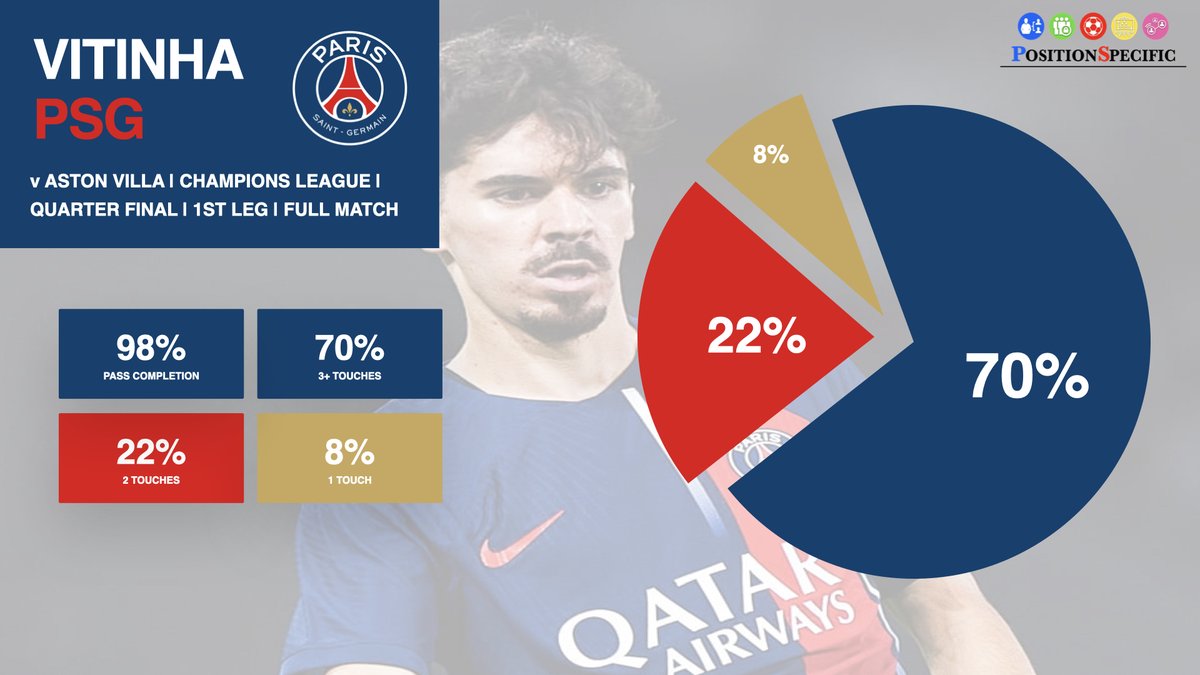
Final stats from Vitinha (PSG) v Aston Villa. Sensational performance.
90 minutes played
Passes Attempted - 123
Passes Completed - 121
Pass Completion - 98%
1 Touch Passes - 11 (8%)
2 Touch Passes - 17 (22%)
3+ Touch Passes - 87 (70%)
Watching the best players closely can help us develop young players 👍
This is excellent from Sean Dyche.
A top quality game model has to be well rounded in the 4 key moments of the game. Having a plan or an idea in 1 key moment is flawed if you don’t consider the performance problems and how the other moments fit within that plan aswell….being adaptable in the chaos of the game critical.
Good open game so far. It will be interesting to see if Slot adjusts the press from the outside, as Chelsea are gaining control by shifting into a back three with Cucurella dropping low (perfect shift).
If Slot does tweak things, then the key question becomes: how does Enzo respond to try regain control in midfield?
Legacy of a Master Coach: Dick Bate and the Modern Centre-Back
The Future Game
For those fortunate enough to have worked with Dick Bate—or even just crossed paths with him—it was clear how deeply passionate he was about football and its continual evolution. He constantly challenged coaches to think more creatively and critically, always with the aim of developing players who could not only succeed in the present, but adapt and thrive in the future.
Dick had a unique ability to take complex ideas and distill them into simple, relatable concepts that players could immediately connect with. His clarity of thought and language was one of his greatest gifts as a coach and educator.
Back in 2013, he shared with us his thoughts on how the role of the centre-back was beginning to change. Looking at the game today, it’s remarkable how accurate—and forward-thinking—his observations were.
Centre-Backs: Defending Implications (Dick Bate, 2014)
✅ Greater capacity for sustained defensive phases
✅ More frequent and split-second decision-making
✅ Increased need for rapid, high-speed directional changes
✅ Ability to quickly calculate ball speed and trajectory
✅ Greater demands on lower-body mobility and range
✅ High requirements for agility, acceleration, deceleration, and explosive power
✅ Enhanced lower-limb and foot speed with more frequent shifts in stride cadence
✅ Quicker defensive reactions to unpredictable attacking patterns
✅ Excellence in 1v1 defending during counter-attacks (e.g. 30–40 yards from goal, often backpedalling or moving laterally at pace)
✅ Increased need to deal with fast, intricate interplay near goal
Above all: Defensive intelligence—the ability to read the game, anticipate danger, and respond decisively
Of course, this isn’t to suggest that centre-backs of the past didn’t possess these qualities. But as Dick predicted, the pace, complexity, and volume of defensive demands have all intensified—and the data bears that out.
Back then, the average centre-back recorded around 40 possessions per game, with a 79% success rate and roughly two touches per possession.
Today, in 2025, those actions have nearly doubled. Modern centre-backs are expected to operate at 88–92% efficiency, often with three or more touches—all while under intense tactical and physical pressure.
One of Dick’s most enduring messages to coaches was simple, yet profound:
“Watch the game—it tells you what you need you need to coach .”
Dick Bate didn’t just coach skills—he coached understanding. His influence continues to live on in the minds and methods of those he mentored. Over a decade later, his insights still resonate as strongly as ever in a game that’s constantly evolving—just as he always knew it would.
More of the ‘Brilliant Basics’ on show this time from a CB in a WF position to create space to cross….every player in every position can benefit from mastering the basics!!
Quality from McGuire 👏
This is absolutely mind blowing and Yamal is sensational to watch which is what the game is all about but the big questions are….
- Do Barcelona need to protect him a bit? That’s a lot of games already at 17 and Pedri and Gavi suffered big injuries.
- Can Barcelona afford to protect him? He’s so influential and pivotal to their team already.
He could have 300 apps and 100 goals before he’s out of his teens 🤯
We recently did a presentation on our ‘Brilliant Basics’ and talk about how the best young players can do all the skills on our skills list allowing them to comfortably deal with:
- Front Pressure ✅
- Side Pressure ✅
- Back Pressure ✅
Beautifully demonstrated by Yamal here….what a goal 🙌
LAMINE YAMAL PULLS ONE BACK 🤩
Yamal glides through the Inter defence and hits a mesmerising finish on his 100th Barcelona game 🔥
📺 @tntsports & @discoveryplusUK
So hopefully, we’ve broken it down clearly:
✅ WHAT ARE SIDE CONNECTIONS?
✅ WHY DO YOU USE THEM?
✅ HOW DO THEY WORK?
Check out our website if you’d like a deeper dive into how we train and coach these patterns week to week.
From La Masia to Your Touchline: The Power of Side Connections
In this short thread we will run through the filling:
1️⃣ WHAT ARE SIDE CONNECTIONS?
2️⃣ WHY DO YOU USE THEM?
3️⃣ HOW DO THEY WORK?
⸻
Short lead-in:
During our first visit to La Masia, we watched Barcelona’s U14s in training. In the warm-up, they ran two three-player combinations that ended with finishes on goal. The patterns were clear and purposeful—quick passing, sharp movement, unopposed, with three distinct rotations.
As we watched more sessions across different age groups, both in training and in games, it became clear how important that initial drill was. We later began referring to it as Side Connections — and it gave us our first real understanding of how structured, intentional wide-play works in elite environments.
Read more ⬇️
HOW DO YOU USE THEM?
Before we dive in, it’s important to say that every coach will have their own rationale for when, why, and how they use rotations. What follows is how we apply them in our model — and if people want more detail, we’ll follow up in future threads.
1️⃣ FULL-BACK INSIDE
This rotation has seen a real resurgence in recent years. Think of Rico Lewis (Man City), Ethan Nwaneri/Lewis-Skelly (Arsenal), or Trent Alexander-Arnold (Liverpool).
In this setup, the full-back moves into midfield. The midfielder moves higher to stretch the line, while the wide forward stays wide but drops slightly deeper to connect and create space behind.
2️⃣ FULL-BACK HIGH
Here, the full-back pushes high and wide, effectively taking the winger’s position. This allows the midfielder to pull wide and offer an outlet around the press, while the wide forward drifts inside to find pockets between the lines. This rotation is particularly useful against compact mid-blocks.
3️⃣ FULL-BACK LOW
The full-back holds a deeper position, often forming a back three. This rotation draws the opposition press, creating space to break through or around it.
It also gives the midfielder and winger freedom to combine further up the pitch. Crucially, it maintains defensive balance and secures key transition zones. Think Nuno Mendes (PSG vs. Liverpool & Arsenal in the Champions League) or how Robertson has operated under Arne Slot at Liverpool.
Arsenal v PSG HT thoughts:
PSG have been relentless so far and Arsenal need to deal with the following performance problems:
1. Picking up Dembele - may have to sacrifice the +1 on their defensive line to get tighter to him.
2. PSG side rotations are really hurting Arsenal - either better communication or go man to man.
3. PSG’s Defensive Transition and High Press have been excellent - Arsenal may have to progress rather than possess in Attacking Transition and play Over more in Attacking Organisation.
Big halftime for Arteta and Arsenal.
Barcelona become the first club to win the UEFA Youth League 3 times.
Two sensational performances over finals weekend….they have been individually technically far superior to every team we’ve watched them against which makes tactics easy!!
Individual development will always be king 🙌
Our 'Brilliant Basics' research is now available in a full 2 part presentation on our YouTube channel, we hope you enjoy watching the videos.
If you have any questions, please feel free to contact us, we are always available to talk about the game.
BRILLIANT BASICS | RESEARCH | PART 1
https://t.co/g7aFdHB1Kb
BRILLIANT BASICS | RESEARCH | PART 2
https://t.co/5kOyh9pimA
Over the last few months we watched 30 games across the following competitions:
Champions League 🇪🇺
Premier League 🏴
La Liga 🇪🇸
Bundesliga 🇩🇪
Serie A 🇮🇹
We wanted to research which skills out of our Position Specific 'Brilliant Basics' were used the most at the top levels and if there are any other skills used more!!
🧵 THREAD
What does success look like in each phase of the game?
Understanding the 4 key moments, and when to be proactive or patient, can shape how your team controls matches.
⸻
1️⃣ Attacking Organisation
How you build and progress with the ball.
•Proactive – Play forward early, targeting key players or spaces to break lines quickly.
•Patient – Keep possession, shift the opposition, and wait for the right moment to play through
⸻
2️⃣ Defensive Transition
Your immediate response after losing the ball.
•Proactive – Press straight away to regain possession or force a mistake.
•Patient – Recover into key areas to prevent progression and delay the counter.
⸻
3️⃣ Defensive Organisation
How you defend when the opposition has established possession.
•Proactive – Press high or step out to regain the ball quickly and disrupt their build-up.
•Patient – Stay compact, protect central spaces, and wait for the right trigger to press.
⸻
4️⃣ Attacking Transition
What you do immediately after winning the ball.
•Proactive – Play forward quickly into dangerous areas before the opponent can reset.
•Patient – Secure possession (3–5 passes), then build with control.
⸻
Final thought
Success in the game isn’t just about what you do — it’s when and why you do it.
Know your moment. Choose the right behaviour.
Poll Question:
Over the past couple of months, we’ve been focusing on the types and number of touches players are taking before releasing the ball.
When it comes to the number of touches, which do you find yourself leaning towards the most in your practice design?