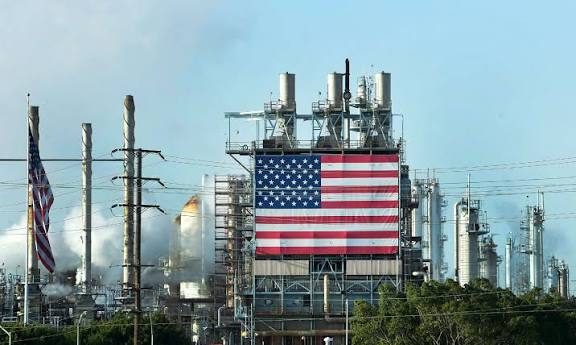
⚠️🇺🇸Washington is now treating oil refining as defence.
Trump signed a memo declaring US petroleum production and refining essential to national defence.
It opens Defense Production Act money for oil projects, pipelines and fuel storage.
The problem is capacity.
US refineries are already running almost flat out: about 98% nationally in September, and 96% on the Gulf Coast in October.
The money is small.
Congress set aside $ 1bn of DPA funding for energy last year.
Kinder Morgan’s share of just two new gas pipelines is $ 4.7bn.
The first test case is Delek’s 74,000 b/d refinery in Tyler, Texas, though no expansion size has been given.
A proposed 168,000 b/d refinery in Brownsville, backed by India’s Reliance, could be next.
Refiners have told the White House a new refinery takes years to build.
This is a policy for the 2030 diesel market.
Voters go to the polls in 12 days and pay today’s prices.
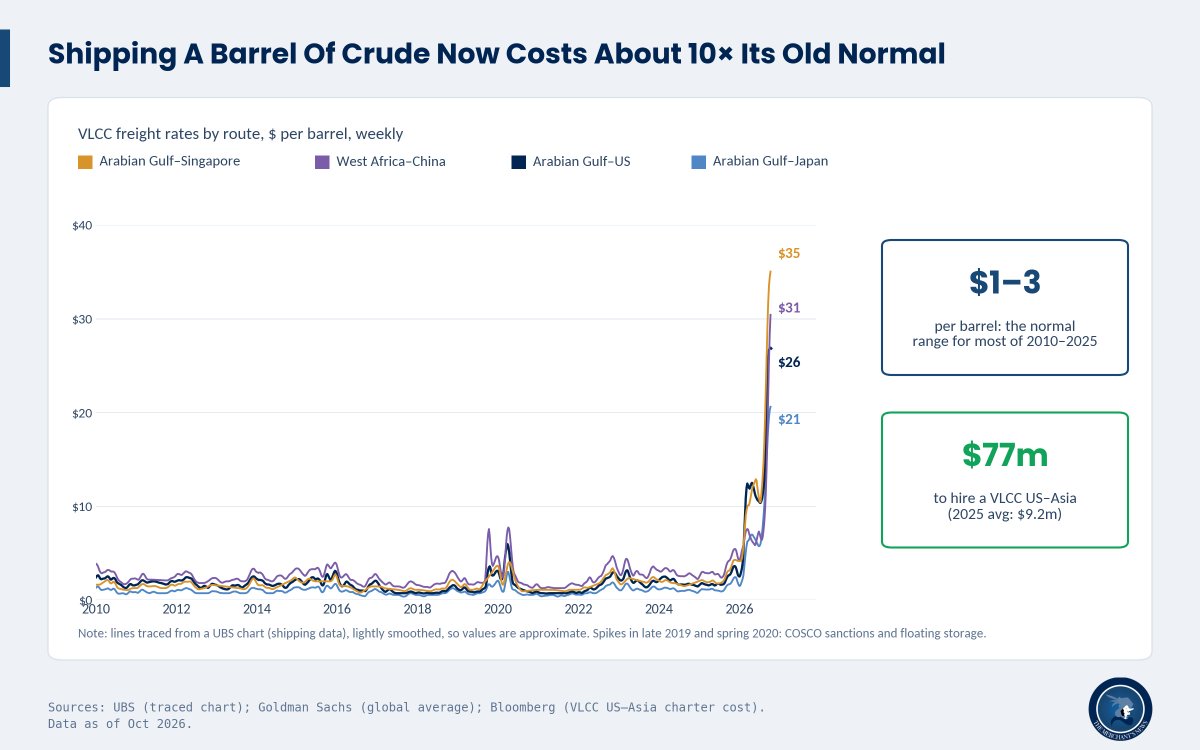
Shipping a barrel of crude now costs about 10 times what it used to.
From 2010 to 2025, a VLCC moved oil for roughly $1–3 a barrel on most major routes.
Now:
-Arabian Gulf to Singapore: about $35
-West Africa to China: about $31
-Arabian Gulf to US: about $26
-Arabian Gulf to Japan: about $21
Not even 2020’s floating-storage spike came close.
It peaked under $10.
Hiring a VLCC from the US to Asia now costs about $77m per voyage, against a 2025 average of $9.2m.
Goldman puts the global average above $20 a barrel. $7 of that is the Hormuz war-risk premium and $4 is fuel.
This is why Gulf crude bound for Asia trades at a discount.
The freight eats the margin.
i explained here: https://t.co/DE0RsMwPBQ