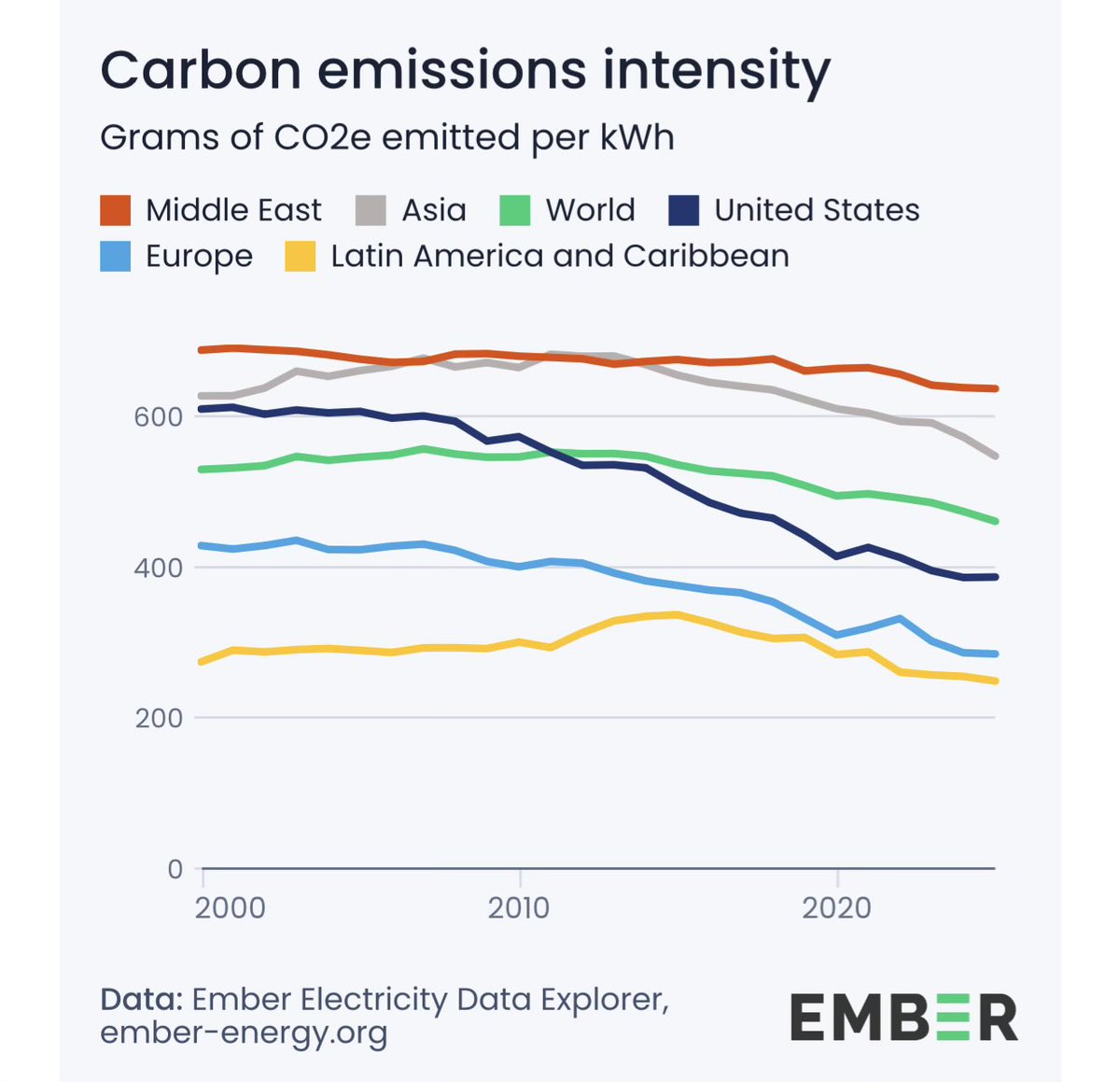
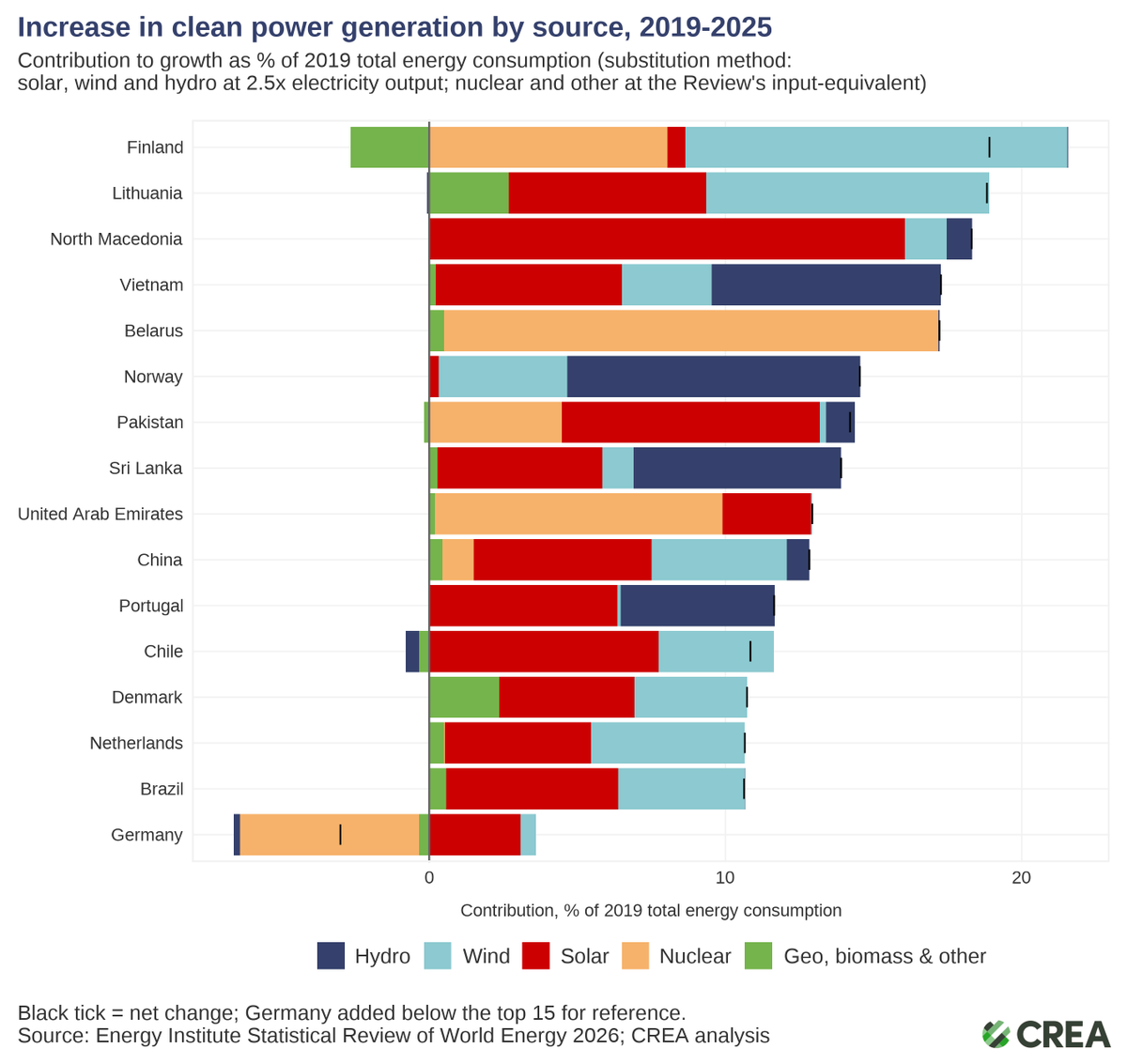
France isn't just building offshore wind, it's building long-term energy security. The EU has approved support for up to 11.1 GW, expected to generate almost 48 TWh annually, around 10% of France's electricity demand.
Why not just build more nuclear? France is, but its first new EPR took 17 years from construction start to grid connection. The first reactor in its next program is not targeted until 2038. Offshore wind projects can generally be built in roughly 3 to 5 years once construction begins. That difference matters because time is money: every year of delay means more financing costs, more imported fuel and more electricity not being generated.
Solar adds another dimension. France installed 5.9 GW in 2025 alone, taking total capacity to 30.4 GW, and deployment is still accelerating. Globally, solar added more than 500 GW in 2025, continuing its exponential industrial scaling.
So ask yourself: why is France, the world's nuclear superpower, going balls-deep into solar, wind and batteries? Not because it has suddenly forgotten nuclear, but because it understands the economics of speed, diversification and technologies that can be manufactured and deployed continuously rather than delivered one giant project at a time.
Where's Germany in these charts? Nowhere, for two reasons. The nuclear phase-out, obviously, but the country also failed to build renewables at scale, as we keep highlighting. Germany's status in people's (incl. many Germans') minds as renewables champion is a decade out of date.
@EVCurveFuturist we agree
much of the Norway commentary neglects this fundamental fact that taxing AND investing are the reasons behind Norway’s success
like these guys
Countries like Norway benefit from taxing their natural resources fairly and funding services for their citizens.
Australia gives away most of our exported gas for free! #auspol
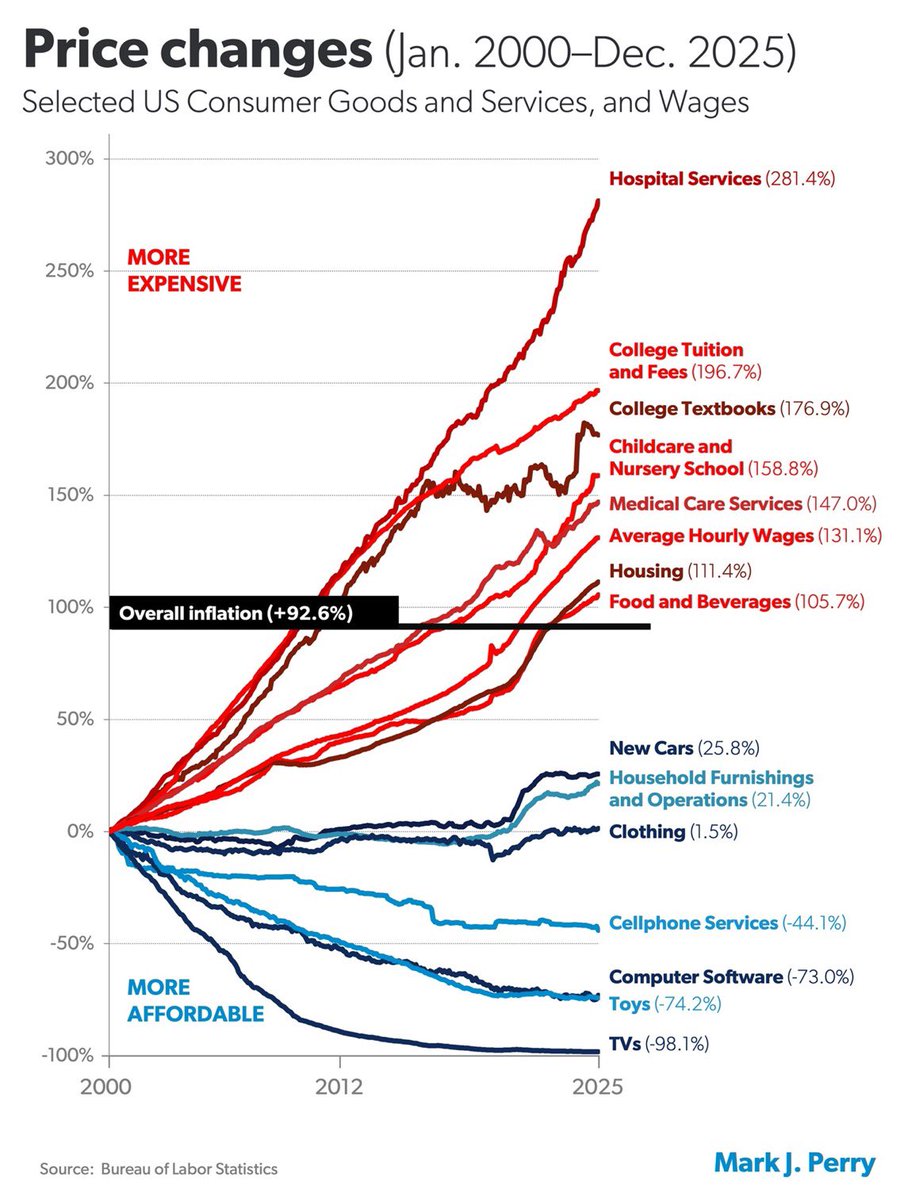
This chart is insane.
Government-heavy sectors (healthcare, college, childcare) exploded in price... and got worse.
Competitive free market sectors (TVs, toys, phones, software) crashed in price... and got dramatically better.
Two countries split from the same colonial body in 1965. One picked economic freedom. The other picked handouts and racial spoils. You already know how this ended.
Singapore had no oil, no farmland, no hinterland. Just a swamp and a port. Lee Kuan Yew looked at that and trusted trade, low taxes, and hard money. Central planners hate what he did.
Malaysia went the other way. In 1971 Kuala Lumpur launched the New Economic Policy, a state program handing quotas, contracts, and university seats to ethnic Malays. Politicians decided who got what. A commissar fantasy dressed in liberal language.
Now let's look at the numbers. In 1965 both places sat around $500 per capita. Today Singapore clears $84,000. Malaysia sits near $13,000. Same climate, same starting line, one sixth the result.
The Singapore dollar holds its value because the Monetary Authority of Singapore manages it against a currency basket and refuses to print its way out of trouble. The ringgit has lost roughly two thirds of its value against the Singapore dollar since 1981.
You cannot subsidize your way to wealth. You cannot redistribute what you never let people produce. Every ringgit funneled through a quota is a ringgit some bureaucrat spent on his own vision instead of a customer's.
Malaysia bet on planners deciding outcomes. Singapore bet on people deciding for themselves. The gap between $84,000 and $13,000 is your answer.