New on https://t.co/rUgpiCdZ6Z
Poulomi Chakrabarti, "Politics of Dignity: How Status Inequality shaped Redistributive Politics in India"
https://t.co/FOPuc9EHp9
https://t.co/rE0qhmZb4F
New on https://t.co/rUgpiCdZ6Z
Poulomi Chakrabarti, "Conceptualizing and Measuring Forms of Ethnic Inequality: Findings from India"
https://t.co/hHzKMQyHOX
https://t.co/o5GapL1S9Q
For those reading about Sankarshan Thakur today and wanting to know his work better, his two books on Bihar--"Single Man" and "Subaltern Saheb"--are terrific guides to one of India's most fascinating and politically complex states https://t.co/XYc6W1Whk3
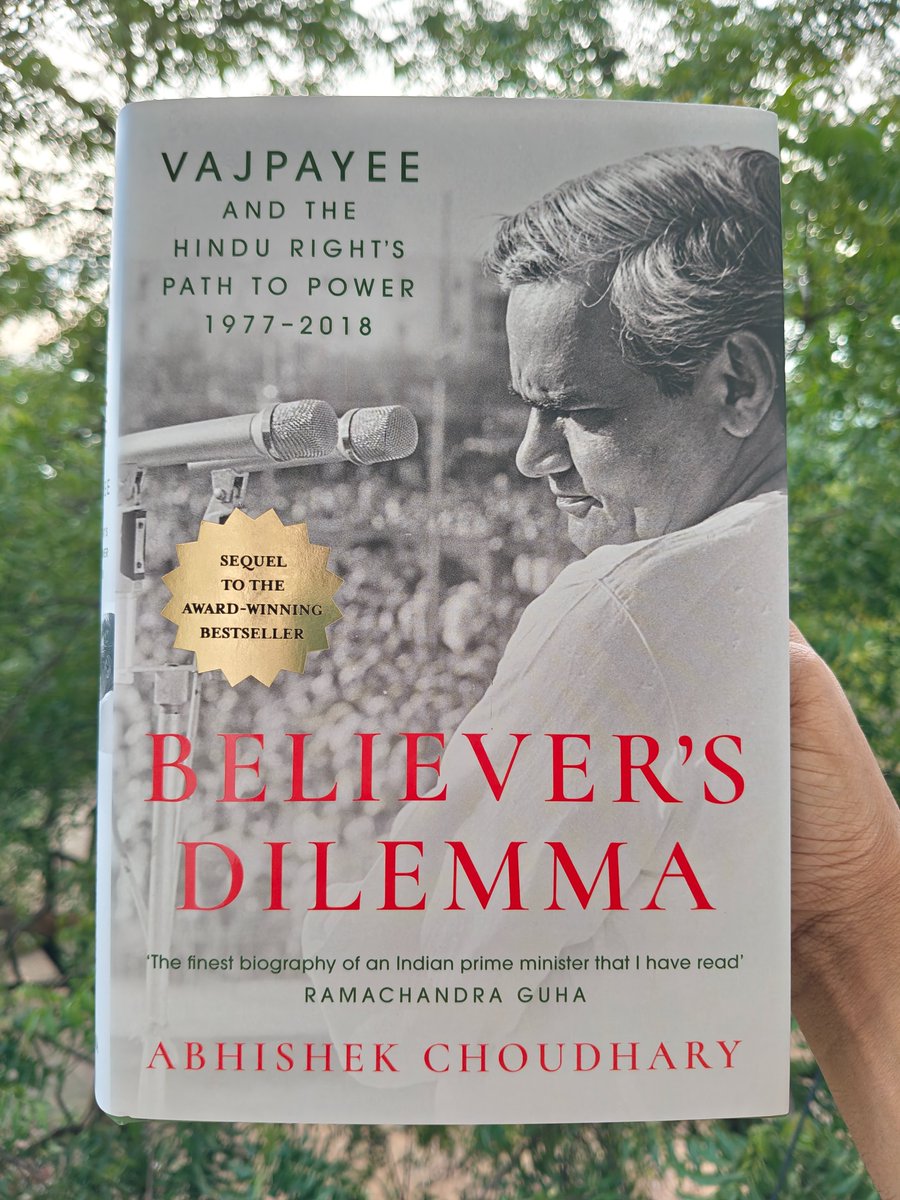
Out today, 20 July: Believer’s Dilemma—the second volume of my study on Vajpayee and the Hindu Right. Now available at bookshops! (Most of them are happy to ship across lands and oceans.) Please do share it with friends or family who might be interested in something like this.
This interview of @RenuWBhatia1, on whose complaint a fabulous professor has been jailed, is a MUST watch. It is very worrying that such ignorant people are heading important commissions. Kudos @PreetiChoudhry for asking the right questions-
My statement re the summons that I received from the Haryana State Women’s Commission.
The posts that were misunderstood and objected to can be accessed on my Facebook page.
A caste census, when it happens, will tell us a lot about India's demography. However, its not as if we know nothing about caste right now. HT's data journalism team will be doing a series of stories to show what we already know. Here is what we have done so far 1/n
Urban–rural cleavages are seen as a defining political divide. But does this polarization hold worldwide? My new working paper tests this question using an original dataset of granular, geocoded election returns from 106 countries (polling station-level in 70). (1/8)
In Raised to Obey, @aspaglayan shows how the expansion of primary education in the West emerged not from democratic ideals but from the state’s desire to control its citizens.
Now available. Learn more: https://t.co/DOKJbYs3Xw
Thrilled to announce the release of Uprooted: How Post-WWII Population Transfers Remade Europe today with @CUP_PoliSci! 🎉🎉🎉
📚[Amazon link: https://t.co/rBASq40mxp]
Every year, millions are displaced by war, repression, disasters, and climate change. My book shows that accommodating the displaced population can strengthen states and benefit local economies in the long run.
I study the effects of large-scale displacement on social and economic development using rich historical data from post-WWII Poland and West Germany.
A thread about the book below: (1/n)
रक्षात्मक सहयोग : भारतीय मुसलमानों के समाज-सार्थक दृष्टिकोण को समझना- मेलनी कैमेट@MelaniCammett, पोलोमी चक्रवर्ती @Poulomi_DC (@Harvard), डेविड रोमनी @David_Romney (@BYU)
पूरा आलेख यहाँ पढ़ें : https://t.co/6ptyVhUTXE
In contrast to theory, it shows that social accountability mechanisms are more effective among Muslims – reflecting coping strategies by minorities to navigate hostile sociopolitical environments.
Full Analysis: https://t.co/EIokOeaSCo
@MelaniCammett@Poulomi_DC@David_Romney✍️
The Nobel prize winners this year are well deserved. I will briefly discuss their work and lengthily describe how they amplify my field, my work, my point of view, and my awards.
We are currently designing a pre-analysis plan for followup research. Feedback and suggestions welcome!
Full paper available here: https://t.co/pV1sjb8yho
Glad to see the summary of our @cps_journal article out in @Ideas4India!
@MelaniCammett, @David_Romney and I carried out a survey experiment in Delhi to examine social norms around cooperation in public goods provision in Hindu and Muslim communities.
In theory, ppl are more willing to contribute to public goods in homogeneous settings. @MelaniCammett@Poulomi_DC@David_Romney conduct study in Delhi slums on how Hindus/Muslims respond to social pressure promoting contribution to community initiatives
https://t.co/gEmhtfST7O
More interestingly, our results are mainly driven by upper-caste Muslims and Muslims with greater sense of obligation to the in-group. Lower-caste Muslims exhibit no difference from lower-caste Hindus. And upper-caste Hindus, in contrast, respond negatively to the intervention.