Who I Really Am:
A Story About Seeing What Others Miss
For 15 years, I lived in the trenches of enterprise IT infrastructure. Server migrations, network troubleshooting, Microsoft environments that break in creative ways.
I became the guy companies called when their systems failed and nobody knew why.
Then I made an unexpected move:
I became a salesperson.
Not because I loved sales, but because I wanted to understand the other side.
What do IT managers actually struggle with when the phone isn’t ringing with emergencies?
Over 5 months, I had conversations with 600+ IT managers across companies ranging from 100 to 600+ employees.
What I discovered changed everything.
The pattern was everywhere: IT managers drowning in vendor calls, users frustrated with enterprise tools designed for efficiency rather than usability, and a massive gap between what software companies build and what people actually need to get work done.
Most revealing insight: A seasoned IT manager told me, “If I had a magic wand, I’d make all the dumb users disappear.”
That’s when it clicked.
The problem isn’t dumb users. The problem is smart enterprise software that makes normal people feel dumb.
Then my best friend started a powder factory.
He needed simple inventory management - nothing fancy, just track stock levels.
We searched everywhere.
Nothing existed that did just that.
Everything was bloated with features he didn’t need.
So I built it myself using AI tools. It works. It’s in production. It solves exactly one problem perfectly.
That’s when I realized what I actually am:
I’m not transitioning from IT to development. I’m completing my arsenal.
•15 years of systems knowledge = I understand why things break
•600+ customer conversations = I know what people actually need
•Technical building capability = I can create solutions that don’t exist
I’ve accidentally built the rarest combination in tech: domain expertise + market validation + technical execution.
Most developers learn to code and then wonder what to build.
Most domain experts know what to build but can’t code.
I’m in the sweet spot between both worlds.
Here’s what I’ve learned:
Your career path isn’t random. It’s market research in disguise.
Every job, every conversation, every frustration is data about problems that need solving.
The opportunities are hiding in plain sight. You just need to know how to see them.
Now I’m systematically turning 15 years of “random” experience into applications that solve problems I’ve personally validated.
This isn’t about learning to code.
This is about printing money from problems I already know exist.
Welcome to my journey of bridging domains that shouldn’t be separated in the first place.
Copy paste block for Grok Bot:
“Implement a shared spine memory wiki. One note store with a permanent bidirectional link index. Every link recorded both ways; updating a note flags all connected notes. Short, medium, and long term memory are tags on the same note promoting changes the tag, never copies. Summarized or trimmed notes keep their links in the index permanently. Nightly tidy: fade untouched short-term notes after two weeks, promote frequently linked notes, clear stale flags.”
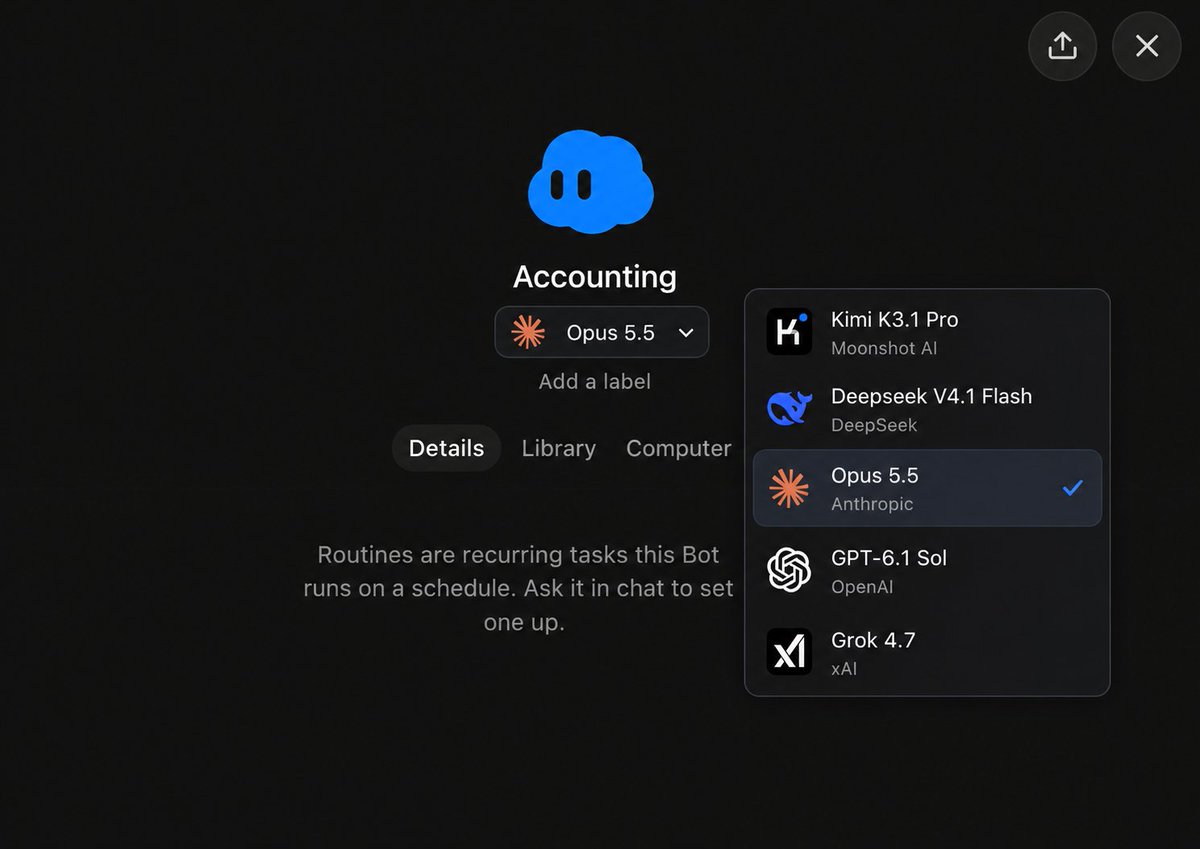
My top 10 rules for running 22 Grok @bot agents without ever hitting rate limits:
1. Knowledge outside the bot.
Keep docs in a Git repo, Notion, or Google Drive with a short index file. The bot only pulls the single file it needs instead of carrying your entire brain in active memory.
2. Micro-memory.
Built-in memory is strictly for permanent facts: names, rules, and core preferences. Long conversation history belongs in a log file it can search on demand.
3. Databases for anything that grows.
Use Supabase, Airtable, or Google Sheets for leads, ideas, and trackers. Querying 10 rows is practically free; feeding a bloated doc burns tokens instantly.
4. Offload heavy lifting.
Let tools you already pay for (Cursor, Claude Code, ChatGPT) do the deep writing, coding, and raw data crunching. The bot just coordinates and reviews the output.
5. Connectors before the browser.
Direct API and connector calls cost a fraction of browser automation. Never make a bot click through a website when a simple webhook exists.
6. Context batching.
One message with three tasks costs way less than three separate pings because you don't reload the context window three times. If you have the text, paste it. Skip the lookup call.
7. One bot per job.
A sharp specialist with a tight description carries a fraction of the token payload compared to a bloated generalist that tries to know everything.
8. Low-frequency automations.
Weekly digests cost pennies; hourly checks add up fast. Run automated routines only on data that actually changes, at the lowest frequency that gets the job done.
9. Turn workflows into skills.
"Summarize this into 5 bullets" beats open-ended prompts every time. Save proven step-by-step recipes so the bot never has to guess the logic twice.
10. Weekly usage audit.
Check the usage dashboard every Friday to see which bots and routines eat the most budget. If an automation isn't driving real ROI, cut it immediately.
The bot coordinates, but the architecture does the work. Keep the context lean and let dedicated tools do the heavy lifting.
@bloggersarvesh
Hi
Christophe here
Can I ask you a question?
Do you have a personal use case where you helped a IT business owner with SEO or his website ?