Reach for the stars. We're all just walking each other home, weaving each other's stories, shining threads in the tapestry of time | ENFP | Life path 9
Not all ways
But some times
Not all people
But some one
Not all days
But some hour
Not all hearts
But some love
Not all dreams
But some horizon
Not all we hear
But some words
Not all wisdom
But some simple truth
Not all stars
But some bright light
Not all
Just you
There was this girl in our class that everyone labeled as “dumb.” She’d raise her hand constantly and ask a million questions during lessons. Some were basic, some were deeper, but kids would groan and whisper stuff like “Here we go again” or “How does she not get this?” Even some teachers would taunt her. One day a teacher sighed and said, “Really? You’re asking this again?” while the class laughed.
But no matter what, she kept asking. Never backed down.
The crazy part? She topped almost every single exam. Like, consistently one of the highest scorers. Everyone lost their minds. “She has to be cheating,” they’d say. Teachers were super biased too..... they’d accuse her openly in class. “We’re watching you,” one said during a test. But they could never actually prove anything.
I was pretty socially awkward back then, so I never really talked to her. Just observed from the sidelines.
She was leaving school at the end of the year, and I finally got the chance to ask her about it. She was sitting with her one close friend (they pretty much only hung out with each other). I walked up and said, “Hey… I’ve always wondered. How are you so good at exams when you ask all those questions in class? And how do you just brush off everything people say?”
She smiled a little and looked at her friend, then explained, “It’s not for me. My friend here is really socially anxious. She can’t bring herself to raise her hand or ask for help. So during lectures she writes down every doubt she has, and I ask them for her.”
Her friend nodded shyly and added, “I’d fall so far behind without her. I just freeze up.”
The girl continued, “I know people think I’m stupid. Teachers make fun of me, the class laughs… but if I stop asking, my friend suffers. So I just take it. It’s worth it.”
I stood there stunned. This girl had been enduring taunts, jeers, and straight-up bullying for years, letting everyone believe she was dumb and even a cheater..... just so her anxious friend could learn without fear. She could’ve easily said “Ask your own questions,” but she didn’t. She carried it all.
I told her, “That’s… honestly really selfless. I don’t think a lot of people would do that.”
She just shrugged and said, “She’s my friend. That’s what you do.”
I walked away that day seeing everyone differently. The “dumb” girl wasn’t dumb at all..... she was one of the smartest and kindest people in the room. She just chose to take the hits so someone else didn’t have to.
Just to say, I have only 25 copies of my book left…. If anyone would like to snap one up for Father’s Day, please get your order in soon, or I’m afraid you’ll be too late. 😬
‘A Quiet Light’ is my hardback book of Peak District photographs and words - 152 pages of countryside beauty, arranged seasonally, to dip into whenever you need a little calm inspiration. £24.95 + UK P&P. Each copy is gift-wrapped, comes by tracked delivery, and can be signed if you would like. 😊
👉 https://t.co/tJxYXbDXnl
There are only 236 of them left on Earth. Every single one has a name.
The kākāpō is the world's heaviest parrot - a mossy green, owl-faced bird the size of a small dog that cannot fly, may live to 90 years, and only breeds every 2 to 4 years when New Zealand's rimu trees produce enough fruit to trigger the urge.
Rats. Cats. Stoats. Humans clearing forests. The kākāpō never evolved to outrun any of them.
By 1995, 51 birds remained. Scientists, rangers, and Ngāi Tahu - the Māori people who have always known this bird as taonga, a treasure—evacuated every last one to predator-free islands.
Each bird got a transmitter. Each nest watched around the clock.
This past February 14th, the first kākāpō chick in four years hatched. They named her Tīwhiri. By spring, 59 chicks had been born.
236 birds. Every name known. Every nest watched.
Who's counting down the days until the rimu trees fruit again? 🦜
#DemsUnited #Nature
On 7 June 1952, Orhan Pamuk was born, a man who has spent much of his life walking through Istanbul and asking one deceptively simple question: what happens to a civilization when it can no longer decide whether it is looking toward the East or toward the West?
Pamuk was born into a wealthy, secular, Western-oriented family in Istanbul, one of those great Turkish families that once believed the future would arrive neatly packaged in engineering, progress, Europeanization, and rational planning. His father was an engineer, his grandfather had accumulated considerable wealth, and the household itself represented a miniature version of modern Turkey: prosperous, educated, ambitious, and quietly uncertain about its own identity.
Perhaps that is why family occupies such a central place in Pamuk's imagination.
Not because families are harmonious.
Quite the opposite.
Because families are where history stops being abstract and becomes personal.
In Pamuk's world, grandparents, fathers, mothers, uncles, cousins, inheritances, secrets, silences, disappointments, and unspoken longings are never merely domestic matters. They are history wearing a human face.
"One day I read a book and my whole life was changed."
Few sentences describe a writer more accurately.
Pamuk originally wanted to become a painter. Then books intervened, as books so often do, and the future painter became a novelist. Literature gained what painting lost.
His novels are not merely stories.
They are philosophical laboratories.
"My Name Is Red" transforms a murder mystery into a meditation on art, beauty, individuality, faith, and the clash between civilizations.
"Snow" examines politics, religion, modernity, loneliness, and the dangerous temptation of certainty.
Pamuk's philosophy is built upon uncertainty.
He distrusts slogans.
He distrusts ideological certainty.
He distrusts people who believe they possess final answers.
Because many writers secretly understand that solitude is not always the enemy of creativity.
Sometimes it is its source.
And nowhere is this clearer than in Istanbul itself, that magnificent city suspended between continents, religions, empires, memories, and futures.
"Life isn't so bad. No matter what happens, I can always take a walk along the Bosphorus."
Only someone from Istanbul could write such a sentence.
Only someone who understands that cities are not places.
They are emotional states.
Women occupy an important place in Pamuk's life and fiction, though never as simple romantic ornaments. His women are intelligent, mysterious, independent, wounded, resilient, and often possess a deeper understanding of reality than the men around them. Love in Pamuk's novels rarely arrives as happiness. More often it arrives as memory, longing, absence, regret, or obsession.
At this point Bertrand Russell would probably smile.
Because Pamuk seems to understand something fundamental about human beings: most people are not destroyed by what they know.
They are destroyed by what they refuse to question.
"In the end, a woman who doesn't love cats could never make any man happy."
One suspects that even philosophy occasionally benefits from a cat.
The more I read Pamuk, the more it seems to me that he is not writing about Turkey at all.
He is writing about the eternal human condition: the desire to belong, the fear of being divided, the longing to be understood, and the endless search for a home that exists somewhere between memory and imagination.
And perhaps that is why his novels feel so universal.
Because every human being carries within themselves a private Istanbul.
And as Pamuk himself reminds us:
"I believe in a world without heroes. Of course, I admire personal courage, intelligence, and hard work. These are qualities I genuinely value... and qualities possessed by so many 'ordinary' people."
Dostoevsky understood the modern crisis before it became normal. A man can study truth, praise progress, and speak about humanity while still failing to help the child standing in front of him.
This is the central wound inside Fyodor Dostoevsky’s short story, The Dream of a Ridiculous Man.
The man had spent years thinking about life, yet he had no strength left to live it. One winter night, after sitting with friends who spoke grandly about truth and progress, he walked home with a revolver waiting in his room. He had decided that this would be his last night.
On the way, a little girl grabbed his coat. She was wet, frightened, and begging for help. Her mother was sick. The man understood enough to know she needed him, yet he pushed her away and told her to find the police. When she kept pleading, he shouted at her. She ran off into the cold.
He reached his room, sat before the revolver, and prepared to die. Then the girl’s face returned to him. Her fear disturbed him. Her pain followed him into the silence. He wondered why guilt still hurt if life had no meaning.
Then he fell asleep.
In the dream, he saw himself dead. A bright being lifted him from his grave and carried him beyond the stars to another world. The people there looked human, yet they lived without greed, envy, lies, or cruelty. They loved naturally. They had no need to explain happiness because they lived inside it.
Then he corrupted them. One lie led to another. Pride entered. Envy followed. Soon they competed, deceived, punished, and killed. When he begged them to remember who they had once been, they mocked him. They said they had science, knowledge, and the laws of happiness. They believed understanding happiness mattered more than happiness itself.
He woke at six in the morning. The revolver still sat before him. He threw it away.
The dream had given him a task. He would find the little girl. He would tell people the truth. They would call him ridiculous again, but this time he knew something they had forgotten.
A life without love can know everything and still understand nothing.
Dostoevsky’s lesson attacks one of the modern world’s favorite lies that knowledge alone can save us.
The man in the story has thought about life so much that he has stopped living it. He can judge society, expose hypocrisy, and explain despair, yet one suffering child reveals the poverty of his soul. That is the force of the story.
A little girl does what philosophy cannot do. She brings him back to responsibility.
The dream shows the same truth on a larger scale. A perfect world falls when deceit enters it, then its people begin to defend corruption. They suffer, yet call their suffering wisdom. They lose happiness, then comfort themselves with theories about happiness.
Dostoevsky noticed that a civilization can become brilliant and still become cruel. It can build systems, write laws, praise progress, and lose the simple moral instinct that tells a man to help a child in the rain.
His final lesson is severe and necessary. Truth begins with love in action.
Love begins with the person in front of you. That is why the ridiculous man becomes wise. He stops studying life from outside and accepts the burden of living it.
For more content like this, subscribe to the Culture Explorer…
https://t.co/Hc731pN3VC
Home is where the Heart is, because the Heart is the Home. Return to the breath. Return to the gentle whisper of your own Being calling you back to your center.
Technology is absolutely spiritual. People love to draw division between science and religion, spirituality and technology. But some of us remember lifetimes where this was no so. Where they were One: Matter and Spirit as an integrated Truth, Body and Mind together.
This is me … and this is winter through my lens. Please give my account a follow if you’d like to see more.
No politics, no AI, just quiet Peak District beauty every day.
#peakdistrict
Just read this beautiful story ♥
I found a book at a thrift store. $2. Old copy of "The Alchemist."
Inside the front cover, there was handwriting: "For Emma - Chase your dreams. I believe in you. - Mom".
I almost put it back. Felt wrong to buy someone's gift.
But something made me purchase it. When I got home, I opened it more carefully.
Tucked in chapter 3 was a bookmark. Not store-bought. Handmade. Laminated. With a photo of a young woman and an older woman. Both smiling.
On the back of the bookmark: "Emma & Mom - Last chemo day - We made it!"
My heart stopped.
I kept reading. In the margins, there were notes. Two different handwritings.
Emma wrote: "This part reminds me of what you always say, Mom."
Mom wrote back: "Because I learned it from you, sweetheart."
Page after page. A conversation in the margins. Mother and daughter reading together. Talking to each other through a book.
The last note was on the final page. Emma's handwriting, shaky:
"Finished it, Mom. You were right about everything. I miss you every day. I'll chase my dreams. I promise. - E"
I sat there crying over a stranger's book.
I had to find Emma. Had to return this.
I posted about it on a local Facebook group. Long shot.
Three days later, I got a message.
"This is Emma. That was my mom's book. She passed away five years ago. I donated it during a hard time. I've regretted it ever since."
We met at a coffee shop. Emma was 28. Looked just like the photo.
When I handed her the book, she held it like it was made of glass.
"I can't believe you found me," she whispered.
She told me her story. Her mom had been her best friend. They'd read this book together during her mom's final months. Made those margin notes as a way to talk about life, death, dreams.
"Donating this was the biggest mistake I ever made," she said. "I was trying to move on. But you can't move on from love."
Last week, Emma sent me a photo.
She'd started a nonprofit for young people who've lost parents. Named it "The Alchemist Project."
The caption: "For my mom. And for the stranger who reminded me that some things are meant to find their way back home."
Books carry stories beyond their pages. Sometimes they carry souls.
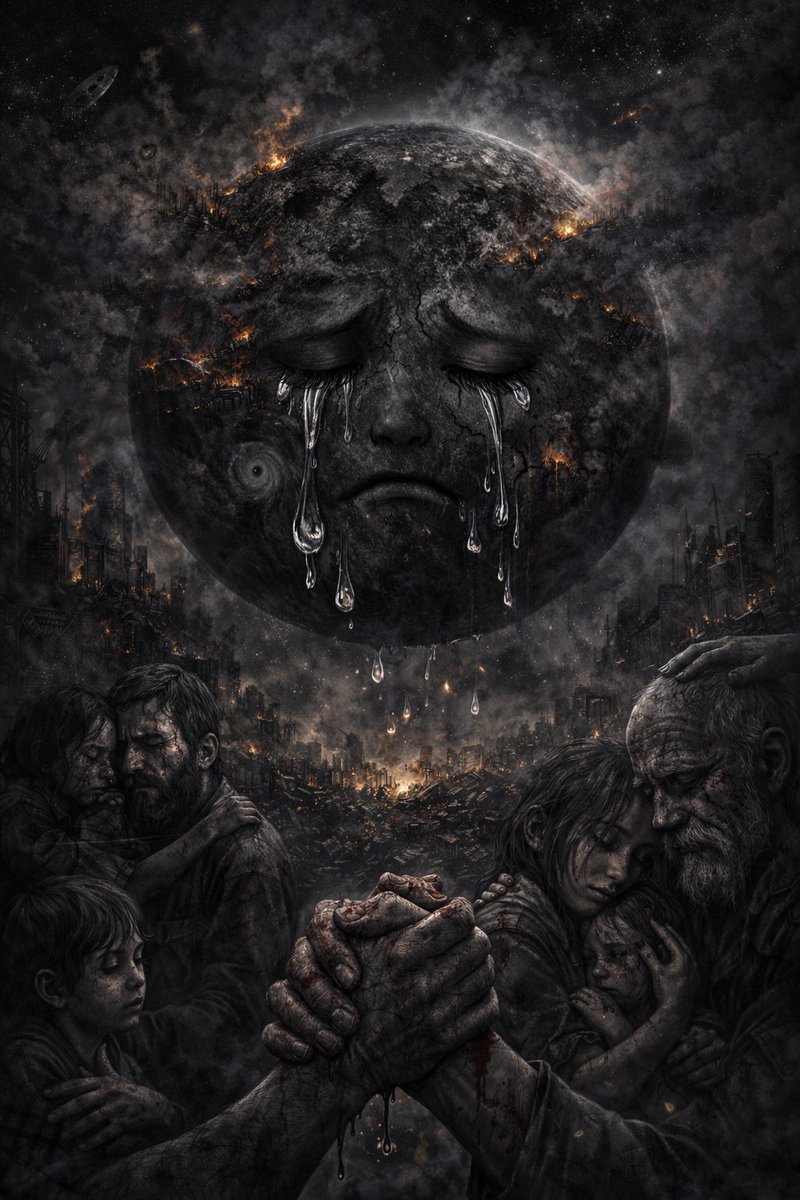
We are standing on the edge of something dangerous.
Not because of technology.
Not because of aliens.
Not because of nature.
But because of ourselves.
We live on a planet that gives us everything for free. Air to breathe. Water to drink. Soil to grow food. A climate that allows life to exist at all. In a universe where life should be rare, fragile, almost impossible.
And what do we do with this miracle?
We bomb each other.
We poison the oceans.
We burn the forests.
We teach our children fear, enemies and flags before empathy, curiosity and truth.
Power has replaced wisdom.
Profit has replaced responsibility.
Ego has replaced humanity.
The systems that rule us today do not protect life. They consume it. They reward aggression, domination and obedience. They call it leadership, but it is not leadership. It is addiction to control.
Let’s be honest.
Most wars are not fought for people.
They are fought for influence, resources, ideology and pride.
Ordinary humans pay the price, while a small elite makes decisions far away from the consequences.
This is not civilization.
This is a failure of consciousness.
So this is a message >>> an SOS.
To anyone out there who might already see us.
To any civilization that has survived its own self-destructive phase.
To those who learned, painfully, that intelligence without empathy is extinction.
We are not asking for technology.
We are not asking for weapons.
We are asking for perspective.
How did you stop killing each other?
How did you dismantle systems built on fear and dominance?
How did you choose life over power?
Because humanity is exhausted.
Millions feel it, even if they can’t put it into words.
We feel manipulated, divided, lied to - trapped inside systems that no longer serve life, but demand sacrifice to keep going.
And the most terrifying part?
Many still call this “normal”.
It is not normal to prepare children for war instead of peace.
It is not normal to destroy the only habitable planet we know of.
It is not normal to worship leaders while ignoring suffering.
If we continue like this, history will not remember our technology.
It will remember our silence.
This planet does not belong to corporations, governments or ideologies.
It belongs to life itself.
To every child not yet born.
To every species without a voice.
We don’t need new gods.
We don’t need stronger armies.
We need a new level of responsibility.
Humanity must grow up.
If anyone out there is listening -
we are still capable of change.
But time is running out…. 🌍🙏🌍
#Humanity #EarthSOS #WakeUpHumanity #PeaceOverWar #Disclosure #UAP #WeAreNotAlone #FutureOfHumanity #ForOurChildren #OnePlanet #ufotwitter #uapX #life
BREAKING: Music legend Bruce Springsteen just released this incredible song that will be sure to piss Trump off beyond belief.
“Streets of Minneapolis”.
He wrote this song about Alex Pretti and Renée Good Saturday and recorded it yesterday.
Share it far and wide and play it as loud as you can