Some days need a car and a chauffeur, not a ride.
24, 12, 6 or 3 hours. Your call.
The investor in town.
The 2am flight.
The wedding in Ikoyi with the reception in Lekki.
Price fixed before you book.
Money held until the car arrives.
Book your day with https://t.co/PMW2yGF02S,
For more enquiries WhatsApp +234 704 785 3697
1/ The numbers first. Roads carry more than 90 per cent of the country's passengers and freight. Transport and storage return 1.56 per cent of GDP. The government called that unsustainable. It is.
2/ The plan came out of a stakeholder meeting in Abuja on Monday, convened by the Vice President's office. Ministries, regulators, transport unions, banks. The priorities, in order: road safety and professional driver development, digital systems for vehicles and drivers, road modernisation, private sector management.
3/ Read that first priority again. Professional driver development and digital records. The state has just named the two things a rider has never been able to check before getting into a stranger's car: who is driving, and what is on file about them.
4/ In fairness, a plan is not a road. Nigeria has had transport reform announcements before and most of them stayed in the communique. What is different this time is the market around it.
5/ Uber left on 2 September. Its help centre closed today. Petrol has sat at ₦1,400 for two weeks. Bolt and inDrive are signing up drivers as fast as they can. The supply reshuffled in a month. Nobody reshuffled the trust.
6/ So the question for every platform in Lagos is now the same one the government just asked out loud. Can you prove who is driving, what the car is, and what the price will be before the trip starts.
7/ Our answer is the one we built. Every chauffeur on Pradini is vetted. The price is fixed before you confirm. Your money is held until the car arrives. Book by the day or by the hour. https://t.co/QPekswTT4A
The Federal Government says Nigeria's road transport is nearly a century behind.
This week it started a plan to fix it. Vetted drivers, digital records, modern fleets. Here's what that means for anyone who gets into a car in Lagos.
1/ The numbers first. Roads carry more than 90 per cent of the country's passengers and freight. Transport and storage return 1.56 per cent of GDP. The government called that unsustainable. It is.
2/ The plan came out of a stakeholder meeting in Abuja on Monday, convened by the Vice President's office. Ministries, regulators, transport unions, banks. The priorities, in order: road safety and professional driver development, digital systems for vehicles and drivers, road modernisation, private sector management.
3/ Read that first priority again. Professional driver development and digital records. The state has just named the two things a rider has never been able to check before getting into a stranger's car: who is driving, and what is on file about them.
4/ In fairness, a plan is not a road. Nigeria has had transport reform announcements before and most of them stayed in the communique. What is different this time is the market around it.
5/ Uber left on 2 September. Its help centre closed today. Petrol has sat at ₦1,400 for two weeks. Bolt and inDrive are signing up drivers as fast as they can. The supply reshuffled in a month. Nobody reshuffled the trust.
6/ So the question for every platform in Lagos is now the same one the government just asked out loud. Can you prove who is driving, what the car is, and what the price will be before the trip starts.
7/ Our answer is the one we built. Every chauffeur on Pradini is vetted. The price is fixed before you confirm. Your money is held until the car arrives. Book by the day or by the hour. https://t.co/QPekswTT4A
The Federal Government says Nigeria's road transport is nearly a century behind.
This week it started a plan to fix it. Vetted drivers, digital records, modern fleets. Here's what that means for anyone who gets into a car in Lagos.
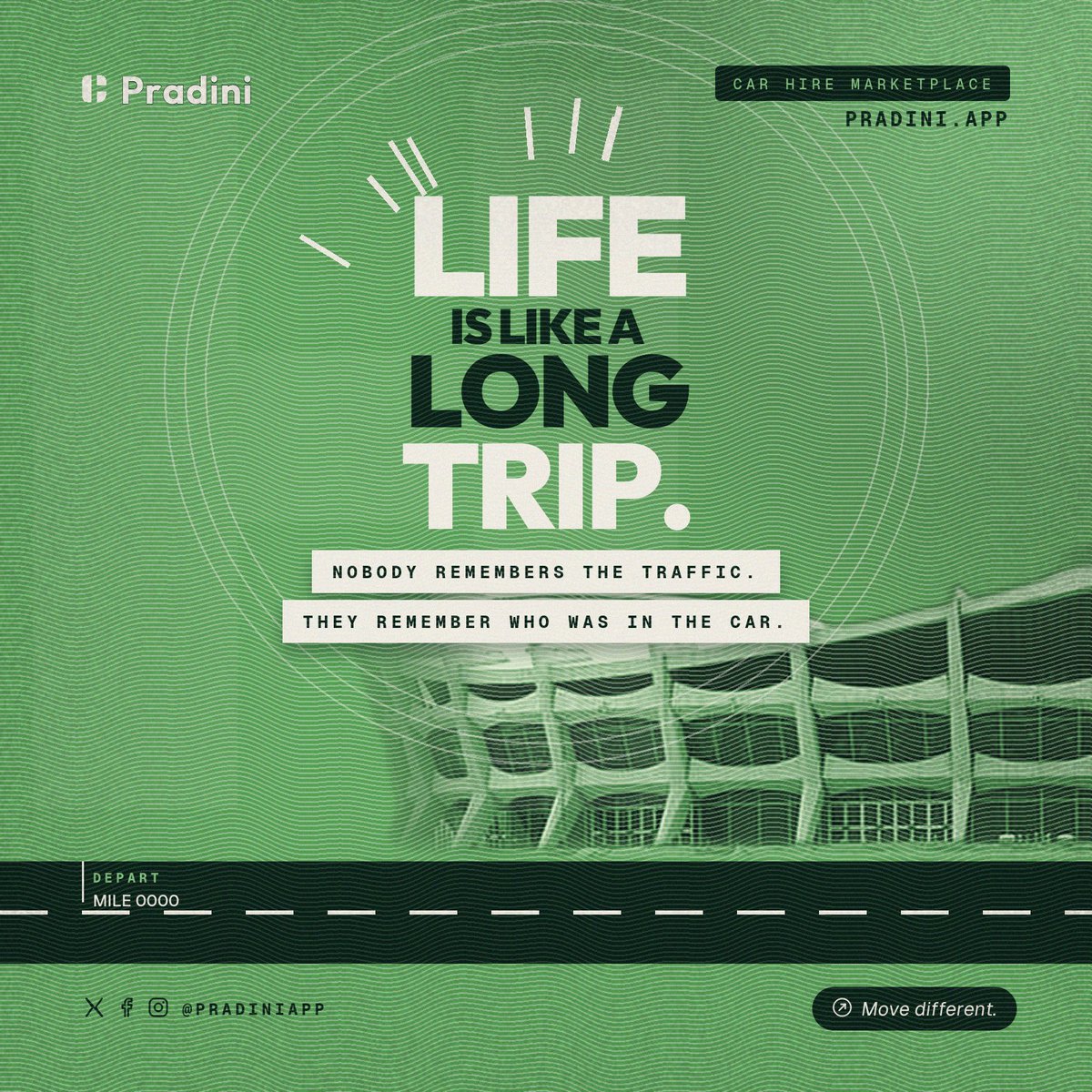
Life is like a long trip. Nobody remembers the traffic, they remember who was in the car.
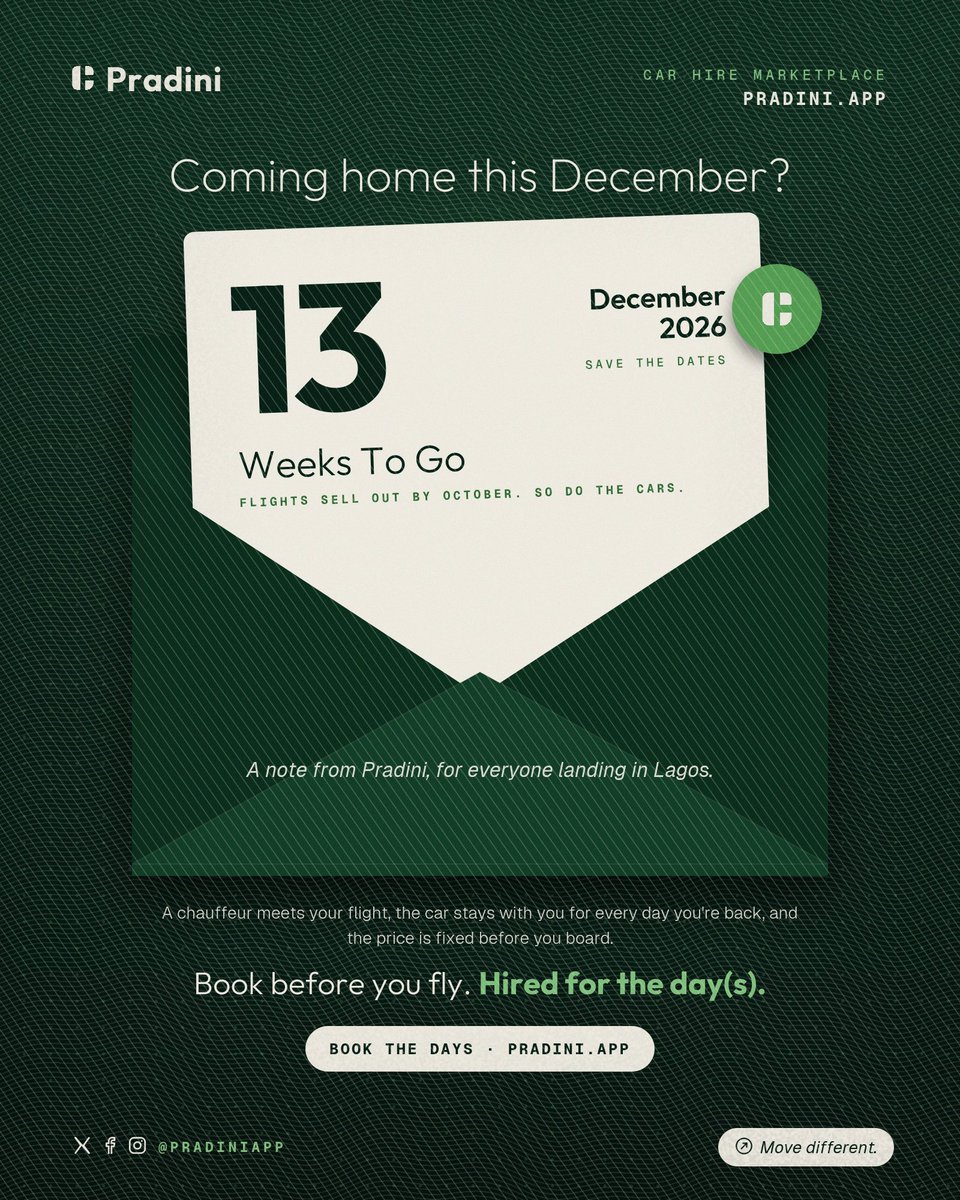
Coming home this December? Book your preferred car before you fly and your chauffeur stays with you for all the days you're here.
https://t.co/QPekswTT4A · Support +234 704 785 3697
#DettyDecember #ComingHome #Pradini #MoveDifferent
You've done the hard miles this year. The last one should be the easiest.
Coming home this December, book your preferred car before you fly. Land, get in, and your chauffeur stays with you for all the days you're here.
https://t.co/QPekswTT4A · for more enquiry +234 704 785 3697
#DettyDecember #ComingHome #MoveDifferent
The talk was 20 minutes. The day was 9 hours. The car was there for all of it.
For keynotes, client days and the meetings in between, book the car and the chauffeur for the day. https://t.co/19Li0MLiez
1. Flights to Lagos start selling out in October. You know this. What you might not know is that the cars go the same way, just quieter. By the second week of December every good car and every good driver in Lagos is spoken for.
2 The plan most people have is an uncle's driver. By 24 December that driver has four families and one car. You'll be the fourth.
3 Island hotel rates roughly double for the last two weeks of the year. Nobody complains. Everybody pays. The car is the one December cost you can still fix at a September price.
4 Here's what the well organised ones do. They book the car before they board. A chauffeur meets the flight, the car stays with them for every day they're back, and the price was agreed in a different time zone before anyone's aunty got involved.
5 Coming home this December? Book before you fly. Hire for the day(s). https://t.co/QPekswTT4A
If you're coming home this December, read this before you book the flight.
In thirteen weeks this city doubles and every car in it is already promised to someone.
1. Flights to Lagos start selling out in October. You know this. What you might not know is that the cars go the same way, just quieter. By the second week of December every good car and every good driver in Lagos is spoken for.
2 The plan most people have is an uncle's driver. By 24 December that driver has four families and one car. You'll be the fourth.
3 Island hotel rates roughly double for the last two weeks of the year. Nobody complains. Everybody pays. The car is the one December cost you can still fix at a September price.
4 Here's what the well organised ones do. They book the car before they board. A chauffeur meets the flight, the car stays with them for every day they're back, and the price was agreed in a different time zone before anyone's aunty got involved.
5 Coming home this December? Book before you fly. Hire for the day(s). https://t.co/QPekswTT4A
If you're coming home this December, read this before you book the flight.
In thirteen weeks this city doubles and every car in it is already promised to someone.
1/ Lagos is the smallest state in Nigeria by land and the most populated by people. Over twenty million of us on 3,577 square kilometres. Every road is a shared road.
2/ The Lekki Ikoyi Link Bridge is 1.36km, opened in 2013, and it's the only bridge in the country most people can name by its toll.
3/ The Blue Line opened in 2023, Marina to Mile 2. The Red Line followed in 2024. Lagos has rail again for the first time in most of our lifetimes.
4/ Eko Atlantic is ten square kilometres taken back from the sea. The city ran out of room, so it made some.
5/ Lagos stopped being the capital in 1991. Nobody told Lagos. It still behaves like the capital of everything.
6/ The sixth thing. Every bridge in this city is a decision, and you make it twenty times a day. Which route, which time, whether to drive yourself. A day with a chauffeur is the day you make that decision once, in the morning, and never again. https://t.co/QPekswTT4A
Third Mainland Bridge was the longest bridge in Africa for six years. You've spent longer than that on it. Five things about crossing Lagos, and one about never having to.
1/ Lagos is the smallest state in Nigeria by land and the most populated by people. Over twenty million of us on 3,577 square kilometres. Every road is a shared road.
2/ The Lekki Ikoyi Link Bridge is 1.36km, opened in 2013, and it's the only bridge in the country most people can name by its toll.
3/ The Blue Line opened in 2023, Marina to Mile 2. The Red Line followed in 2024. Lagos has rail again for the first time in most of our lifetimes.
4/ Eko Atlantic is ten square kilometres taken back from the sea. The city ran out of room, so it made some.
5/ Lagos stopped being the capital in 1991. Nobody told Lagos. It still behaves like the capital of everything.
6/ The sixth thing. Every bridge in this city is a decision, and you make it twenty times a day. Which route, which time, whether to drive yourself. A day with a chauffeur is the day you make that decision once, in the morning, and never again. https://t.co/QPekswTT4A
Third Mainland Bridge was the longest bridge in Africa for six years. You've spent longer than that on it. Five things about crossing Lagos, and one about never having to.
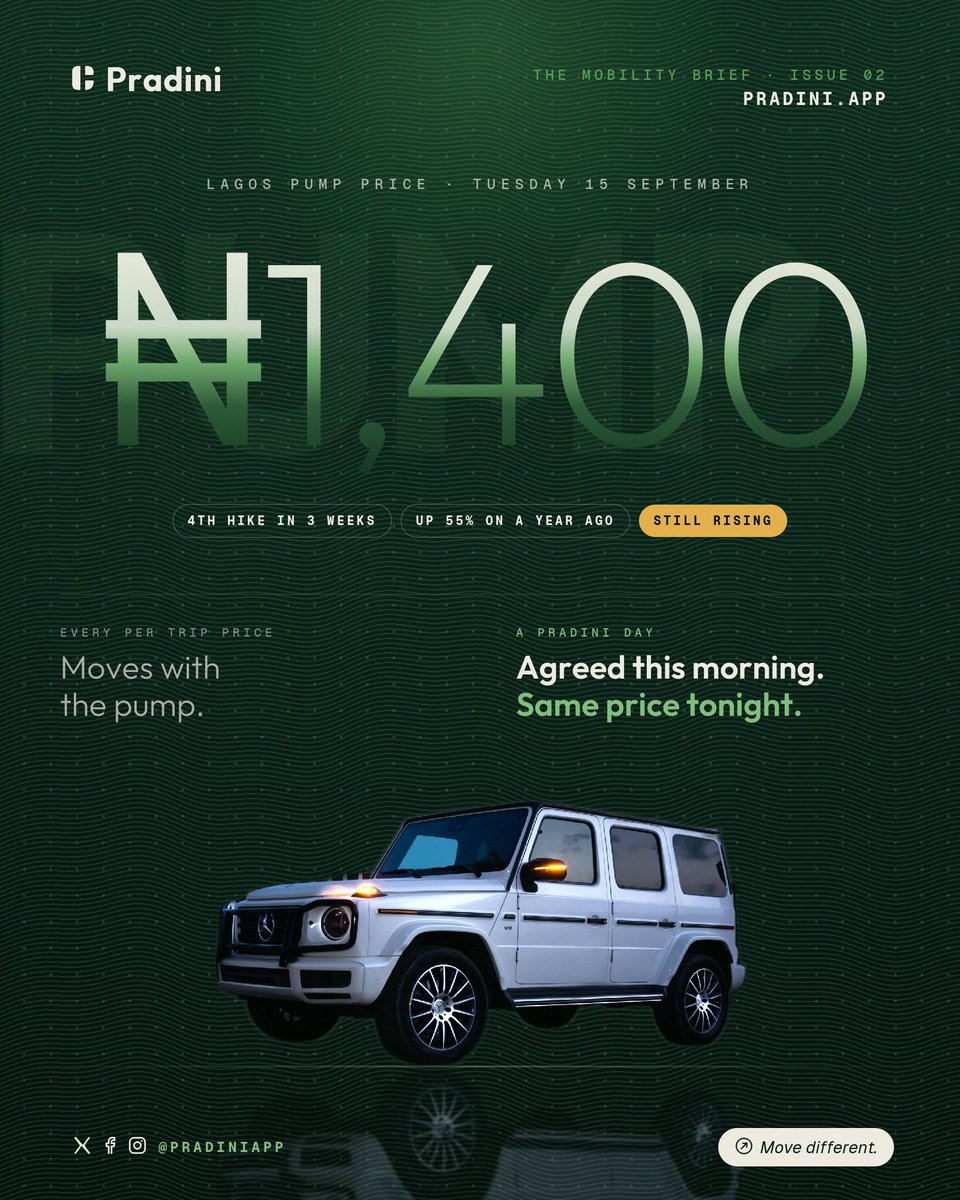
1. Petrol crossed ₦1,400 at Lagos pumps today. Dangote raised its gantry price to ₦1,350 on Friday, the fourth increase in three weeks, and Brent is above $100. A litre is up 55% on this time last year.
2. What that does to a day in the city: every per trip price you're quoted is now a guess against the pump. The 9am price and the 6pm price for the same road are not the same price.
3. Elsewhere. Rensource and Metro EV's renewable electric fleet is live in Lagos since 1 September. CREDICORP's 10,000 vehicle rollout keeps moving state to state, financed to earn. And December is thirteen weeks out, which is when every car in Lagos gets booked.
4. The read. When the pump moves four times in three weeks, the only price worth having is the one that doesn't move. One number for the whole day, agreed before you leave the house.
5. Car and driver, hired for the day, priced before you pay. https://t.co/QPekswTT4A
Our duo, on their Duo.
A car on one screen, a chauffeur on the other. Hired for the day, waiting outside every stop, price fixed before you pay.
Runs on any phone. Folds into your day.
https://t.co/19Li0MLiez
Our duo, on their Duo.
A car on one screen, a chauffeur on the other. Hired for the day, waiting outside every stop, price fixed before you pay.
Runs on any phone. Folds into your day.
https://t.co/19Li0MLiez
The numbers first. Nigeria's ride hailing market is worth around $450m a year. By 2025, Bolt held roughly two thirds of it. Uber, the company that built the category here in 2014, was down to single digits. That was public months before the exit. Almost nobody read it as a warning.
Here's the part nobody says. Uber didn't lose to Bolt. It lost to the model. Drivers run every app at once. Riders switch per trip. inDrive charges about 10 percent and lets you haggle. When loyalty is zero and margins are single digits, a per trip commission business can't make money at scale. Not here.
The competitive unit in Nigerian ride hailing is the trip, not the customer. When one player leaves, nobody inherits its riders. They were never anyone's riders. They belonged to whichever app answered first.
Something else left with Uber. It was the only one that insisted on vehicle certification and a quality bar. Bolt and inDrive compete on price. The next entrant launching in October is competing on affordability. The top of the market just went vacant.
Read the exit statement closely and there's a recruitment ad inside it. inDrive publicly welcomed "drivers and mobility investors affected by Uber's exit." Mobility investors means people who bought cars to put on Uber. Thousands of certified vehicles, owners used to their car earning, no platform this morning.
So the market has two open seats. One for the guest who wanted a certified car, a known chauffeur, a price fixed before they got in, and a car that stays. One for the owner whose car just stopped earning.
Neither seat is a ride hailing product. They never were. A car and a driver for the day, priced upfront, money in escrow, the owner approving every trip. That's what we built. https://t.co/QPekswTT4A