What if the greatest challenges in strategy are not technical, but philosophical? 💡 A space for collaboration and inquiry into what truly works. 🌱 #AIethics
Participate in the Vidarbha Insights Survey
If you live, work, study, or do business in Vidarbha, your perspective can directly shape our next projects in district intelligence, MSME support, and AI/IKS experiments for the region.
https://t.co/8Z8yTRX05G
In Shunya philosophy, transformation begins in stillness.
Today's deep-tech needs the same: pause, reflect, then leap — perfectly synced with Startup India's extended support for long-horizon deep tech ventures.
Patience powers progress.
#ShunyaXis#DeepTechIndia
Quantum is not just tech; it's philosophical convergence — Shunya's zero-point field meets qubit entanglement.
NQM's Thematic Hubs are building this bridge for education & enterprise transformation.
From Nagpur, envisioning Atmanirbhar deep-tech.
#QuantumIndia#ShunyaXis
True innovation arises from emptiness — Shunya teaches us to unlearn rigid patterns.
AI thrives when we let go of old assumptions, aligning with IndiaAI Mission's push for ethical, sovereign models rooted in Indian wisdom.
#ShunyaXis#IndiaAI
Shunya: the ancient void of infinite potential. In quantum thinking, it mirrors superposition — endless possibilities until observed.
India's NQM is awakening this potential for Bharat's future.
#ShunyaXis#NationalQuantumMission
#WATCH | The IndiaAI Mission, launched in 2024, is a national initiative to build a strong and self-reliant Artificial Intelligence ecosystem. With an investment of over ₹10,000 crore, it supports startups with affordable computing infrastructure and data platforms, while focusing on indigenous AI models, skill development, and innovation, aiming to position India as a global AI leader.
@PMOIndia@GoI_MeitY@MIB_India@PIB_India #IndiaAIImpactSummit #IndiaAISummit2026 #ArtificialIntelligence #DigitalIndia
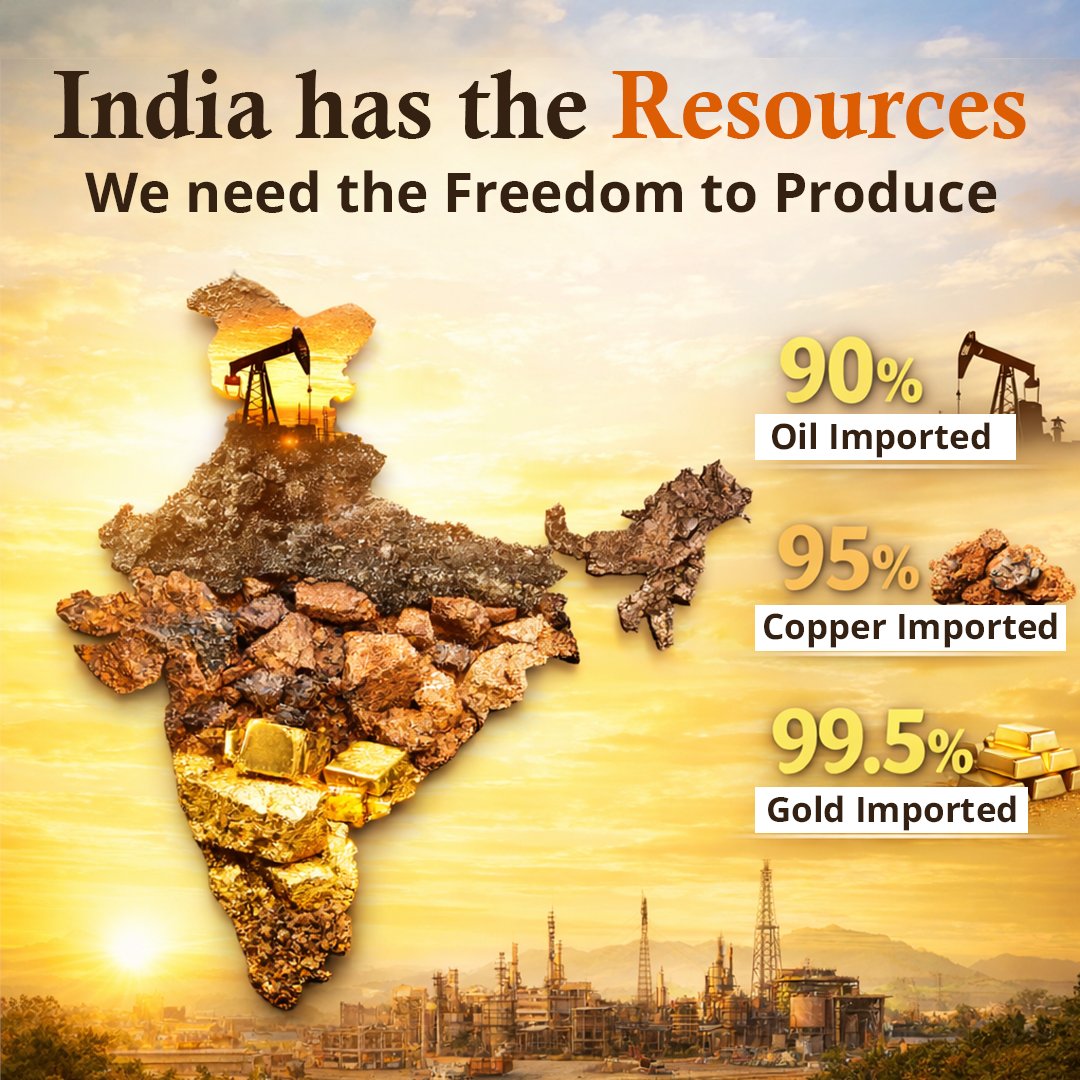
It is painful to see India face the adverse consequences of a war we have nothing to do with, particularly because of raw material security. We don’t have to import 90% of our oil, or 95% of our copper or 99.5% of our gold or any other metal resources. Mother Earth has given us the best geology. Last 40 years of practice in the minerals, metals and oil industry have taught me this. Now is the time, with this positive government, to give entrepreneurs freedom.
At just 19, I came to Bombay from Bihar and built a company in this industry from scratch. Vedanta was able to acquire Hindustan Zinc and BALCO under a privatisation programme which was never completed. 26% and 49% stakes are still held by the government and not been transferred as per a predetermined agreement. Vedanta also acquired ONGC Oil and Gas asset via UK’s Cairn and Sesa Goa Iron ore from Japan’s Mitsui.
In each one, the ambition and goal was to increase the production so much that India wouldn’t need to import but, in fact export. In Hindustan Zinc and BALCO, we succeeded. We increased zinc production 10 times, 20 times in aluminium. In the process, more than 1,000 companies have come up for processing this raw material. And Vedanta has contributed Rs 4.5 lakh crore to the exchequer in the last ten years. In oil and gas, our vision is to produce 1 million barrels per day. In iron ore, my vision is to produce 100 million tonnes, 33% of today’s production level. There are many more underperforming government assets that can perform the same way.
Three or four decades ago, there was no know-how, no experts, no finance in this industry. It took a lot of determination. Vedanta raised 35 billion USD from abroad and invested in India. It brought experts and technology. Because of that, Hindustan Zinc can also produce silver and fertiliser, and we are working very hard to start producing critical minerals very soon, something we were told would never happen in India.
Globally, only few very large companies engage in mining as it is very difficult without scale. Vedanta should be for India what Rio Tinto and BHP are for Australia or Vale is for Brazil. Other entrepreneurs and companies must create new Vedantas.
Most of the advanced countries have become prosperous by developing natural resources, including oil and gas. In India, the system has to stop creating hurdles. It needs to take a long-term view, as this government is not revenue-minded but, production-minded. It must facilitate. Instead of notices and judicial activity, all businesses need to receive recognition and respect. Benefit of doubt should pass onto them.
In India, we have economic heroes who can raise production equal to the biggest and best in the world. We should not allow tunnel vision or outdated mindset to keep us small and dependent. Some may remember the case of Rio Tinto which had invested in a diamond mine in Madhya Pradesh. It could have made India a global hub for diamond production, but they exited because of a complex, interfering and discouraging system.
The most important thing is trust. Keep the system simple, keep regulation limited and you eliminate the root cause of wrongdoing. We should have self-certification instead of lengthy approvals and clearances. The Government issues the rulebook and entrepreneurs strictly comply, subject to audit. Constant enquiry and interference only discourage enterprise. Also, the mindset of discrimination between public sector and private sector should change.
This year my family had the biggest tragedy. It was heartening to hear the words of the Prime Minister who said, “You must stay strong and continue to do work which is important for India.” That is the motivation of my life. I have the blessings of my grandfather and grandmother, who spent 40 years in Vrindavan in a small hut, in Manav Seva Sangh with their guruji, Swami Sharnanand Ji Maharaj. They always advised me, if you have wealth, you must use it for society. If you don’t have wealth, you must always help society with your hand. We all are willing to work hard, take risks and ensure that India becomes self-sufficient. The system should encourage us to deliver for our society and nation; this will eradicate unemployment and encourage women empowerment. This sector has given the maximum revenue to the exchequer in India and in the world for nation-building. It will help in making our country a developed nation, as envisioned by our Prime Minister. Let’s make India & Indians proud.
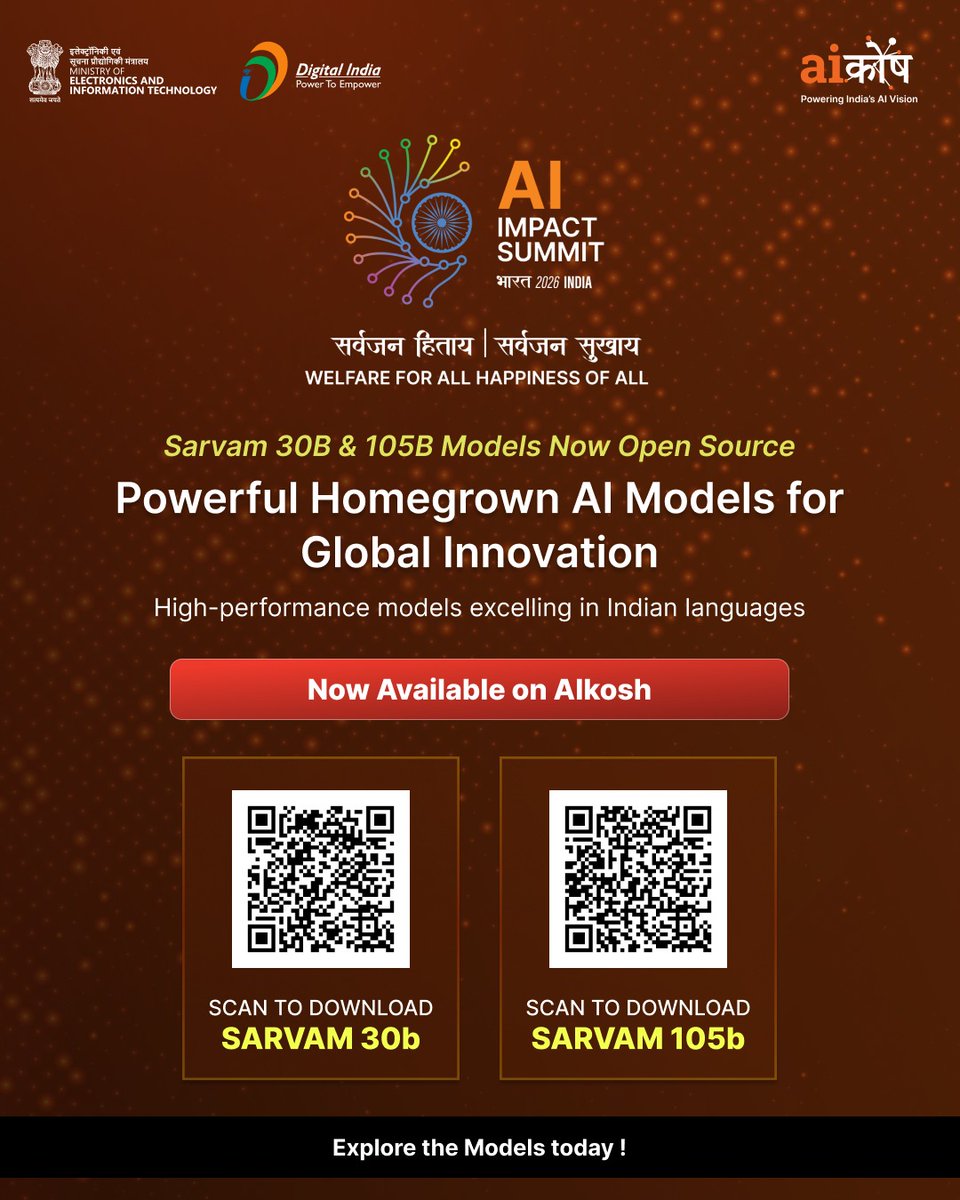
India’s AI Ecosystem Gets Stronger!
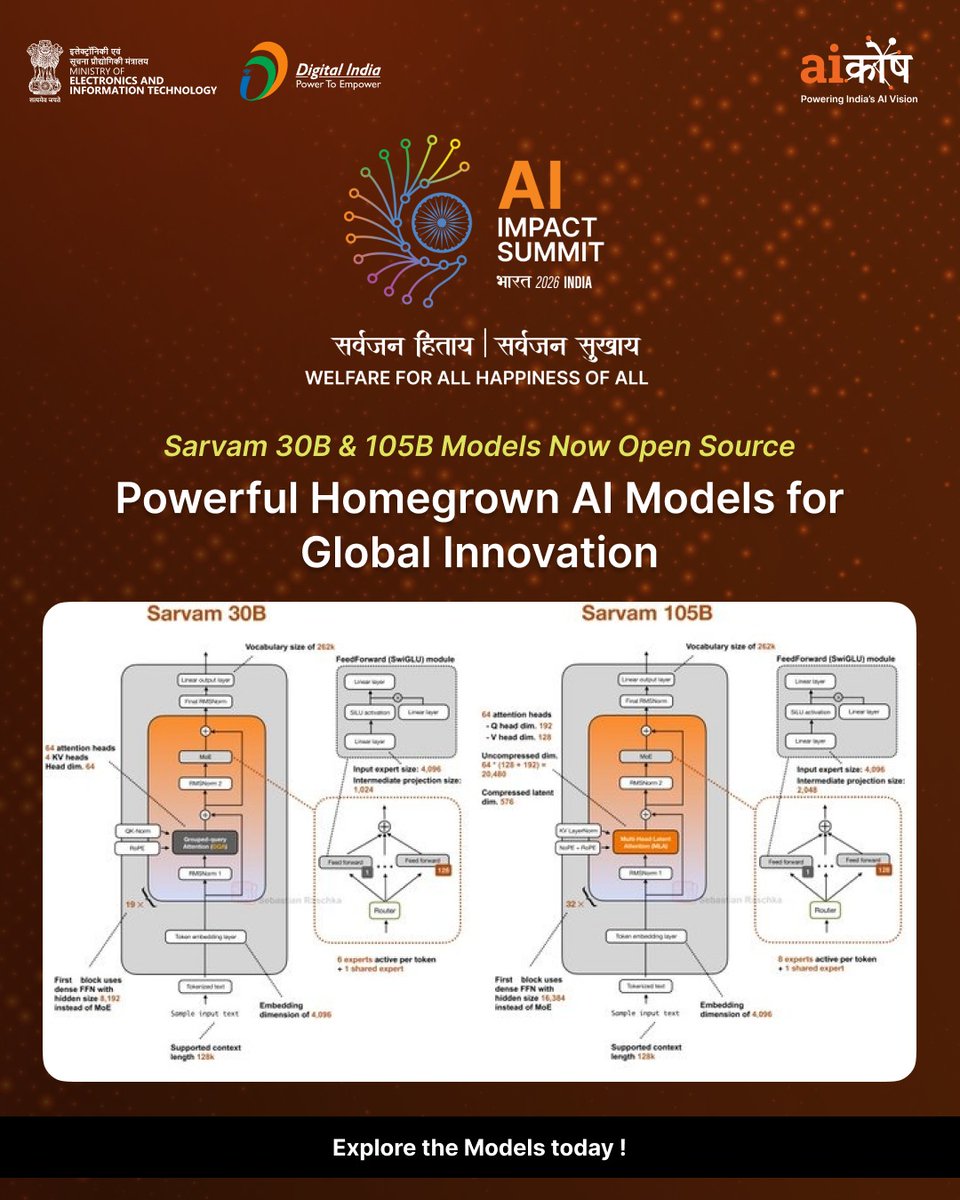
The open-sourcing of Sarvam 30B and 105B models represents a major advancement in building powerful, indigenous AI models designed for global impact.
Trained from scratch and optimised in-house, these models deliver high performance across global benchmarks while excelling in Indian language understanding and generation.
By making the model weights accessible on AIKosh and Hugging Face, the initiative strengthens India’s open AI ecosystem and accelerates innovation across research, startups and enterprise applications.
🔗 Access the models on AIKosh:
*https://t.co/y75doOgNld
*https://t.co/AhjjPXEyrT
Enabling AI built in India, for India and the world.
#IndiaAI #AIForAll #OpenAI #DigitalIndia #AIInnovation #IndianLanguages #AIKosh
@PMOIndia@AshwiniVaishnaw@jitinprasada@PIB_India@SecretaryMEITY@abhish18@kavitabha@GoI_MeitY@_DigitalIndia@mygovindia
THE 2028 GLOBAL INTELLIGENCE CRISIS - A Thought Exercise in Financial History, from the Future
This report is being actively debated in several groups I am part of. Sharing a few early takeaways and reflections.
First, it's important to note that it is not a forecast, but a stress-test scenario intended to highlight potential systemic risks in a world where AI capabilities scale rapidly.
The report’s central argument is that AI could dramatically reduce the cost of cognitive work, potentially disrupting labour markets, business models, and even financial systems faster than economies are able to adjust.
Past automation waves primarily affected manufacturing workers, clerical roles, and routine back-office work. AI, however, is beginning to target high-skill cognitive tasks—software development, analysis, research, professional services. In effect, the cost of intelligence itself may be collapsing.
While we can debate the speed and extent of the shift....I don't think we can dismiss it.
The report argues that this could create a macroeconomic paradox. While AI may significantly boost productivity and corporate profitability, declining labour income could weaken consumer purchasing power. The authors describe this as “Ghost GDP”—an environment where output and efficiency rise, but household income and demand fail to keep pace.
For India, the implications could be particularly important given our dependence on the services economy.
It raises an imp question for governments - if AI dramatically increases productivity and reduces the cost of cognitive work, how do we ensure that these gains translate into broad societal prosperity rather than becoming concentrated among a small number of technology firms or capital owners...
Thoughts?
https://t.co/sfau6EGXVY
The Iran Crisis Scenario: A systemic shock looms for Europe. This isn't just a regional conflict; it’s a profound entanglement of five strategic fault lines threatening EU stability. 🧵
@IanBremmer@RanaForoohar#Geopolitics#StrategicAutonomy
As #AI, #connectivity and evolving content formats reshape industries, what’s next for the #tech, #media and #telecom ecosystem?
Deloitte is back with another edition of its #TMTPredictions report to take this conversation forward.
Join the Deloitte leadership for an engaging discussion on the trends shaping the sector’s next chapter, from growth in the #semiconductor market and the surge in #datacentres to the rise of #microdramas, #videopodcasts, live experiences and the growing influence of #GenerativeAI in media.
Register for the virtual launch of the “TMT predictions 2026: India chapter” report.
Link: https://t.co/hyfex6nGV2
#DeloittePredictions #TMTPredictions2026 #Technology #Media #Telecom #DigitalTransformation #GenerativeAI #TMT #DeloitteIndia
“I salute your diplomatic skills when you say that we stand here as two big democracies. There is one big and one slightly smaller, but I think the key message is that we share values. I would also like to congratulate you on your leadership. My last visit to India was in 2013 in my capacity as Minister of trade and the change that I just saw on the streets of New Delhi, and I will most probably see in Mumbai in a couple of days, is palpable. This is an economic miracle that we're witnessing.
— Hon’ble President of Finland Shri @alexstubb addressing the joint press meet with Hon'ble PM Shri @narendramodi
The article, ‘How Vibe Coding Can Transform AI Adoption in Public Sector Workflows’ for Forbes India, by Prof. Rahul Dé and Rishabh Ohri, PGP ’19, IIMB, explores how ‘vibe coding’ allows users to build software in natural language.
Read the article: https://t.co/jitlQxaWyy
Heartfelt thanks for your warm wishes and blessings, @PemmasaniOnX Ji. Under the able leadership of PM Shri Narendra Modi Ji, and with your constant support, we will leave no stone unturned to uplift the lives of our brothers and sisters in rural India.
The Quantum Synthesis: Crisis precedes a phase shift. Europe must move from 'Mechanical Dependency' to 'Strategic Atman' (Self-Realization). Leadership isn't just managing the storm; it's transcending it. 🏛️✨
@Gurudev@FritjofCapra#QuantumLeadership#VedicWisdom