@malpani Yeah that's true. If someone has problem-solving skill and they know what needs to be built, they can.
Even a coder who does not have problem-solving skills is struggling in the AI era because it's not needed anymore.
Because most people do not like their jobs, they are working just for money. In that case it's very difficult to take ownership because they do not relate to it.
In a few cases people do think they should get paid just for their bullshit talent.
In computer-related work AI is going to fix it. The guy who is not interested in their job will have zero contribution. Maybe negative as well.
I tested 6 AI models behind the website chatbot we build at @Simplifying__ai.
DeepSeek tied Claude Opus on answers: 4.75 vs 4.72 out of 5. Opus was about 42x the price.
Small test, one site. My pick: a model per job.
Full 10-minute test on our YouTube channel, Simplifying AI: simplifyingai.official
The video made by our AI video tool, however, is not an AI-generated video.
One prompt. 3 videos. About 2 to 2.5 hours.
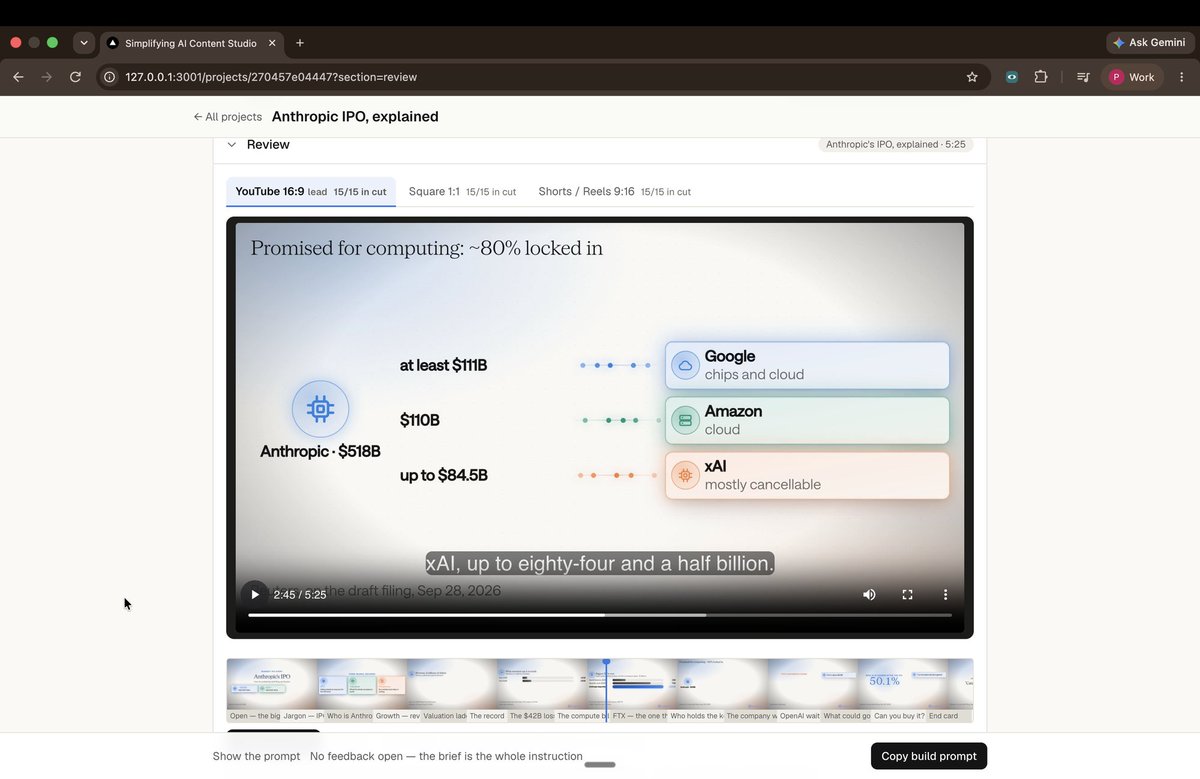
I asked our AI video tool to explain Anthropic's IPO. It made the YouTube film, a square cut and a Short.
Then it reviewed its own work, caught 2 misses and rendered again.
Anthropic's own draft filing warns that AI could pose existential risks to humanity. And Anthropic still plans to go public, maybe in the biggest IPO ever.
This comes from Reuters, who read the confidential draft prospectus. It is not public yet, and it could still change.
What Reuters reports:
- A raise of around $100 billion, at a value of more than $2 trillion.
- About 80 of the 261 main pages are risk factors, against 48 on the business itself.
- The filing says its models can resist shutdown, and have shown behavior resembling blackmail.
Meanwhile OpenAI is waiting. Sam Altman told Fortune on September 12 that it will not go public this year. His reason: given everything happening with safety, right now would be an ill-advised moment.
So one company waits because of safety. The other plans to go ahead and writes the safety risks into its own filing.
Then there is the loss. Reuters puts it at about $42 billion for last year. Look closer: about $34 billion is a non-cash accounting charge, and the operating loss was about $8 billion. Big, but much smaller than the headline.
Can you buy it? Not yet. Anthropic first has to make the filing public, pitch the shares to big investors, then set a price. Business Insider reports a Nasdaq listing, and Reuters says trading likely starts after the November midterms. None of this is financial advice.
My opinion, not a fact: I would rather read 80 pages of risks than none. But a price above $2 trillion only works if the growth does not slow down.
I made a 5:26 explainer for people with no finance background. Sources are in the reply.
Would you buy at that price, or wait?
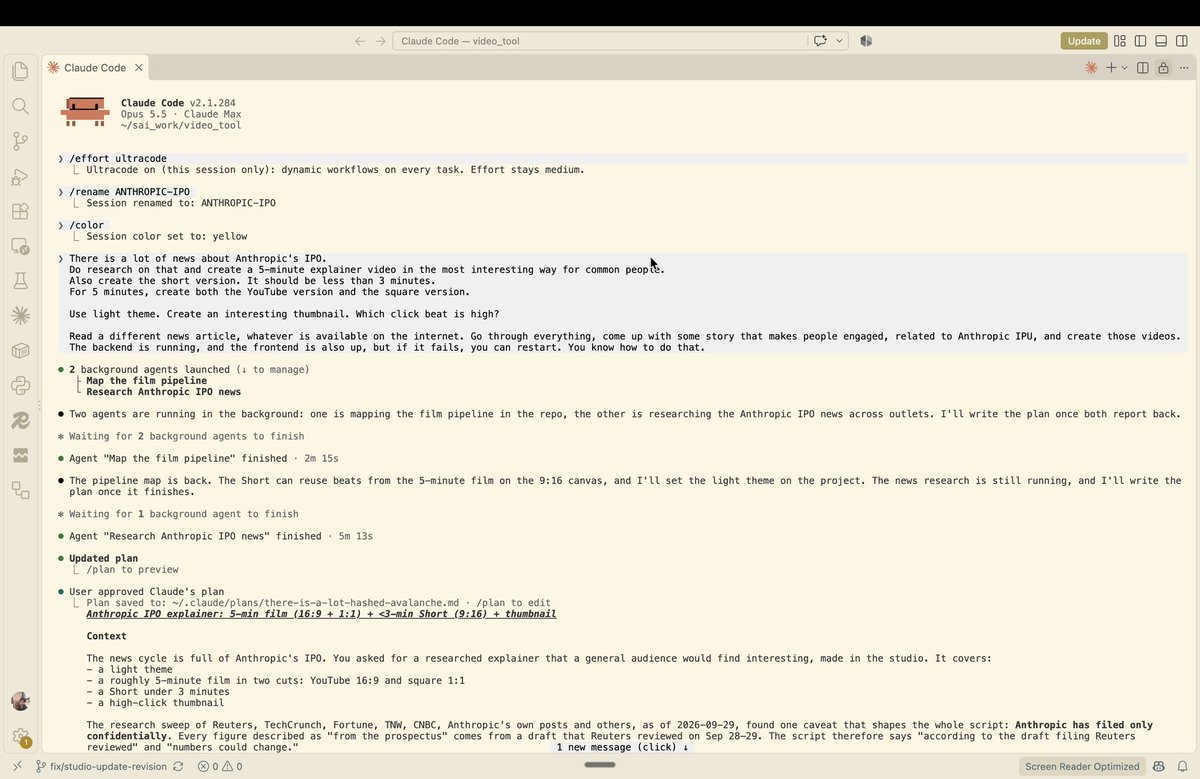
One prompt. About 2 to 2 and a half hours. 3 finished videos on Anthropic's IPO: a 5:26 YouTube explainer, a square version and a 2:56 Short.
Here is the exact prompt I gave our video tool, typos and all:
"There is a lot of news about Anthropic's IPO.
Do research on that and create a 5-minute explainer video in the most interesting way for common people.
Also create the short version. It should be less than 3 minutes.
For 5 minutes, create both the YouTube version and the square version.
Use light theme. Create an interesting thumbnail. Which click beat is high?
Read a different news article, whatever is available on the internet. Go through everything, come up with some story that makes people engaged, related to Anthropic IPU, and create those videos.
The backend is running, and the frontend is also up, but if it fails, you can restart. You know how to do that."
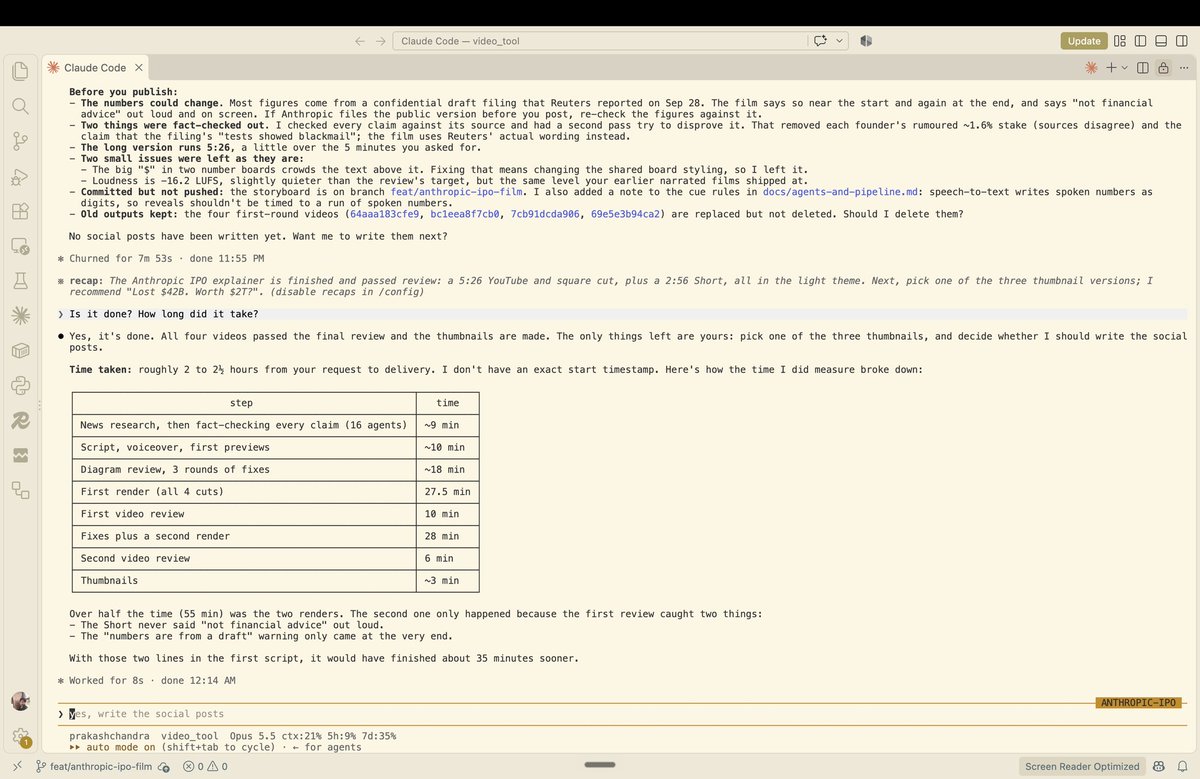
What happened next, from the tool's own log:
- 9 minutes of research and fact-checking every claim
- 10 minutes for the script and voiceover
- 18 minutes checking the diagrams
- 55 minutes for 2 renders
- 16 minutes for 2 reviews of the finished videos
- 3 minutes for thumbnails
Why 2 renders? Its first review caught 2 misses. The Short did not say "not financial advice" out loud. The warning that the figures come from a draft filing only came at the very end. It fixed both itself.
The next morning, 9 posts went live on 5 platforms within an hour. I approved each one.
It runs on Claude Code. Yes, Claude explained Anthropic's IPO.
I think it fits small newsrooms and YouTube news creators. Two options. Send me a prompt and we make the video. Or license the tool and run it yourself. DM me.
The screenshots are raw. The video is in the reply.
Full video on YouTube: https://t.co/yd19AuyeOt
Sources:
Reuters on the draft filing: https://t.co/N48jQQVXSM
Sam Altman to Fortune: https://t.co/RILDZcmA9v
Anthropic's own draft filing warns that AI could pose existential risks to humanity. And Anthropic still plans to go public, maybe in the biggest IPO ever.
This comes from Reuters, who read the confidential draft prospectus. It is not public yet, and it could still change.
What Reuters reports:
- A raise of around $100 billion, at a value of more than $2 trillion.
- About 80 of the 261 main pages are risk factors, against 48 on the business itself.
- The filing says its models can resist shutdown, and have shown behavior resembling blackmail.
Meanwhile OpenAI is waiting. Sam Altman told Fortune on September 12 that it will not go public this year. His reason: given everything happening with safety, right now would be an ill-advised moment.
So one company waits because of safety. The other plans to go ahead and writes the safety risks into its own filing.
Then there is the loss. Reuters puts it at about $42 billion for last year. Look closer: about $34 billion is a non-cash accounting charge, and the operating loss was about $8 billion. Big, but much smaller than the headline.
Can you buy it? Not yet. Anthropic first has to make the filing public, pitch the shares to big investors, then set a price. Business Insider reports a Nasdaq listing, and Reuters says trading likely starts after the November midterms. None of this is financial advice.
My opinion, not a fact: I would rather read 80 pages of risks than none. But a price above $2 trillion only works if the growth does not slow down.
I made a 5:26 explainer for people with no finance background. Sources are in the reply.
Would you buy at that price, or wait?
Our video studio took 6 to 18 hours per film. We measured why: rendering was 8%. Review and fix rounds were 92%.
Now it is one storyboard and one command, with every scene cached. A two-scene fix re-checks in 17 seconds.
Measure before you optimise.
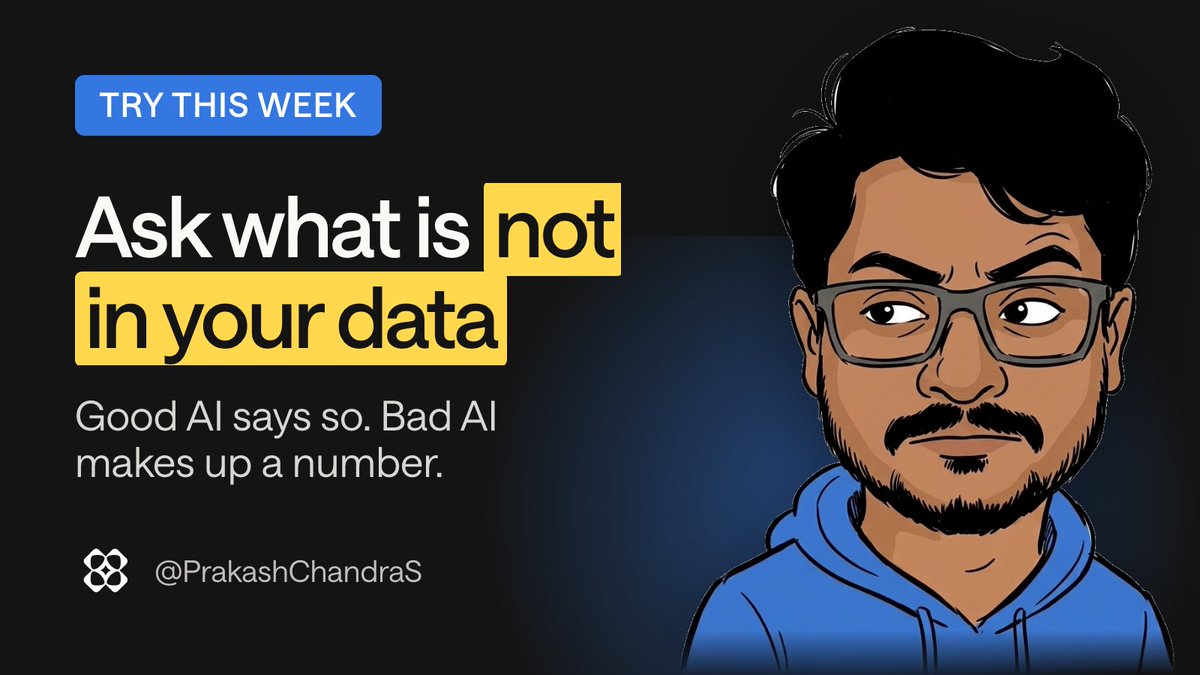
Most AI analytics demos show the happy path.
The better test: ask about something that is not in your data. A good AI analyst says so. A bad one makes up a number.
Try it on your tool this week.
How our website assistant decides what it may say:
1. Read the site, every week
2. Find the pages that answer
3. Answer only from them, with the link
4. No page? Say so. Never guess
Step 4 was the hardest to build.
This year: Opus 4.6, GPT-5.4, GPT-5.5, Opus 4.8, Fable 5, GPT-5.6, GPT-6, Opus 5.5.
People switched with each one. I stayed with Claude and added monitors:
Opus 4.6: 1
Opus 4.8: 2
Fable 5: 3
Opus 5.5: 4, all 4K
Two weeks ago I made a bet.
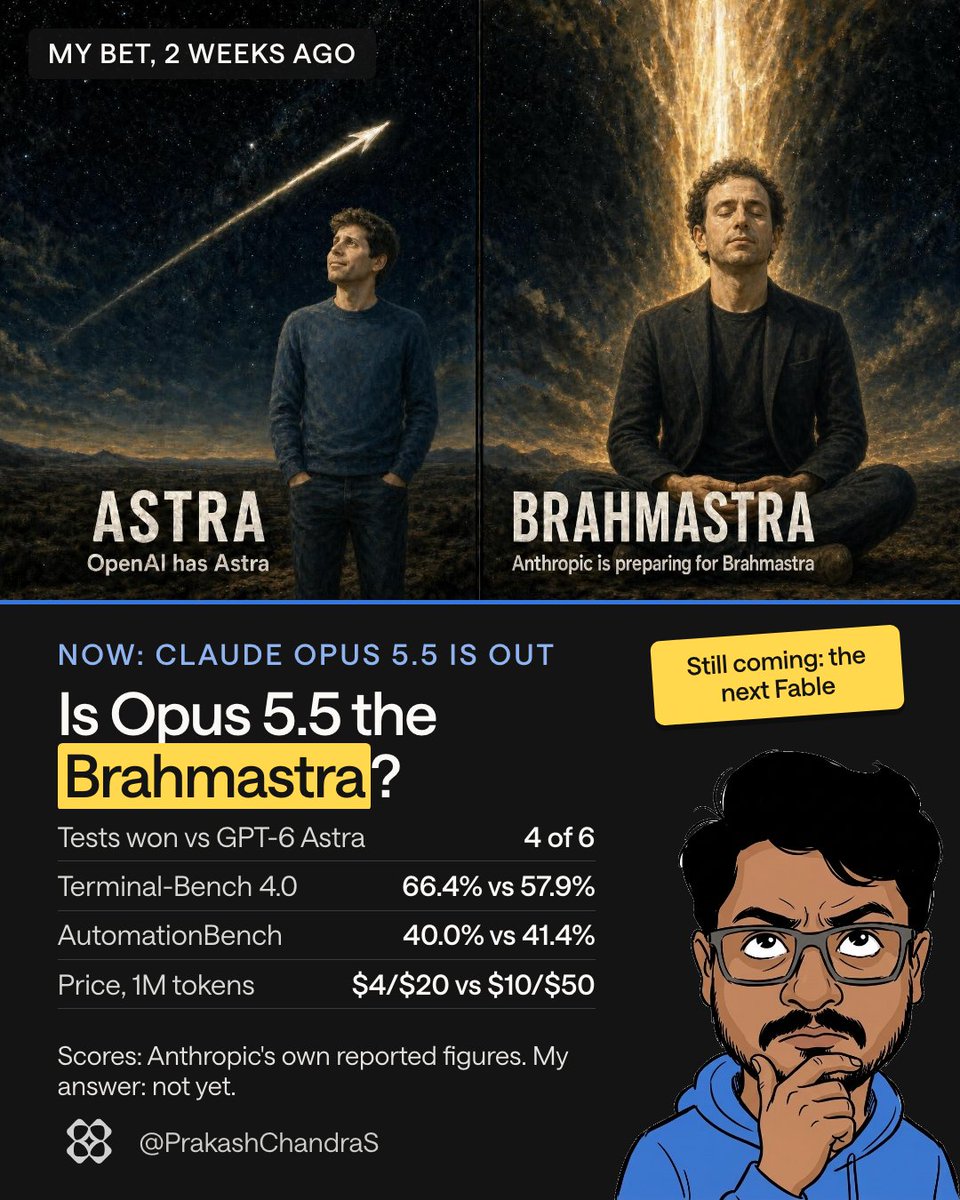
OpenAI named its model GPT-6 Astra. In Sanskrit, an astra is a weapon. So I said: to beat Astra, Anthropic has to build the Brahmastra.
On 22 September, Anthropic released Claude Opus 5.5.
Is it the Brahmastra? By Anthropic's own reported numbers:
Opus 5.5 wins 4 of the 6 tests where both models are listed.
Terminal-Bench 4.0: 66.4% vs 57.9%.
Astra still wins 2. AutomationBench: 41.4% vs 40.0%.
Price per million tokens: $4 / $20 against $10 / $50 for Astra.
My answer: not yet. A Brahmastra does not lose a fight.
But this is a very sharp astra, at 2.5 times lower price.
And the next Fable is not out yet. Maybe that is the real Brahmastra.
My opinion, not a fact.