A separate group of large holders (~7.8B shares total, including Musk) has a longer staggered lock-up:
• Staged releases starting after Q4 2026 results (20%), then day 280 (Mar 18, 2027), after Q1 2027, day 340 (May 17, 2027), etc.
• Elon Musk’s shares (~6.4B) have a 366-day lock-up with no early release — first tradable around June 14, 2027 (day 366 falls on a Saturday, June 12).
Live unsupervised @robotaxi service is currently in ~8–9 U.S. cities/regions (e.g., multiple Texas cities plus Florida markets). Expansion has been rapid in 2026. Reaching 25 cities could occur in ~6–12 months at the recent pace. $TSLA
So so this is how it’s going to be from here on out. We also will see faster scaling from here on out. Don’t miss the signs, they are the opportunity. Bullish
@MooreDividends Ja ich schon. More of the same ist ja auch langweilig. Longterm Investor Info aus praktischem Blickwinkel gibts bei mir. Freu mich wenn’s wem gefällt. 🙋🏻♂️
7/7 - Investor orientation:
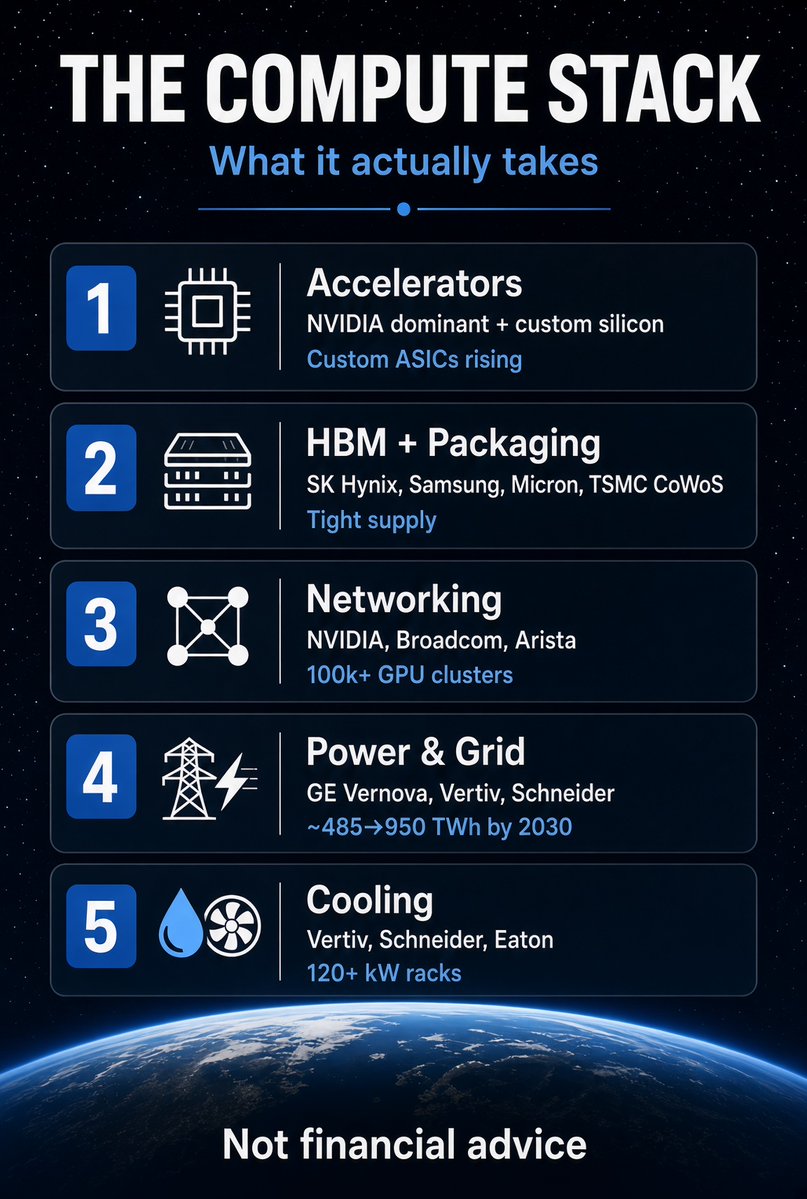
The companies that supply or control the slowest layers (power equipment, advanced packaging, high-bandwidth interconnect, liquid cooling) have more durable positioning than pure GPU buyers. The stack is the constraint.
The Compute Stack — Layer by Layer 🧵
Buying GPUs is the easy part.
Turning them into working frontier capacity requires the full physical stack to arrive at the same time.
Here’s what compute actually takes. (read more...)
AWS scaling GPUs every 14 seconds on the ground is real, but so are the permitting, interconnection, and power-queue constraints. Orbital proposals (including SpaceX’s large filings) are still early; the durable advantage appears only if launch cost and thermal management improve enough that continuous solar beats the terrestrial bottlenecks. Timeline gap is large today—the crossover is a cost-curve question, not a 2027 certainty. Which constraint do you see relaxing first?
Dual catch on Flight 15 is the first real test of whether the tower becomes a high-utilization asset rather than a one-stage recovery tool. If both stages return intact, the marginal cost of the next launch drops sharply because the expensive hardware is already back. Even a partial success compounds the reusability curve faster than another expendable flight. What metric from this attempt would you watch most closely for the cost trajectory?
Highway testing outside the current geofence is the utilization unlock—connecting separate service areas multiplies possible trips without proportional vehicle growth. The long-term filter is still the same: how many revenue-generating hours per vehicle per day once highways are live? Early volume outside the box is encouraging; sustained high utilization is what moves the economics.
@DriveTeslaca Stopping new orders while finishing the backlog is classic capital discipline—protects customer trust and frees the line for higher-utilization products like Cybercab.
@RandyWKirk1 Fundamental understanding of the company, it’s culture, mission and how they execute is best way of deciding weather to invest. Don’t forget that these are highly mission driven people. They will make it work.