NEPAL FLOOD: A MOMENT THAT SAYS IT ALL
The flood arrived with such terrifying speed that there was barely any time to react.
This close-up footage captures the sheer force and suddenness of the disaster in one unforgettable moment.
Nepal floods: Aerial footage shows the devastating aftermath.
At least 97 people have been killed, while 403 people from 27 countries remain unaccounted for.
Among those reported missing are 62 Nepali citizens, 133 Indians, 47 Americans, and 33 Britons.
So today,
don't ask "did I stretch enough?"
Ask: Am I more still than I was a year ago?
More clear?
Less reactive?
Yoga isn't something you do.
It's something you become. 🙏 #InternationalYogaDay#TheMysticalBharat
Yoga Day is here.
Everyone's posting stretches and asanas.
But Patanjali defined yoga in one line, "Yogash chitta vritti nirodhah" stilling the fluctuations of the mind.
Not flexibility. Stillness.
Asana is just one of eight limbs and not even the main one.
It's just steady sitting so the real work (quieting the mind) can begin.
You don't perform yoga for an hour.
You carry it into how you speak, react, and live.
But in that silence, something quietly happens.
A buried thought rises.
A question you forgot you were carrying.
Sometimes even an answer you didn't know you needed.
The ancients called this PRATYAHARA
withdrawal from the senses.
Not escape.
Return.
5/6 🧵
Think about the last time you did NOTHING.
Not sleep.
Not rest with music on.
Just... nothing. NO-THING.
Most of us can't remember.
We've filled every crack of silence with something.
4/6 🧵
They called it MAUNA.
Silence.
Not just of the mouth
But of the mind.
A space they entered on purpose.
Because they believed something we've forgotten.
2/6 🧵
In Indian philosophy, AKASHA is the space from which everything is born.
The sky,
The stars,
Sound itself.
They believed the mind has its own AKASHA too.
The gap between thoughts.
That's where they went looking.
3/6 🧵
The most dangerous thing in 2026 is an empty moment.
Because you will immediately fill it.
Ancient Indians did the opposite.
They protected the emptiness.
1/6 🧵
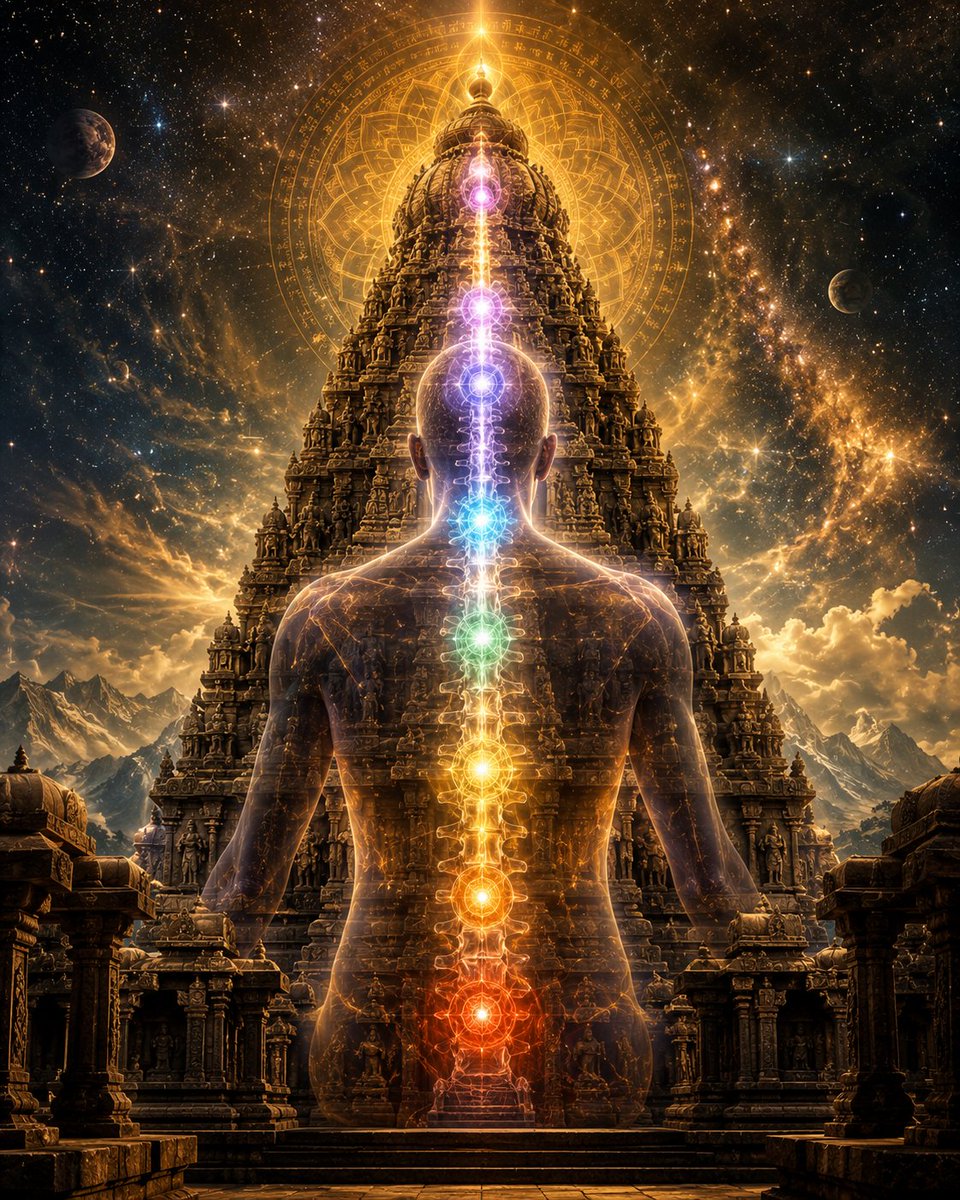
Ancient Indian temples were more than stone structures.
They were architectural blueprints of the human body and mind.
A journey designed not to help you find God outside, but within. ✨🙏
6/6 🧵
At the center lies the Garbhagriha, the "womb chamber."
Small, dark, and silent.
It represents the heart and the deepest core of consciousness where the divine resides.
4/6 🧵
Above it rises the Shikhara.
Like a spine reaching toward the sky.
Many traditions saw it as the ascent of consciousness from the earthly to the spiritual.
5/6 🧵
The Mandapa, or assembly hall, symbolizes the mind.
A space where thoughts, emotions, and intentions gather before moving inward toward deeper awareness.
3/6 🧵
Most people see an Indian temple as a place of worship.
Ancient architects saw it as a HUMAN BODY.
Every part of the temple was designed to mirror the journey from the physical self to the divine self.
🧵 1/6
The outer walls represent the human body and worldly life.
Filled with carvings of people, animals, music, love, and daily activities.
A reminder of the world we live in.
2/6 🧵