Hi Bangalore founders.
Want to try something on Saturday. A small meetup in Indiranagar, no pitches, no decks, just people who've actually hit the same wall.
Every early-stage company runs into this. You ask your lawyer something, and he says check with your CA. You ask the CA, and he says that's a legal question. Nobody owns the middle, and that's exactly where the expensive mistakes hide, a missed filing, a form nobody tracked, a deadline that slips until it becomes a fine.
Calling it The Missing Middle. If you're a founder in Bangalore who's felt this, or you run legal or finance at an early stage company, I want you in the room.
Reply or DM. Once I get 20-30 people, I'll lock the venue and send details.
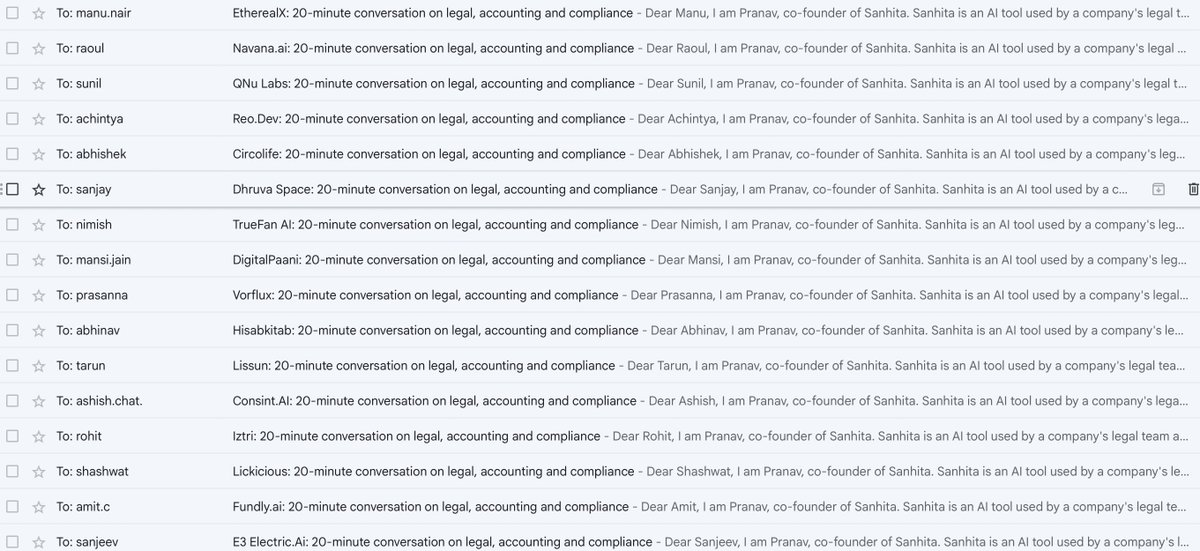
Sent 40 emails this morning, one at a time, to 40 different founders.
We're an early-stage startup, still building the product, so I'm not selling anything finished. I'm asking questions instead. I open by finding out what's actually breaking for them right now in legal, accounting or compliance, not by describing what we're building. The product only comes up if it's genuinely relevant to what they tell me.
A few weeks into doing outbound this way, and the pattern is clear: most cold outreach leads with the product and asks nothing. Flipping that order changes the whole conversation, and honestly it's shaping what we actually build next.
If you're a founder and this is how you'd want to be approached, or you do outbound yourself and have a different approach that works, I'd like to hear it. Reply or DM.
https://t.co/7Vfiko4b9u
Read something recently that named a problem I've been circling for a while. Legal and finance both depend on contracts, but need completely different things from them, and neither side can actually see what the other is doing with the same document. Finance is tracking renewal dates and payment schedules. Legal is tracking indemnities and compliance terms. Different systems, different owners, no visibility into each other, so a renewal slips past finance, or a clause changes and legal never hears about it.
That's the gap we're building Sanhita to close. Not one system replacing both teams, but the bridge between them, so legal and finance can actually see each other's side and the obligations that connect them get automated instead of falling through the middle.
If you're a founder, or work in legal or accounting, and this sounds familiar, I'd like to talk. Reply or DM.
Article: https://t.co/STKV0s0Dk9
Nearly 7,000 Indian startups have been shut down by the Ministry of Corporate Affairs, not because they failed as businesses, but because they stopped filing paperwork. Miss your filings for three years and the company gets struck off, and the director gets banned from holding that role again for five years.
I read a piece on this recently, and one line in it stuck with me: most founders don't actually have a compliance problem. They have a calendar problem. Nobody sits down and decides to ignore the law. It just quietly falls off the list, because nobody owns it full time, and by the time anyone notices, the deadline is already gone.
This is the exact pattern we kept running into while building Sanhita. You ask a lawyer something, he tells you to check with your CA. You ask the CA, he says that's a legal question. Nobody actually owns the middle where filings, deadlines, and money all meet, so it falls through, quietly, until it becomes a strike-off notice or a fine or a funding round that stalls.
So that's what we're building. Not another legal tool, not another compliance checklist. One place that tracks what's due, what it costs, and what happens if you miss it, so a founder never finds out the hard way. That's Sanhita.
@MrBrjan Yes. 100% . More than that I have realised that it helps me feel good and happy. After sharing something with someone it just feels like the weight has gone.
Hi Twitter,
A few days ago I stood in front of a room and actually spoke. Walked them through something I built, out loud, no hiding in the back.
I used to freeze the second eyes were on me. Wouldn't speak up in class, wouldn't raise my hand, definitely wouldn't stand at the front of a room like this.
Looking back, the biggest thing this whole journey has taught me isn't even the building part. It's this. Learning to say what's in my head instead of sitting on it. Learning that my voice is allowed to take up space in a room.
Still scared half the time if I'm honest. Hands still shake a little before I start.
Doing it anyway now. That's the whole difference.
@pareen The problem is real but this also means The company's who are getting banned after 3 years are already dead company's. In india it very difficult for closing a company officially So most founders leave it as it is.Huge paper works and audits . We are going to solve that also .