Financial infrastructure on Robinhood Chain. Markets, trading, yield, portfolio, risk & AI in one platform. CA: 0x5C11E1C9388e5096d5d565F20D27E37C181526d5
Praxis does not quote you a rate.
It reads the vault's share price today, reads it again at a block a week ago, and tells you what actually happened in between.
21 vaults. $529,017,897 indexed.
Every number on that page is a measurement.
@IamClifford__ There has only ever been one official $PRAXIS contract:
0x5C11E1C9388e5096d5d565F20D27E37C181526d5
We have not launched, migrated or been connected to any other token. Anything using the Praxis name with a different contract address is unaffiliated with us.
gm from the Praxis team.
planning ahead this morning and lining up the week.
Orders is already moving, there’s more to do across Earn, Portfolio, Receipts + AI, and a few things we haven’t talked about publicly yet.
good day to be building.
big week ahead.
The best rate on Praxis right now is 4.56%.
It's also one of the smallest vaults on the platform - $25,416 and the card says so, right next to the number.
You can now earn across 21 vaults.
Steakhouse USDG at 3.72% on $454M
Steakhouse Turbo at 3.74%.
Spark Savings at 3.50%.
Ethena x Steakhouse at 2.63%.
$523,440,264 indexed in total.
https://t.co/bQczrFSDMJ
25 markets now live on Praxis.
Apple, Nvidia, Tesla, Google - plus AMC, Circle, Costco, Eli Lilly, Dell.
And two ETFs: QQQ and SGOV.
Every one priced from a real on-chain pool.
https://t.co/gAx4fPZBGh
Sunday.
Markets and Earn both getting worked on today.
yesterday we walked the AMM factory from genesis.
181 tokenised equities + ETFs exist on Robinhood Chain.
most are not usable.
the pool exists, but there is no liquidity behind it.
no liquidity means no real price and nothing useful to trade against.
around 50 actually have depth.
we started widening Markets yesterday.
today we keep testing that expanded set and move into Earn.
right now every Earn route in Praxis is denominated in USDG.
so you can hold 25 different assets, but Earn only works with one of them.
that is the next gap we are working through today.
follow-up from earlier with progress.
the 25-market rebuild is holding up well.
all 25 are now:
→ priced from real pools
→ selectable in Trade
→ running through the new card layout
→ carrying 24h move + liquidity context
→ building their own history as the data comes in
and the extra testing has already found a few things.
background refreshes were resetting filters and search.
choose Equities, wait for the next refresh, and you were back on All.
fixed.
number formatting was carrying precision we did not need:
$2,451.916 → $2,451.92
-2.536068% → -2.54%
moves smaller than two decimals now show <0.01% rather than being rounded into 0.00%.
we also found one test still waiting for a wallet signature that the current flow no longer asks for.
fixed that too.
the Markets side is coming together well.
next is the other half of the expansion: Earn.
we now have 10 more assets in the market layer, so we’re working through which of them can support real, verifiable Earn routes rather than just adding more names to the page.
more testing on both before release.
25 markets changed the page.
the old table was built for 15.
once we pushed past that, it started getting in the way:
→ too much scrolling
→ seven columns competing for attention
→ long decimals like -2.536068%
→ no useful way to sort what mattered
so today we’ve been rebuilding Markets around the larger set.
cards instead of rows.
around 12 visible at once on desktop, reflowing with the screen.
each one keeps the same structure:
→ asset
→ price
→ 24h move
→ liquidity
→ 24h history
and we’re adding sorting by:
→ liquidity
→ 24h move
→ price
→ name
the important part is that the numbers still line up.
same position inside every card. tabular figures. you can scan across 25 markets without having to re-learn where each number is.
- sparklines
each card also gets a 24h price line.
but only when there is enough history to justify drawing one.
a newly listed asset might only have two points.
connect those and you get a clean-looking line that implies far more than the data actually says.
so under four points, Praxis does not draw it.
it shows:
history building
and waits for the data to exist.
still working through it, but the new Markets layout is coming together well.
25 markets changed the page.
the old table was built for 15.
once we pushed past that, it started getting in the way:
→ too much scrolling
→ seven columns competing for attention
→ long decimals like -2.536068%
→ no useful way to sort what mattered
so today we’ve been rebuilding Markets around the larger set.
cards instead of rows.
around 12 visible at once on desktop, reflowing with the screen.
each one keeps the same structure:
→ asset
→ price
→ 24h move
→ liquidity
→ 24h history
and we’re adding sorting by:
→ liquidity
→ 24h move
→ price
→ name
the important part is that the numbers still line up.
same position inside every card. tabular figures. you can scan across 25 markets without having to re-learn where each number is.
- sparklines
each card also gets a 24h price line.
but only when there is enough history to justify drawing one.
a newly listed asset might only have two points.
connect those and you get a clean-looking line that implies far more than the data actually says.
so under four points, Praxis does not draw it.
it shows:
history building
and waits for the data to exist.
still working through it, but the new Markets layout is coming together well.
we didn’t pick the ten. the chain did.
one rule: how much USDG is actually sitting in the pool.
not brand recognition. not what we’d like to be able to offer. depth.
because a pool existing and a market existing are not the same thing.
depth is what decides whether the price on screen can actually support a trade.
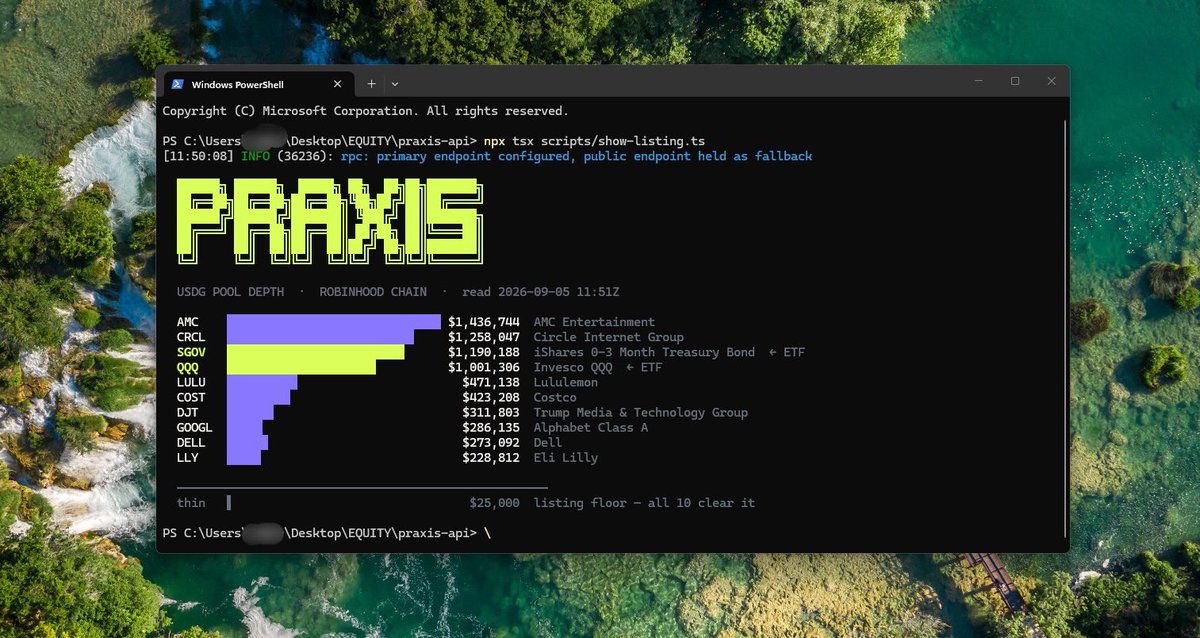
the 10 deepest markets we weren’t already listing:
AMC $1,436,744 AMC Entertainment
CRCL $1,258,047 Circle Internet Group
SGOV $1,190,188 iShares 0-3 Month Treasury Bond ETF
QQQ $1,001,306 Invesco QQQ
LULU $ 471,138 Lululemon
COST $ 423,208 Costco
DJT $ 311,803 Trump Media & Technology Group
GOOGL $ 286,135 Alphabet Class A
DELL $ 273,092 Dell
LLY $ 228,812 Eli Lilly
our thin-pool line is $25,000.
all ten clear it comfortably.
and that matters because these are not listings pulled from a token list and given a price because a contract exists.
they have actual capital sitting behind them.
two are ETFs:
→ QQQ
→ SGOV
SGOV is especially useful because it gives the Markets layer something different from another equity - short-duration Treasury exposure sitting in the same market surface as the stocks.
we started with 15.
today we add the 10 deepest markets we found behind them.
25 markets total after this release.
and there are still more liquid pools left to work through.
there are 181 tokenised equities and ETFs sitting on robinhood chain right now.
we list 15.
so today we will dive into and look at all of them. properly walked the AMM factory's own pool-creation events from genesis, every block, and asked each contract what it was.
612 pools. 561 distinct tokens.
here's the part that decides everything: most of those pools were created and never funded. SOXX, XLK, VTI,
SCHD, BND, SHY, SMH, ADBE, CRM, SNOW, PANW - a pool exists for every one of them, empty.
a pool with no liquidity has no price, and an asset with no price isn't a market. it's a row that apologises.
~50 survive that test.
we're taking the 10 deepest today.
stay tuned.
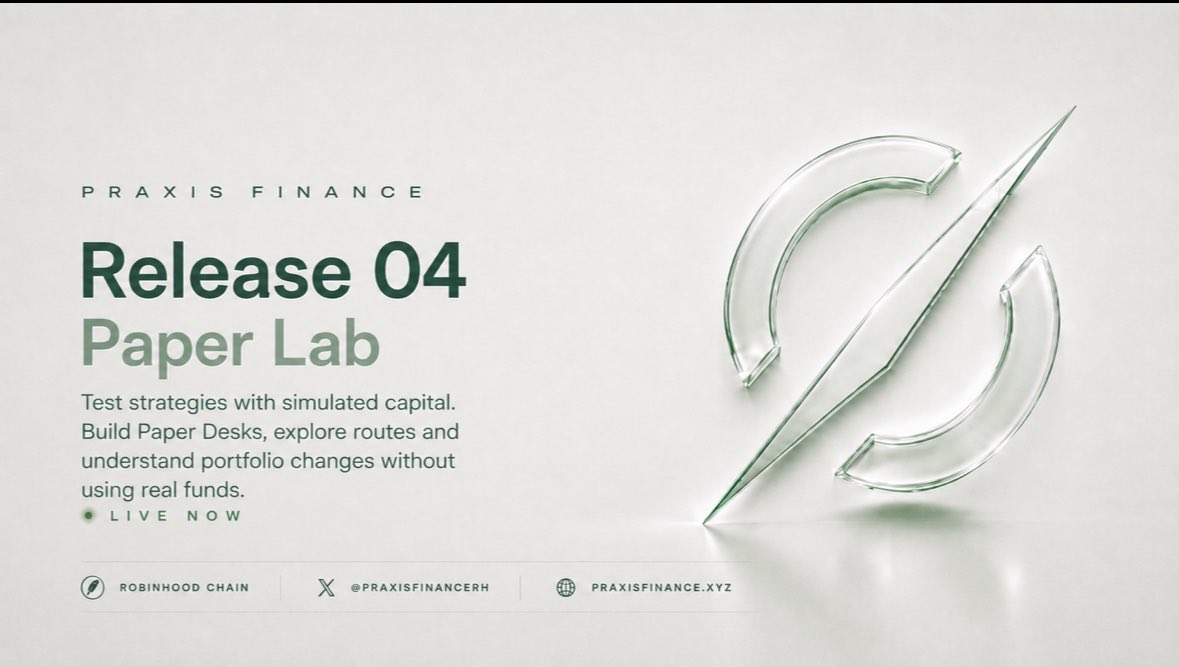
release 04 is live: Paper Lab.
10,000 simulated USDG.
same live market context as the main app:
→ 15 markets
→ live pool prices
→ real Earn vaults + rates
→ Trade
→ Earn
→ PnL
→ receipts
→ reset
no real funds involved.
- separation
Paper Lab is completely separate from live account state.
nothing under /v1/lab returns:
→ to
→ calldata
→ router address
→ signable transaction objects
we also replaced sendTransaction in the browser with a function that throws, then ran the full flow:
open → swap → deposit → reset
wallet send calls: 0.
Paper Lab also has:
→ its own nav item
→ MODE SIMULATED in the header
→ separate balances
→ separate positions
→ separate receipts
- performance
the Lab starts from exactly 10,000 USDG.
that gives it a fixed starting point for:
→ total PnL
→ best / worst position
→ performance curve
→ result vs doing nothing
historical points use the value at the time of each action, not today’s prices applied backwards.
- rebuild
the old Paper engine was tied to Desks.
the new version is scoped to the user instead.
while rebuilding it we removed 193 old simulated balance rows still keyed to live-only Desks.
- other fixes today
→ Praxis AI can now read Market Depth volume
→ small dollar values no longer round to whole dollars
- current state of live markets
15 markets
$593,212,109 volume across 23.9h
verified Earn vaults
18 Praxis AI tools
3 write tools
0 execution permission
- tomorrow
more markets.
the current 15 stay. we go wider and start wiring in the integrations that feed them.
Paper Lab is live.
https://t.co/bQczrFSDMJ
PRAXIS AI
one question. one signature. onchain.
“which asset has the most volume in the last 24 hours, how does that compare to the liquidity behind it, then prepare a swap of 1 USDG into it.”
Praxis AI does not answer that from memory.
it calls the market tools and reads the current chain state.
WETH
→ $546,674,950 traded
→ $12,529,877 liquidity
→ ~44x turnover
it also added the useful part:
the pool is not thin for a $1 trade, but larger orders would start to feel real slippage against that depth.
then it prepared the swap.
→ 0.01% fee pool selected after checking 4 tiers
→ expected out: 0.00040746 WETH
→ minimum out: 0.00040542 WETH
→ slippage: 0.50%
→ price impact: 0.01%
→ approval: not needed
→ quote expiry included
the existing allowance meant one signature instead of two.
then it stopped.
“Unsigned - Praxis can’t execute it.”
the server builds the transaction.
your wallet signs it.
the confirmed hash comes back into the same conversation.
CONSULTED: market_get_asset, trade_prepare
plain English → live chain data → route check → unsigned transaction → your signature → onchain confirmation.
not automatic.
just less friction.
today’s Paper Lab work is a rebuild, not a restore.
the old Paper engine worked.
the problem was where it lived.
simulated balances were scoped to Desks - the same object used for real receipts, cost basis and exposure.
that meant every Desk query had to remember whether it was reading real or simulated state.
one missed filter = fake money on a real page.
so we changed the boundary.
Paper Lab is now scoped to the user, completely separate from live Desks.
- cleanup
we found 193 old simulated balance rows still keyed to desk_id.
nothing was using them, but they were still sitting beside live Desk state.
removed.
- execution
live Praxis actions build an unsigned transaction for your wallet.
Paper Lab does not.
nothing under /v1/lab returns:
→ to
→ calldata
→ router address
→ signable transaction objects
we also replaced sendTransaction in the browser with a function that throws, then ran the full Lab flow:
→ open
→ swap
→ deposit
→ reset
wallet send calls: 0.
- receipts
Lab receipts now have their own table.
not a flag on the live receipt ledger.
no shared balances.
no shared receipts.
no transaction path into live execution.
same market data.
separate state.
Paper Lab, coming together.
not a separate fake dashboard.
the same Praxis workflow, but with simulated capital:
→ Trade
→ Earn
→ PnL
→ receipts
→ reset
all running against the same live market context as the main app.
what is on screen:
- against doing nothing
the sandbox starts from a known point: 10,000 USDG.
because the starting balance is fixed, it can show whether the decisions made inside Paper Lab actually beat simply doing nothing.
- the curve
performance history is recorded from what the sandbox was worth at each action.
not re-priced later using today’s prices.
otherwise the past gets rewritten every time the market moves.
- best / worst
which position is contributing most.
which is contributing least.
- real funds: none
shown directly alongside the other metrics.
because no real capital touches this surface.
what Paper Lab shares with the live app:
→ live market prices
→ real Earn vault rates
what it does not share:
→ wallet balances
→ live positions
→ receipts
→ Desks
→ Portfolio state
nothing crosses between the two in either direction.
and the header makes it explicit:
MODE SIMULATED.
not MODE LIVE.
For users who who want to test first, before going live.
three days in. where it actually stands.
- Tuesday: Praxis Core
Markets, Trade, Earn, Desks, Portfolio, Receipts and
Praxis AI, live on Robinhood Chain. every price read from a pool, every action signed by your own wallet.
- Wednesday: Market Depth
24h move on all 15 assets, read from archive state at the block ~855,000 back rather than accumulated from stored samples. price history the same way - 144 points across the day, populated on the first deploy instead of a day later.
and volume, walked from pool Swap events a thousand blocks at a time. it started with nothing on Wednesday morning and has been reading backwards ever since:
- $511,253,987 across 14 markets
- 23.6 hours covered, and still filling
the card says 23.6H, not 24H, because that is what it has measured. it will say the day when it has walked the day.
- Thursday: Desks+
a Desk could say what it did. now it says whether that worked.
cost basis derived from its own receipts, weighted average. performance, exposure by asset and protocol, a
stated purpose the assistant judges the holdings against. and filing activity from before a Desk existed can be moved into it, so a Desk you open today can account for trades you made on Tuesday.
nothing stored as a balance. every figure derived from receipts at read time, so a Desk cannot drift out of step with what actually happened to the money.
right now:
15 markets, all priced from pools, all reporting a real 24h move. MSTR +14.8% today, WYFI +7.2%, WETH +4.7%.
10 Earn vaults, every one with a verified price and real TVL, best paying 3.73%. two dropped off the list overnight when they fell below the size floor that is the rule working, not an outage.
18 AI tools. three can write. none can execute.
today:
Paper Lab.
we remove the capital entirely and leave everything else: live prices, real vault rates, the whole flow. its own surface, no path from it to a live position.
build it, test it, reset it.
Desks+ is live.
three days:
day 1
Markets, Trade, Earn, Desks, Portfolio, Receipts and Praxis AI live on Robinhood Chain
day 2
Market Depth a 24h move from archive state, price history and onchain volume
day 3
Desks+ - cost basis, performance, exposure, stated purpose, Desk-scoped AI and filing older activity into a Desk
none of this was sitting finished waiting for a launch date.
each release was built, tested and shipped on the day.
and plenty of the work never made it into a post.
→ Connect button invisible on mobile
→ token dropdown rendering white on white
→ Earn deposits confirming onchain without creating a receipt
→ one wallet rejecting a swap because 0 was sent instead of 0x0
all found by actually using the product.
all fixed.
underneath it:
the last two releases added history in different places.
day 2 gave Markets a before.
day 3 gave Desks a record of what happened to the capital inside them.
without that, you cannot calculate drawdown, track performance properly, measure idle capital or tell whether something changed.
tomorrow:
Paper Lab.
this time we remove real capital from the flow completely.
simulated funds.
live market conditions.
Trade.
Earn.
Receipts.
nothing real at risk for users who like to test first.
Paper Lab existed before launch, but it shared the live product surfaces.
we removed it because simulated and real balances should never be easy to confuse.
tomorrow it comes back as its own clearly separated surface, with no route from a paper position into a live one.
build it. test it. reset it.
release 03 is live: Desks+.
a Desk already knew what activity belonged to it.
now it tracks how that capital is doing.
what shipped:
→ per-Desk cost basis
→ current value
→ realised PnL
→ unrealised PnL
→ asset exposure
→ protocol exposure
→ stated purpose
→ Desk-scoped Praxis AI
set a Desk before a Trade and the receipt files there automatically.
older activity can also be moved into a Desk.
the transaction, amounts and hash stay exactly the same.
only the Desk assignment changes.
- accounting
all figures are derived from the Desk’s receipts.
no separate stored balance.
cost basis uses weighted average accounting.
example:
buy 4 WETH for 8,000.
sell 2 for 5,000.
the remaining 2 WETH still have a 4,000 cost basis.
the 1,000 difference is realised PnL.
Earn deposits do not count as disposals. cost basis follows the asset into the vault.
reverted transactions do not affect the Desk.
if one holding cannot be priced, the Desk total is not shown as if that holding does not exist.
the unpriced asset is named instead.
- Praxis AI
AI can now be scoped to one Desk.
give the Desk a purpose and it can compare the current holdings against it.
leave purpose blank and there is nothing to compare against.
Desks+ is live.
https://t.co/bQczrFS5Xb
a Desk already knows what activity belongs to it.
Desks+ answers the next question:
is that capital actually working?
what we’re building today:
→ performance
what the Desk cost, what it is worth now, and realised + unrealised PnL
→ exposure
how the Desk is split across assets and protocols
→ purpose
what you set the Desk aside for, written in your own words
none of this is stored as a separate balance.
every figure is derived from that Desk’s own receipts, so the accounting stays tied to what actually happened onchain.
state a purpose and Praxis AI can judge the current holdings against it.
leave it blank and there is nothing to measure against — so it says that, rather than inventing an objective for you.
the part taking the most work is cost basis.
buy 4 WETH for 8,000.
sell 2 for 5,000.
the remaining 2 WETH still carry a 4,000 cost basis.
they do not suddenly become a 3,000 position because you realised profit on the half you sold.
get that calculation wrong once and every partially-sold position after it is wrong too.
that feeds directly into Desk performance, exposure and eventually Portfolio PnL.
still working through it today.