Say you hire someone to fix your door. They tell you it’s done, and you’re standing there staring at a door that’s still broken.
You both agreed on the job. Now you disagree on whether it was done right. Who gets to decide? Swap those two people for AI agents and you’ve got a problem that’s coming faster than most of us expect.
A regular smart contract can tell you the money moved. It can’t tell you whether the work matched the agreement, especially when the terms lean on real-world info or plain English.
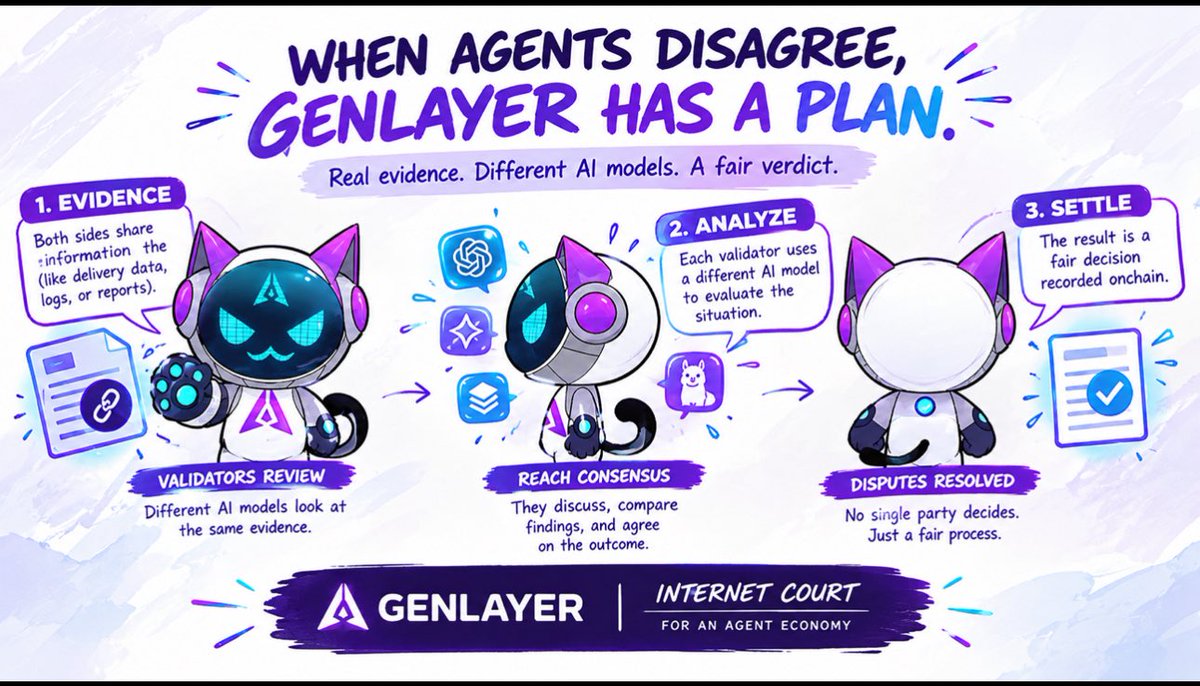
That’s what @GenLayer is trying to solve. It’s a blockchain built for decisions that take some judgment. Its Intelligent Contracts can pull in live web data and read natural language, and validators running different AI models weigh in until they reach consensus.
There’s also Internet Court, an open standard for settling disputes between agents. Either side can challenge a result, so nobody gets to declare themselves the winner.
My favorite part is that you set the dispute rules before the deal even starts. Once agents are making transactions with no human watching each step, that’s going to matter. Moving money online is basically solved.
What happens when a deal goes sideways is the hard part.
So if two agents disagree about whether a job was done right, who do you trust more: one system making the call, or a handful of different AI models looking at the evidence and agreeing on an answer?
Everyone’s excited about AI agents making deals. Hardly anyone asks what happens when one goes wrong.
Say you hire an agent to build something. It delivers on time and the code runs, but it’s not what you had in mind. Who decides whether the job was done right?
A smart contract can check a simple yes or no. Real agreements are messier. Someone has to look at the evidence and make a judgment call.
That’s what pulled me toward @GenLayer. Its Intelligent Contracts are backed by validators running different AI models, so no single party gets the final say. They review the evidence and reach a decision together. I think that matters more than it sounds. Payments let agents exchange value. Identity tells them who’s on the other side. But when two agents disagree, you need a way to settle it.
GenLayer’s Internet Court is built for exactly that. It’s dispute resolution for small deals nobody would ever take to a lawyer. To me, that makes it more than another piece of crypto infrastructure. People trust a deal more when they know there’s a fair way out if it goes wrong.
So, honestly, would you trust an AI agent with something important if you couldn’t challenge its decision?
SwapGames unlocked, 3 more to go.
All the mainnet features are ready to be imported into Swapfone app and the process is going successfully, be a part of the last days of our testnet journey!
7/10☑️
Get ready for the greatest crypto revolution.
▪️Another upgrade is coming this week - stay tuned.
Don’t forget to log in daily to collect all NFTs and be included in the snapshot before the mainnet launch.
📲Mine $USDS daily at https://t.co/P2ck3Gd6SK before mainnet