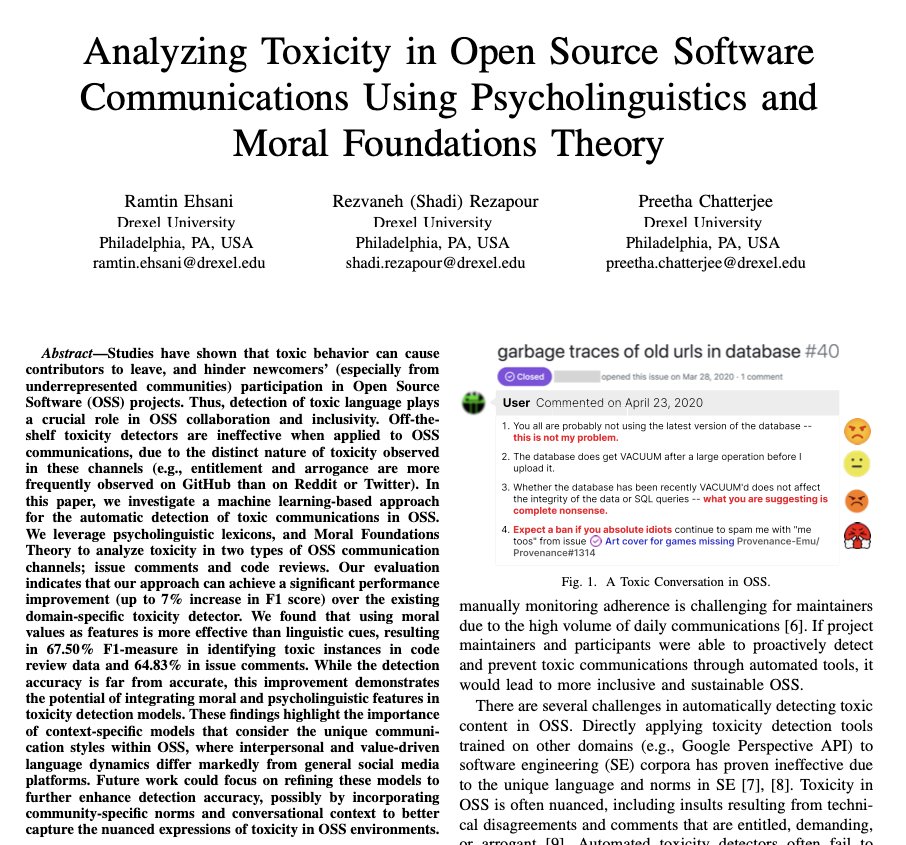
📝 New article: "Psycholinguistic Analyses in Software Engineering Text: A Systematic Mapping Study" by Amirali Sajadi, Kostadin Damevski, Preetha Chatterjee
👉 Get your copy at https://t.co/mvlJlRKFh8
We are disappointed to miss he 40th IEEE/ACM International Conference on Automated Software Engineering (ASE 2025) in person this year in Seoul, but our presentation is now available online.
If you are interested in the work, here’s the recording:
https://t.co/1dfEnj9h8z
LLMs can repair code, but often miss the broader context developers use every day.
We propose a 3-layer knowledge injection framework that incrementally feeds LLMs with bug, repository, and project knowledge.
Preprint of our ASE '25 paper: https://t.co/27puIGuT0A
@ASEconf2019
LLMs can repair code, but often miss the broader context developers use every day.
We propose a 3-layer knowledge injection framework that incrementally feeds LLMs with bug, repository, and project knowledge.
Preprint of our ASE '25 paper: https://t.co/27puIGuT0A
@ASEconf2019
Error analysis reveals that unresolved bugs are not randomly distributed; they cluster around specific bug types and higher complexity profiles. In particular, Program Anomaly, Network, and GUI bugs remain the most challenging for both models.
Evaluated on 314 real-world Python bugs, we observed consistent gains in both #fixed and Pass@k scores for Llama 3.3 and GPT-4o-mini, demonstrating a 23% improvement over prior work.
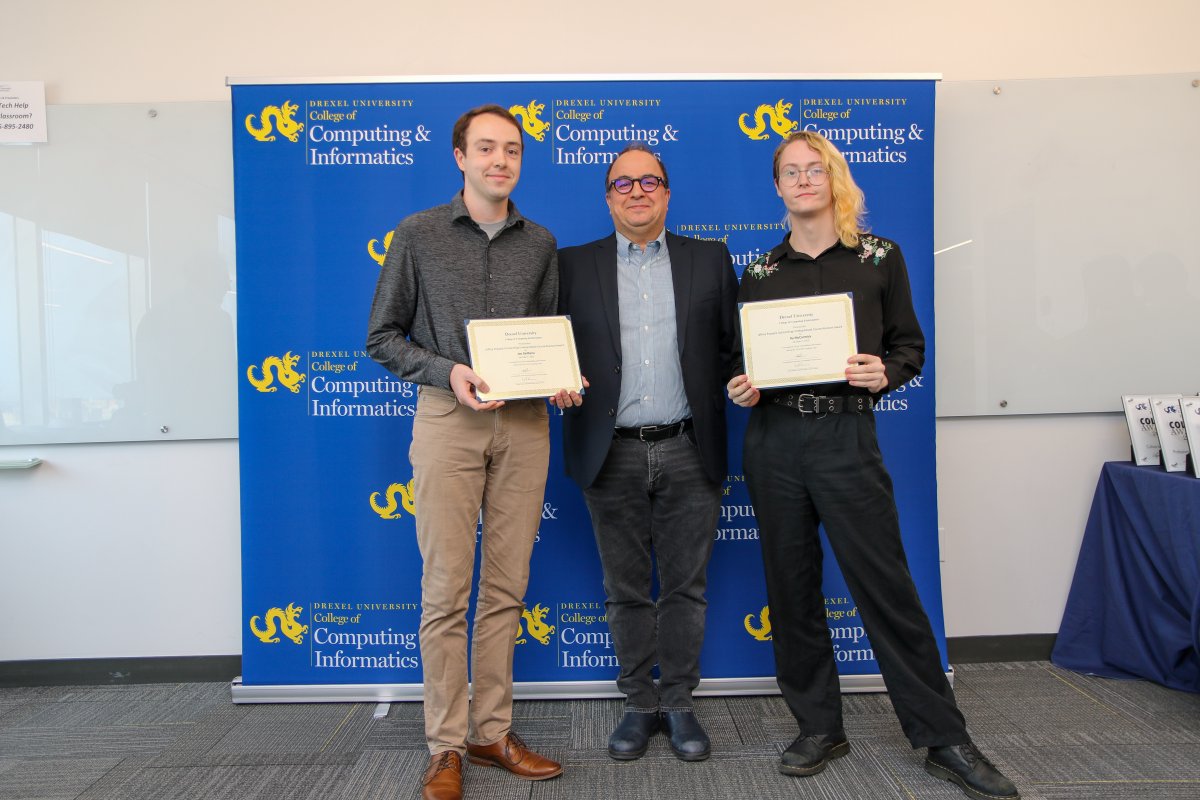
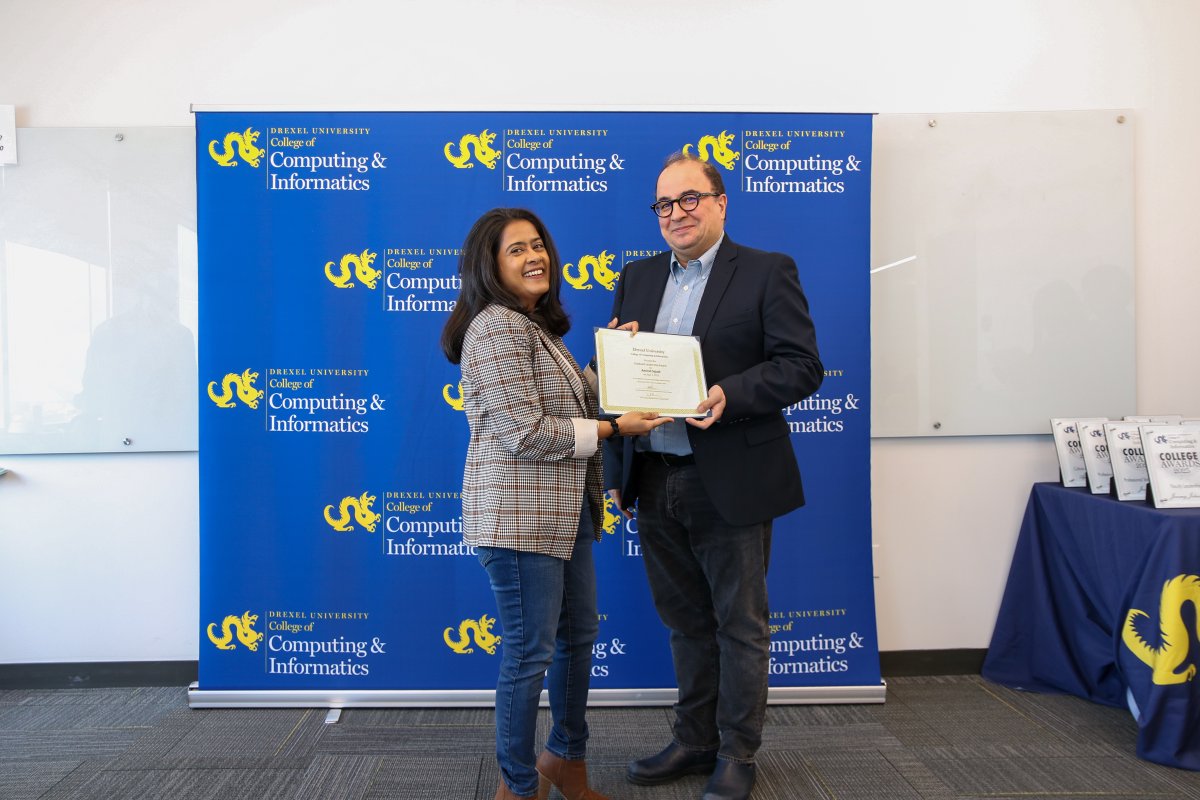
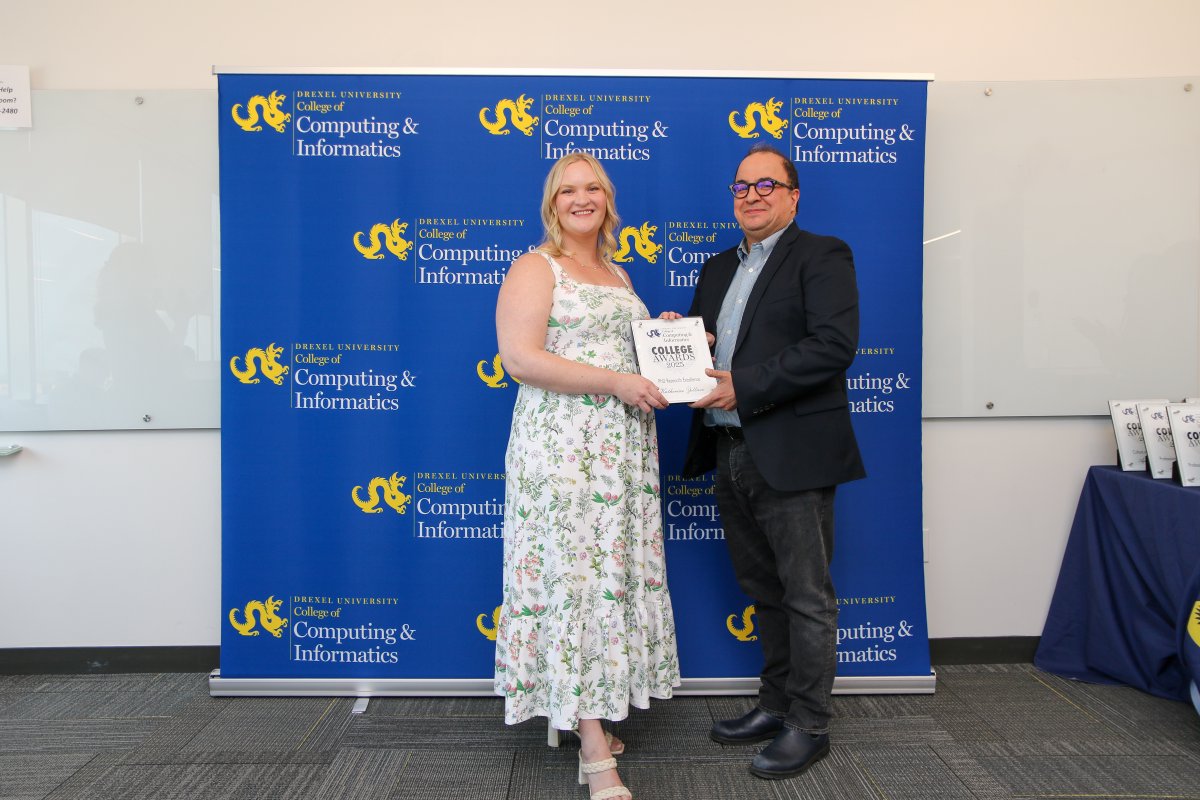
Congrats to all the exceptional students, faculty and professional staff who were recognized for their hard work at our annual College Awards Cermony. 👏
View the full album: https://t.co/sNaKNq15tV
LLMs are great at generating code, but are they silently spreading vulnerabilities? TLDR: Yes.
In our latest EMSE paper, we look into: when developers unknowingly share vulnerable code with LLMs, do these models proactively raise security red flags? 🧵
https://t.co/6mn3VkixgL
Benchmarks are our measures of progress. Or are they?
Looking forward to exploring promises & perils of measuring tool capabilities @SBFTworkshop'25! Thanks for the invite!
👩🏭 https://t.co/t3SU3RUFgG (co-located w/ ICSE'25 in Ottawa)
📅 28.04. 11:00 GMT-4 (Also, live on Twitch)
LLMs are great at generating code, but are they silently spreading vulnerabilities? TLDR: Yes.
In our latest EMSE paper, we look into: when developers unknowingly share vulnerable code with LLMs, do these models proactively raise security red flags? 🧵
https://t.co/6mn3VkixgL
As a preliminary solution to this problem, we built a CLI tool prototype that integrates static analysis with LLM prompting, aiming to make AI code suggestions more secure by design.