Also a part of Northeast India 🇮🇳
Tsomgo Lake, located in the state of Sikkim, is a stunning glacial lake in Northeast India.
@scenedook Uff bro, uff! Your photography skills are truly दिल को छू लेने वाले...
Loop engineering cycle for AI Product Managers.
For the last two years PMs have been trying to write the perfect prompts. The better move is to stop prompting one-off and start building loops. A loop is a system that improves every time it runs.
At the center is a reusable artifact. A PRD-review skill, an eval rubric, a launch checklist. The thing you reuse across dozens of runs, not a prompt you throw away after one.
Here is the cycle.
1. Change the artifact
Add a review criterion. Remove a stale instruction. One small edit that shapes how the agent behaves.
2. Run the agent
Point it at real work. Review a PRD. Summarize ten calls. Whatever the artifact is built to do.
3. Evaluate the output
This is the quality gate. Not "did it sound smart." Is it better than the last version? Did it catch the real gaps? Did the evidence hold up?
4. Keep or revert
If quality went up, keep the change. If it dropped, revert. The gate decides, not your gut.
5. Commit the learning
The change goes into version history. The commit, the diff, the decision log. The repo becomes product memory.
6. Better version next
The next run does not start from zero. It starts ahead of the last one. That is the whole point.
Prompting helps you do the task once. Loop engineering improves the thing that does the task every time.
The agent runs the loop. You own whether it keeps getting better.
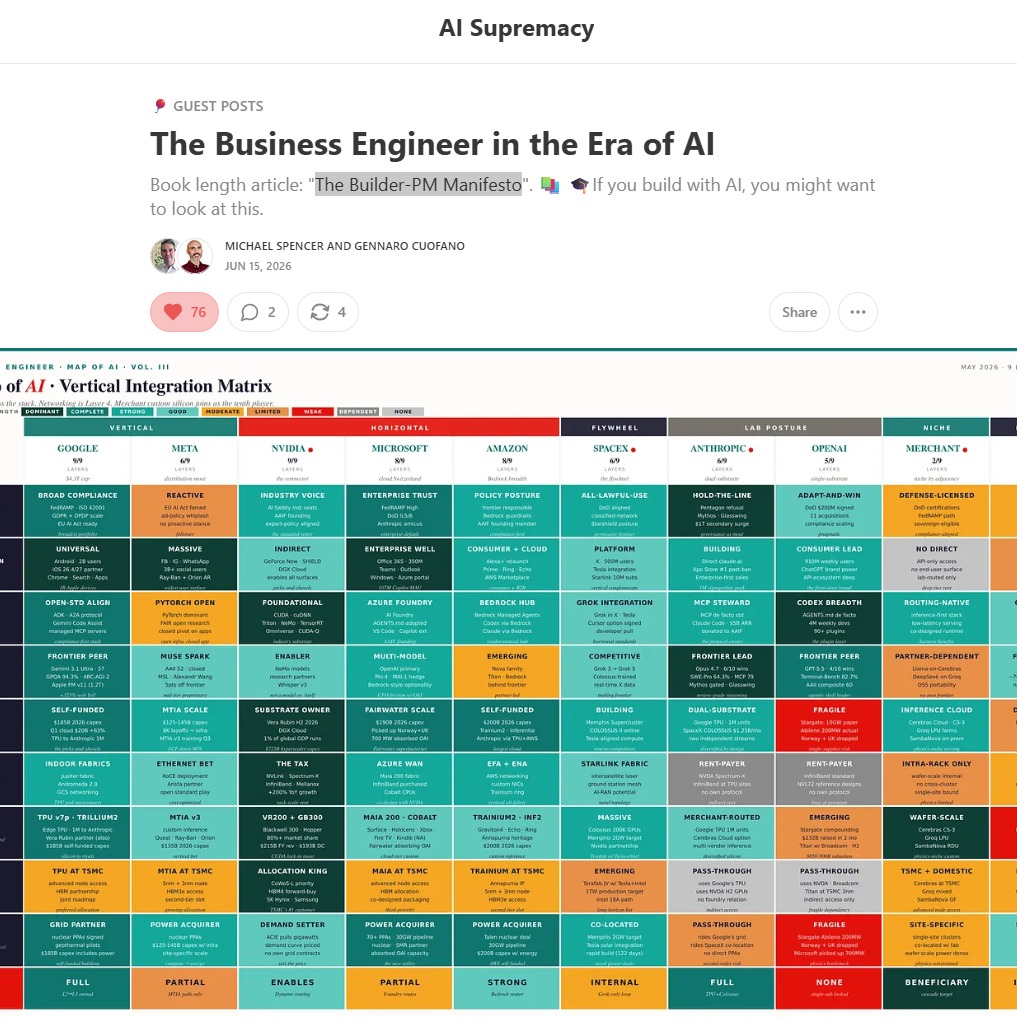
Read the full article to learn more.
Build a Large Language Model from scratch!
This repository contains the code examples for developing, pretraining, and finetuning a LLM from scratch.
It is the official codebase for the book Build a Large Language Model (From Scratch).
Notebook examples are included for each chapter:
Chapter 1: Understanding Large Language Models
Chapter 2: Working with Text Data
Chapter 3: Coding Attention Mechanisms
Chapter 4: Implementing a GPT Model from Scratch
Chapter 5: Pretraining on Unlabeled Data
Chapter 6: Finetuning for Text Classification
Chapter 7: Finetuning to Follow Instructions
Link to the repo in the comments!
Math + Statistics -> ML Engineer
Linear Algebra + Probability -> Research Scientist
AI + ML + DL -> AI Engineer
NLP + Transformers -> LLM Engineer
Computer Vision + CNNs -> CV Engineer
DSA + Systems Design -> ML Infrastructure Engineer
DBMS + Vector Databases -> RAG Engineer
Cloud + Distributed Systems -> MLOps Engineer
Prompt Engineering + APIs -> AI Product Engineer
Ethics + Policy -> AI Safety Researcher
Reinforcement Learning + Game Theory -> RL Engineer
Data Engineering + ETL Pipelines -> ML Data Engineer
Robotics + Control Systems -> Robotics AI Engineer
Speech Processing + Audio Signals -> Speech AI Engineer
Edge Computing + Model Compression -> Edge AI Engineer
same foundation. fifteen different directions... depending on what you specialize in.
and people still ask why we're forced to study "useless" subjects.
Bookmark & Repost!
- Math behind Attention- Q, K, and V
- Math behind √dₖ Scaling Factor in Attention
- Math Behind Backpropagation
- Math Behind Gradient Descent
- Math Behind Cross-Entropy Loss
- Math Behind RoPE (Rotary Position Embedding)
- RMSNorm (Root Mean Square Layer Normalization)
Hashing ≠ Encryption ≠ Decryption ≠ Encoding
I still see these terms used interchangeably, but they solve very different problems.
✅ Hashing → One-way fingerprint (password storage, integrity checks)
✅ Encryption → Locks data with a key to keep it secret
✅ Decryption → Unlocks encrypted data using the correct key
✅ Encoding → Changes data format for compatibility, not security
⚠️ Base64 is encoding, not encryption.
If you are building APIs, authentication systems, or secure applications, knowing the difference is essential.
Saved this as a quick handwritten cheat sheet for developers. 👇
The ultimate Full-stack AI Engineering roadmap to go from 0 to 100.
Bookmark this.
This is the exact mapped-out path on what it actually takes to go from Beginner → full-stack AI engineer.
> Start with coding fundamentals.
> Learn Python, Bash, Git, and testing.
> Every strong AI engineer starts with fundamentals.
> Learn how to interact with models by understanding LLM APIs.
> This will teach you structured outputs, caching, system prompts, etc.
> APIs are great, but raw LLMs still need the latest info to be effective.
> Learn how LLMs are usually augmented with more info/patterns.
> This will teach you the basics of fine-tuning, RAG, prompt/context engineering, etc.
> Strong LLMs are useless without context. That’s where Retrieval techniques help.
> Learn about vector DBs, hybrid retrieval, indexing strategies, etc.
> Once retrieval is solid, move into RAG.
> Learn to build retrieval + generation pipelines, reranking, and multi-step retrieval using popular orchestration frameworks.
> Now, step into AI Agents, where AI moves from answering to acting.
> Learn memory, multi-agent systems, human-in-the-loop design, Agentic patterns, etc.
> Learn how to ship in production with Infrastructure.
> This will teach you CI/CD, containers, model routing, Kubernetes, and deployment at scale.
> Focus on observability & evaluation.
> Learn how to create eval datasets, LLM-as-a-judge, tracing, instrumentation, and continuous evaluation pipelines.
> Security is crucial.
> Learn how to implement guardrails, sandboxing, prompt injection defenses, and ethical guidelines.
> Finally, explore advanced workflows.
> This covers voice & vision agents, CLI agents, robotics, agent swarms, and self-refining AI systems.
This is the actual journey to becoming a full-stack AI Engineer and not just "use” AI, but designing full-stack AI systems that can survive in production.
If you need specific resources, I wrote a detailed article that provides a structured learning roadmap for AI engineers in 2026.
It covers prompting, RAG, fine-tuning, agents, MCP, evals, and inference, with guidance on what to prioritize and in what order.
Read it below.
Train your own LLM from scratch.
This repo builds a GPT-style transformer from the ground up, without using any high-level libraries.
You see exactly how attention, multi-head attention, the feed-forward block, embeddings, residuals, and layer norm fit together.
And it doesn't stop at the model. It walks the whole path from raw data to generated text.
↳ Data download, preprocessing, training, and generation
↳ Training data from The Pile (825GB across 22 sources)
↳ Tokenized with tiktoken (r50k_base) and stored in HDF5
↳ Training loop with eval, LR decay, and crash-safe checkpoints
↳ An SFT and RLHF guide for what comes after pretraining
The same code scales by changing a few config values. Around 13M parameters is where the output starts producing correct grammar and spelling, and you can train that in about a day on a free Colab or Kaggle T4.
If you've ever wanted to actually see how a transformer works instead of importing one, this is a clean place to start.
Link to the repo in the comments.
Interested in ML/AI Engineering? Check my FREE AI engineering Guidebook with 380+ pages (downloaded over 80k times, link below)
Everything I Used to Prepare for Coding, System Design, and Machine Coding Interviews
Someone on reddit posted all the coding strategies and resources he used to get interview at Google
1. Coding Patterns & Strategy
Before jumping into problems, understand the patterns:
All LeetCode Articles on Coding Patterns Summarized (https://t.co/NXa4N9wQf3)
Solved All Two Pointers Problems in 100 Days (https://t.co/qgcrNoBIHG)
Tree Question Pattern 2023 — Tree Study Guide (https://t.co/w0oMd97Kv5)
Important and Useful Links from All Over LeetCode (https://t.co/3DUhT6AjkW)
Coding Interview Preparation Problems for Beginners (https://t.co/zSacSvb2Kn)
2. Company-Specific Prep
Google, Meta, Apple, Amazon Senior SDE Preparation (https://t.co/bpa1OLESZs)
A Study Guide for Passing the Google Interview (https://t.co/gdWNR4e3zh)
I was solving problems randomly but had no way to track progress by company. So I built a small tool where you can filter problems by company, mark status (todo/solved/revision), and it auto-schedules what to review next. Also added an AI coach that gives hints (not full solutions) — helps me stay honest when I'm stuck. Have added company-wise questions (https://t.co/KpV9SzxHpo)
3. System Design (HLD)
The general LeetCode docs are great for breadth, but what actually moved the needle for me was working through structured, progressive sheets instead of random docs. The Design Round has curated HLD sheets that go from crash-prep to full coverage — start narrow, expand when ready:
Arch 25 — crash sheet of the highest-frequency systems and reusable patterns to cover first
Arch 50 — Arch 25 plus deeper infra, data, reliability, and advanced product systems for SDE2/Senior prep
Arch 75 — Arch 50 plus high-signal variants, niche domains, and company-style specialization
Arch All — the complete 103-question HLD bank for full coverage and long-term mastery
Core Concepts — 33 distributed-systems deep dives to build the underlying intuition
4. Machine Coding (LLD)
The machine coding / LLD round caught me off guard the first time — it's a different muscle from DSA, and most prep ignores it. The Design Round has LLD sheets and design-pattern references that map directly to what gets asked:
MaCo 30 — the core 30 machine-coding problems, highest ROI for interviews
MaCo 60 — MaCo 30 plus extended coverage across all categories
MaCo All — the complete list of all 103 machine-coding problems
Design Patterns — 31 OOP & structural patterns you'll lean on during the round
A Stanford professor just gave a public lecture on exactly how GPT, Claude, and LLaMA are built under the hood
no insider access required
just the clearest breakdown of modern LLM architecture I've seen
this lecture reveals the framework professors are paid up to $750K a year to teach
the gap between "I use ChatGPT" and "I understand how it works" is smaller than most people think
the most complete public breakdown of modern LLM architecture I've seen this year
Someone built a web-based System Design Simulator,
where you drag & drop architecture components and actually simulate traffic, failures, latency, and scaling in real time,
System design just got way more interactive.
🚨BREAKING: Claude can now write your entire job application like a top recruiter.
Here are 10 prompts that turn a job description into a tailored CV, cover letter, and interview prep guide in under 5 minutes.
(Save this)