SEMI LAUNCHPAD
The SEMI launchpad opens Friday, 11 September.
Launch a token paired against a tokenized stock — MU, SK hynix, NVDA, whatever is listed - on the same contracts $SEMI runs on. You choose which mechanics are on and what every number is.
70% of the fees the launchpad collects are converted and locked into
$SEMI liquidity
https://t.co/rM9R7BJjiG
$APT isn't a side quest. It's a $SEMI product.
1% of every APT trade, buy or sell, gets converted and locked into the SEMI floor. Automatic, every 5 minutes, forever. First hour: $4,100 in.
Stake SEMI → up to 2× lottery tickets.
APT volume is SEMI floor income now.
I believe that @Semivaultxyz will act as a much slower OHM fork than @NetNetCap. Both have their own specific niches and I have a significant amount invested in both. I really like the price floor mechanism (even after we retraced by 50%+).
been digging deeper into how $SEMI actually works, and the “watch” analogy they’re using here is honestly pretty fitting.
at the center is the floor.
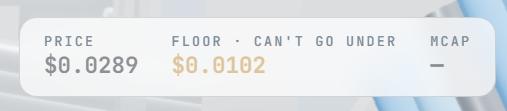
$SEMI isn’t built around a random number on a dashboard. The floor is backed by tokenized Micron, and the system is designed so that backing can move in one direction.
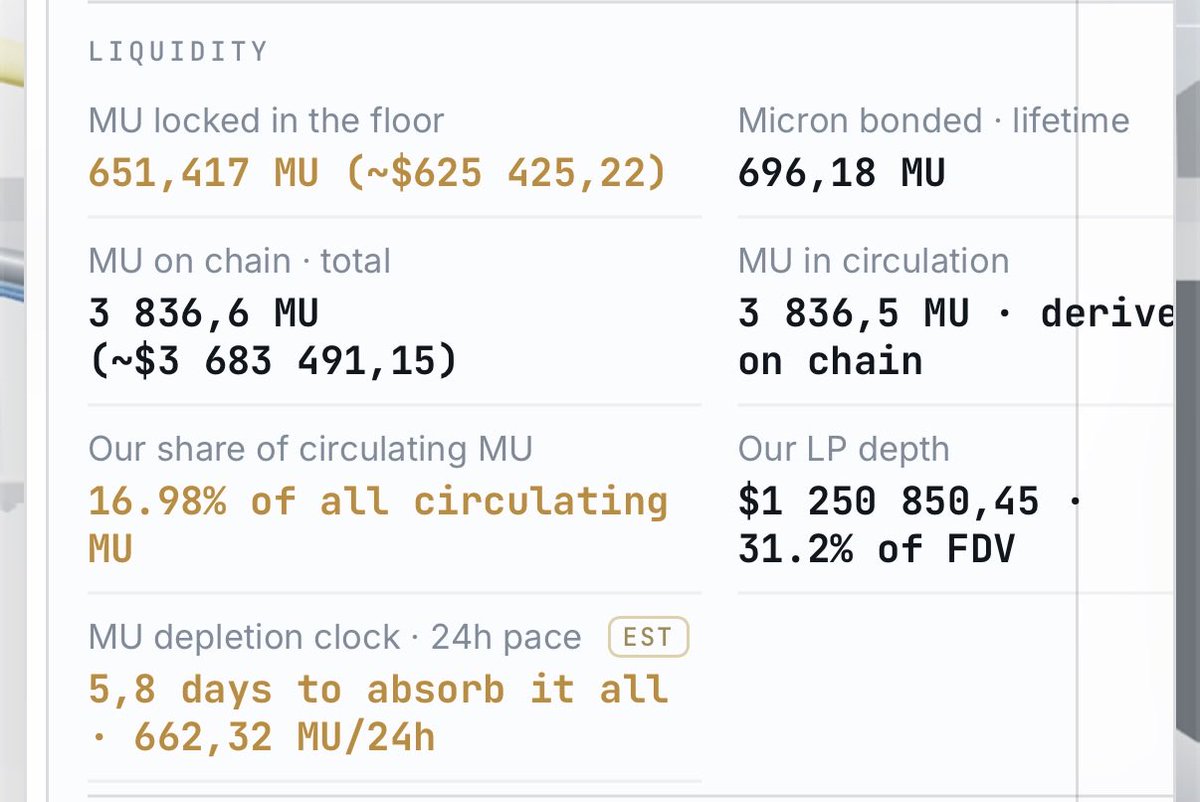
the barrel is where bonding comes in. users bring MU into the system, receive $SEMI at a discount, and that MU gets pushed into the protocol’s locked liquidity.
then you have the ratchet.
this is probably the part I find most interesting.
emissions aren’t just switched on because a new epoch started. The system looks at backing per $SEMI and only allows the ratchet to move when a new high-water mark is actually established.
no new high = no ratchet emission.
new high = the system can mint against that improvement.
and it runs on a 6h cycle, which makes the whole thing less about chasing a temporary price spike and more about proving the backing actually held.
then there’s the staking side, where part of the newly minted supply goes to stakers.
so you end up with this loop:
bond MU → grow the floor → improve backing per $SEMI → ratchet can move → emissions → stake → repeat
that’s a very different proposition from simply launching a token and hoping demand keeps the chart alive.
there’s actual machinery underneath $SEMI.
real-world asset backing, Olympus-style bonding, a one-way floor, and emissions tied to the strength of that backing.
still early, obviously. but the more I look under the hood, the more I understand why the team keeps treating $SEMI like a machine rather than just another token.
you don’t really “own the machine.”
you keep it running for the next cycle.
$SEMI
NetNet has 17× the FDV and 17× the audience of SemiVault.
Yet their deepest pools both hold roughly the same liquidity: ~$1.3M.
One built distribution.
The other built capital efficiency.
I dug into both machines to see what the market is actually pricing.
At first flipping $NET was a bit unrealistic, but now I can clearly envision $SEMI doing it
I mean, it’s just better? With an even better narrative lmao
We are going for all the onchain $MU