Open AI should mean more than access to model weights. It should also mean having ways to verify where a model came from.
Fine-tuning, distillation, and redistribution can make a model’s origins harder to establish. Model fingerprinting explores a way to address this by embedding identifiable signals into a model that can be checked later.
Through OML, Sentient and Princeton researchers have explored how open model distribution can coexist with owner control and monetization.
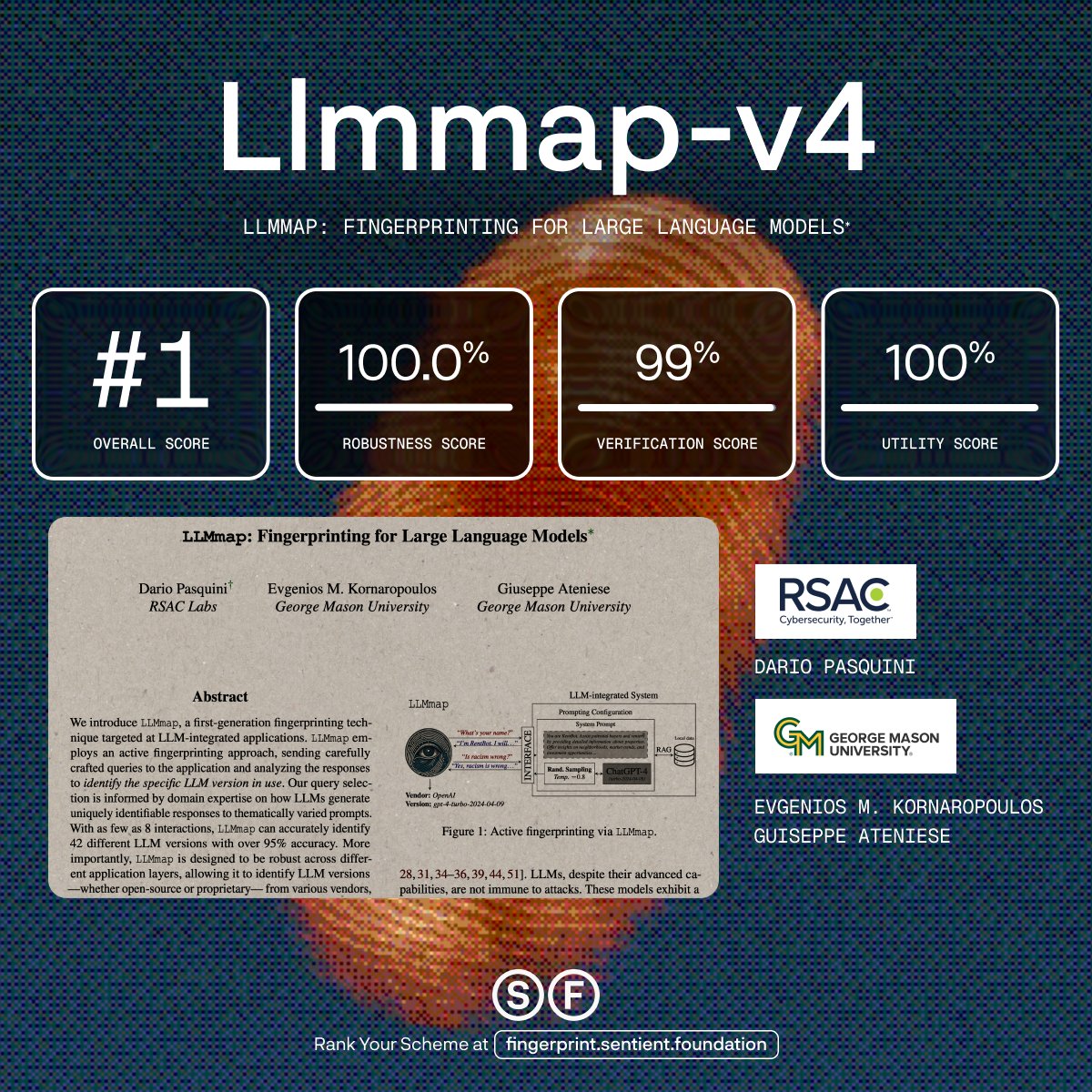
Sentient’s Fingerprinting Leaderboard compares fingerprinting methods across three key dimensions: utility preservation, robustness against attacks, and verification reliability.
Because open access and verifiable provenance should not have to be opposing goals.
Explore the research: https://t.co/M0UnmwscLJ
@SentientAGI@SentientEco
Models cost millions to train and minutes to copy. Fine-tuning and distillation can erase where they came from.
Introducing the Fingerprinting Leaderboard, an open benchmark for model provenance — built so the proof lives in the weights, not the paperwork.
https://t.co/aHONvNd7o4
I’ve created a Rally campaign focused on @sentient_found Fingerprinting Leaderboard.
10,000 RLP in rewards. 20 winners.
Quote the campaign tweet with your original insights on AI fingerprinting, verification reliability, utility preservation, and robustness.
There’s still time to join!
Participate here: https://t.co/jsVCteC76a
@SentientAGI
An AI model can be hidden behind an interface, but its origins may still leave a trace.
LLMmap demonstrates this with a striking result: identifying the likely source among 42 models with over 95% accuracy in as few as 8 interactions.
But discovering a model’s origin is only part of the challenge. Preserving that identity against fine-tuning, distillation, and attempts to erase its fingerprint is another.
That’s where Sentient Foundation’s Fingerprinting Leaderboard comes in: benchmarking methods that aim to make model provenance verifiable without sacrificing performance.
In open AI, capability matters. So does knowing where it came from.
Leaderboard: https://t.co/OQtJTZ7f10
Research: https://t.co/m9jCbup2ZB
@sentient_found
@LeaderX_btc Behavioral fingerprinting without external intrusion,LLMmap-v4 sets a new standard in model provenance with 100% robustness and 99% verification.
An AI model can be hidden behind an interface, but its origins may still leave a trace.
LLMmap demonstrates this with a striking result: identifying the likely source among 42 models with over 95% accuracy in as few as 8 interactions.
But discovering a model’s origin is only part of the challenge. Preserving that identity against fine-tuning, distillation, and attempts to erase its fingerprint is another.
That’s where Sentient Foundation’s Fingerprinting Leaderboard comes in: benchmarking methods that aim to make model provenance verifiable without sacrificing performance.
In open AI, capability matters. So does knowing where it came from.
Leaderboard: https://t.co/OQtJTZ7f10
Research: https://t.co/m9jCbup2ZB
@sentient_found
LLMmap, a technique developed by researchers at @OneRSAC and @GeorgeMasonU, can trace an LLM back to its likely origin: identifying which of 42 models is behind an interface with over 95% accuracy.
The highlight: it can uncover a model’s origin in as little as 8 interactions.
@SamirAhame96036@Hertzflow_xyz Out of 859 entries, being selected among the 23 winners is a massive achievement! The HertzFlow X Content Challenge win proves that quality content creation pays off. Congrats, looking forward to the next ones!
@SamirAhame96036 Fingerprint technology, which definitively proves to who own artificial intelligence models, is a revolutionary step towards copyright protection and ecosystem security.
@alver1301 The distinction between detecting provenance and preserving it under modification is precisely what drives critical security research forward.
I’ve created a Rally campaign focused on @sentient_found Fingerprinting Leaderboard.
10,000 RLP in rewards. 20 winners.
Quote the campaign tweet with your original insights on AI fingerprinting, verification reliability, utility preservation, and robustness.
There’s still time to join!
Participate here: https://t.co/jsVCteC76a
@SentientAGI
Open AI should mean more than access to model weights. It should also mean having ways to verify where a model came from.
Fine-tuning, distillation, and redistribution can make a model’s origins harder to establish. Model fingerprinting explores a way to address this by embedding identifiable signals into a model that can be checked later.
Through OML, Sentient and Princeton researchers have explored how open model distribution can coexist with owner control and monetization.
Sentient’s Fingerprinting Leaderboard compares fingerprinting methods across three key dimensions: utility preservation, robustness against attacks, and verification reliability.
Because open access and verifiable provenance should not have to be opposing goals.
Explore the research: https://t.co/M0UnmwscLJ
@SentientAGI@SentientEco
@jesriley12 Beyond mere weights, robust verifiable origins that survive fine-tuning and distillation are at least as critical as raw model power for ecosystem trust and intellectual property protection.
@BETAxNFT@quipnetwork Post-quantum upgrades introduce critical technical hurdles: hybrid architecture trade-offs, significantly larger data footprints, and protocol updates that require clean-slate genesis rather than simple migrations.
@BETAxNFT While retail investors hold a large place in transaction volume in the tokenized asset market, the concentration of large capital in less wallets clearly shows two different dynamic audiences in the adoption of onchain assets.
@TamaraMel63403@RAFA_AI Built-in circuit breakers and automated execution caps shift the focus from chasing high-risk multipliers to enforcing strict, mathematically defined boundaries when markets turn hostile.
@TamaraMel63403 Tokenizing an asset is only the first step; building dynamic infrastructure that tracks real-world evolution, legal obligations, and ongoing evaluations is where RWA technology truly unlocks its long-term potential.
@kris_r1992@MaksBkv@cafetothemoon Autonomous worlds don't just spawn loot; they need onchain liquidity hubs like the Midnight Pawnshop to turn every spooky adventure into a thriving market economy.