Researcher & lecturer on Pricing & Consumer Behavior. Author of Handbook on the Psychology of Pricing & #pricingnuggets. Published in leading academic journals.
Looking for inspirations for your pricing, selling & marketing? Handbook on the Psychology of Pricing selected as top 5 books on pricing (Consumer Neuroscience in Business, (6) 2019, p. 21). With exclusive & free updates for readers. https://t.co/0lL1ggmWCT
[Nugget #23] In recessions, customers need to feel as "smart shoppers". They do so if they feel responsible for price savings. Coupons outperform other tactics, not despite but because of the effort required by customers #marketing#retail#pricingnuggets https://t.co/297oEcoeGq
[Nugget #22] Negative feelings of spending money makes customers more price sensitive. Cause marketing brings a positive warm-glow of giving that offsets price sensitivity. https://t.co/GxKnBKbpsz #marketing#retail#pricingnuggets
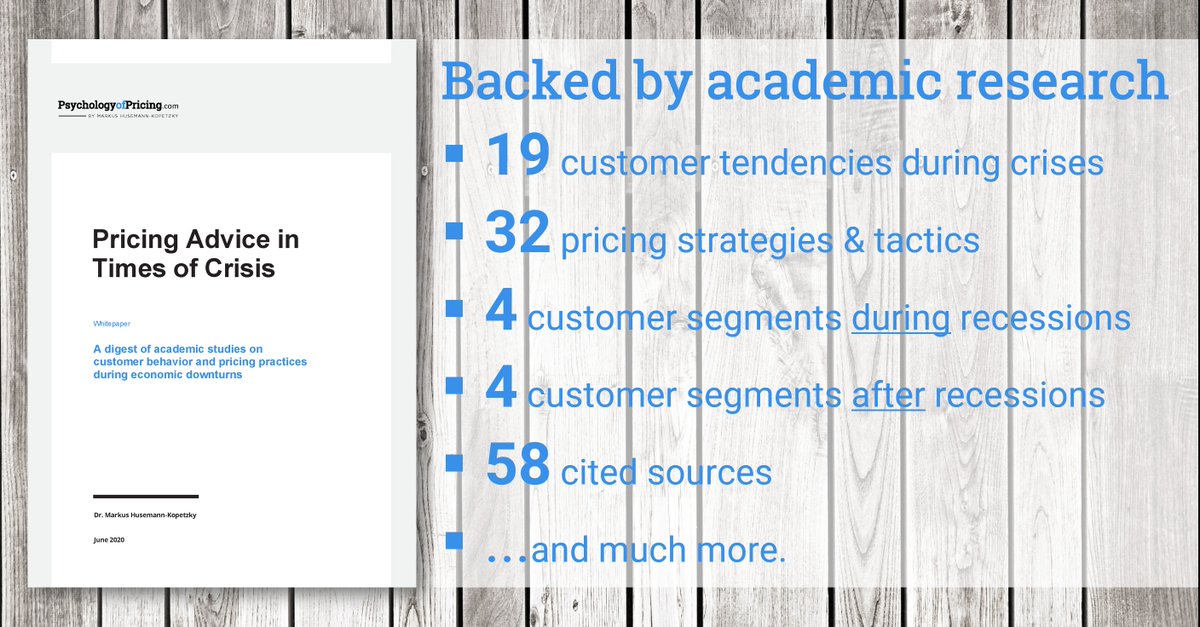
New whitepaper "Pricing Advice in Times of Crisis": 58 sources, 19 customer tendencies during economic crises, 32 pricing strategies/tactics to consider, 4 customer segments before/after recessions, much more. https://t.co/9qHHFDNULM #pricingnuggets#marketing#retail#consulting
[Nugget #20] Price sensitivity during crises: [1] Anxiety about financial future, frugality to cope with. [2] Guilt of spending money: against own moral compass & new social norm. [3] Feel as Smart Shopper: emotional rewards https://t.co/iCmb0mtUG3 #pricingnuggets#Marketing
[Nugget #19] [own research] Selling B2B add-on services, clients expect them for free when buying an expensive machine and are willing to pay more when their personal reputation is at stake to insure against attributing failure to them https://t.co/KlfvcJz8jG #pricingnuggets#b2b
[Nugget #18] #hospitality: new stamp cards (every 11th meal for free) AND increased prices: using loyalty card is a price drop => price fairness high, but breakage leads to price increase that customers attribute to themselves and not the business https://t.co/2CCdB3D8MR #pricing
[Nugget #17] Tempting "vice" products like potato chips: gaining self-control by buying smaller pack sizes? Many think so and would pay more for smaller packs (Wertenbroch 1998). But no, small pack fly under the radar (Do Vale et al. 2008). https://t.co/kDrFoveQn9 #pricingnuggets
Humbled, I found my book on a recommended reading list. If you look for some ideas for your personal reading list 2020 on "how customers tick" you might check out the second recommendation here :-) Wishing you an inspired start in 2020! https://t.co/FVVgflm1i9
[Nugget #16] Anchoring is one of the most robust effects to influence customers' price perception. You wonder how long do they last after anchoring? Yoon/Fong (2019) give an answer: at least two months. https://t.co/WmaRvKXvxc #retail#pricing#pricingnuggets
[Nugget #15] Store remodeling increases sales for existing customers by disappointing ~5%, but blows new customers away with a surge in revenue of >40% (Dagger/Danaher 2014). https://t.co/a1TurBZn7y #pricingnuggets#Retail#Marketing
[News] To all readers of the Handbook on the Psychology of Pricing: The 3rd update has been released. Readers find it in the exclusive Readers Area. Enjoy the read. https://t.co/XXtkAemk0w #pricingnuggets#pricing#marketing
[Nugget #13] It smells like Xmas. Madzharov/Block/Morrin (2015) found that warm (vanilla/cinnamon) vs. cold (peppermint) scents make customers buy more premium products, buy more items, and spend more overall. #pricingnuggets#retail#pricing https://t.co/BNKmmEeUie
For RETAILERS: Find out who shops for gifts and provide options that do not make them look cheap. For GIFT RECEIVERS: Leave some degrees of uncertainty with your friends. For GIFT GIVERS: Ask what your friend actually wants.
[Nugget #12] Gift givers pay higher prices on gifts than on products for personal use, and this lower price sensitivity depends on uncertainty about gift receivers' preferences (Wang/van der Lans 2018). Implications are... https://t.co/owATeIXvzR #retail#pricingnuggets#pricing
@LeimrothScott To quantify this tradeoff for prices >$100, this might deserve a new experiment, as the original study that found a negative long-term effect on post-promotion customer choice when discount were expressed as absolute amount only included FMCG products w/ prices <$5.
@LeimrothScott You are right. For prices <$100, the percentage discount frame is always optimal. For prices >$100, there might be a trade-off between during-promotion & post-promotion conversion depending on the discount frame.




![PricingResearch's tweet photo. [Nugget #23] In recessions, customers need to feel as "smart shoppers". They do so if they feel responsible for price savings. Coupons outperform other tactics, not despite but because of the effort required by customers #marketing #retail #pricingnuggets https://t.co/297oEcoeGq https://t.co/udKzXMBiwo](https://pbs.twimg.com/media/EiAvQsuXkAEtdUE.jpg)
![PricingResearch's tweet photo. [Nugget #22] Negative feelings of spending money makes customers more price sensitive. Cause marketing brings a positive warm-glow of giving that offsets price sensitivity. https://t.co/GxKnBKbpsz #marketing #retail #pricingnuggets https://t.co/CTsppxfRZf](https://pbs.twimg.com/media/EfCRK15X0AALjmW.jpg)
![PricingResearch's tweet photo. [Nugget #21] Reduce customers' financial anxiety w/ cashflow (CF) management: (1) Make CFs more predictable with longer warranties. (2) Match negative & positive CF via financing options. (3) Lower negative CFs with discounts "in-kind". https://t.co/wjVrAeYZPU #pricingnuggets https://t.co/M53Wc96UMW](https://pbs.twimg.com/media/Ec3kXBXXYAAPPri.jpg)


![PricingResearch's tweet photo. [Nugget #20] Price sensitivity during crises: [1] Anxiety about financial future, frugality to cope with. [2] Guilt of spending money: against own moral compass & new social norm. [3] Feel as Smart Shopper: emotional rewards https://t.co/iCmb0mtUG3 #pricingnuggets #Marketing https://t.co/mu5UjkA3Vf](https://pbs.twimg.com/media/EbaiLPvXYAAedEg.jpg)
![PricingResearch's tweet photo. [Nugget #19] [own research] Selling B2B add-on services, clients expect them for free when buying an expensive machine and are willing to pay more when their personal reputation is at stake to insure against attributing failure to them https://t.co/KlfvcJz8jG #pricingnuggets #b2b https://t.co/vEHGi11Tl0](https://pbs.twimg.com/media/EasGy05WsAMqsn5.jpg)
![PricingResearch's tweet photo. [Nugget #18] #hospitality: new stamp cards (every 11th meal for free) AND increased prices: using loyalty card is a price drop => price fairness high, but breakage leads to price increase that customers attribute to themselves and not the business https://t.co/2CCdB3D8MR #pricing https://t.co/T8NXwUX89e](https://pbs.twimg.com/media/EQbesTUVAAAEtZi.jpg)
![PricingResearch's tweet photo. [Nugget #17] Tempting "vice" products like potato chips: gaining self-control by buying smaller pack sizes? Many think so and would pay more for smaller packs (Wertenbroch 1998). But no, small pack fly under the radar (Do Vale et al. 2008). https://t.co/kDrFoveQn9 #pricingnuggets https://t.co/4UVZOwm6fT](https://pbs.twimg.com/media/EO6qhIfX4AU1mE1.jpg)

![PricingResearch's tweet photo. [Nugget #15] Store remodeling increases sales for existing customers by disappointing ~5%, but blows new customers away with a surge in revenue of >40% (Dagger/Danaher 2014). https://t.co/a1TurBZn7y #pricingnuggets #Retail #Marketing https://t.co/JPzjxIF9rm](https://pbs.twimg.com/media/EM-1j1zXUAAUzod.png)
![PricingResearch's tweet photo. [News] To all readers of the Handbook on the Psychology of Pricing: The 3rd update has been released. Readers find it in the exclusive Readers Area. Enjoy the read. https://t.co/XXtkAemk0w #pricingnuggets #pricing #marketing https://t.co/6is9W50zMJ](https://pbs.twimg.com/media/EM3wwiWW4AARVKt.jpg)
![PricingResearch's tweet photo. [Nugget #14] Heavier wine bottles trigger price/quality inferences (Piqueras-Fiszman/Spence 2012). Implications? Guests give heavier bottles to hosts. Retailers consider product packaging in #pricing. Manufacturers rethink packaging.https://t.co/BOH5D1lNPs #pricingnuggets #Retail https://t.co/1RybdkKePL](https://pbs.twimg.com/media/EMZJT4WXsAAxz1i.jpg)
![PricingResearch's tweet photo. [Nugget #13] It smells like Xmas. Madzharov/Block/Morrin (2015) found that warm (vanilla/cinnamon) vs. cold (peppermint) scents make customers buy more premium products, buy more items, and spend more overall. #pricingnuggets #retail #pricing https://t.co/BNKmmEeUie https://t.co/JDKXEznwmD](https://pbs.twimg.com/media/EL1hAD1WwAETgFp.jpg)
![PricingResearch's tweet photo. [Nugget #12] Gift givers pay higher prices on gifts than on products for personal use, and this lower price sensitivity depends on uncertainty about gift receivers' preferences (Wang/van der Lans 2018). Implications are... https://t.co/owATeIXvzR #retail #pricingnuggets #pricing https://t.co/R3jpwGDqx2](https://pbs.twimg.com/media/ELSfVq3WoAE4Fn6.jpg)


